Why FE 500D 12mm TMT Bars Are Preferred in Government Infrastructure Projects


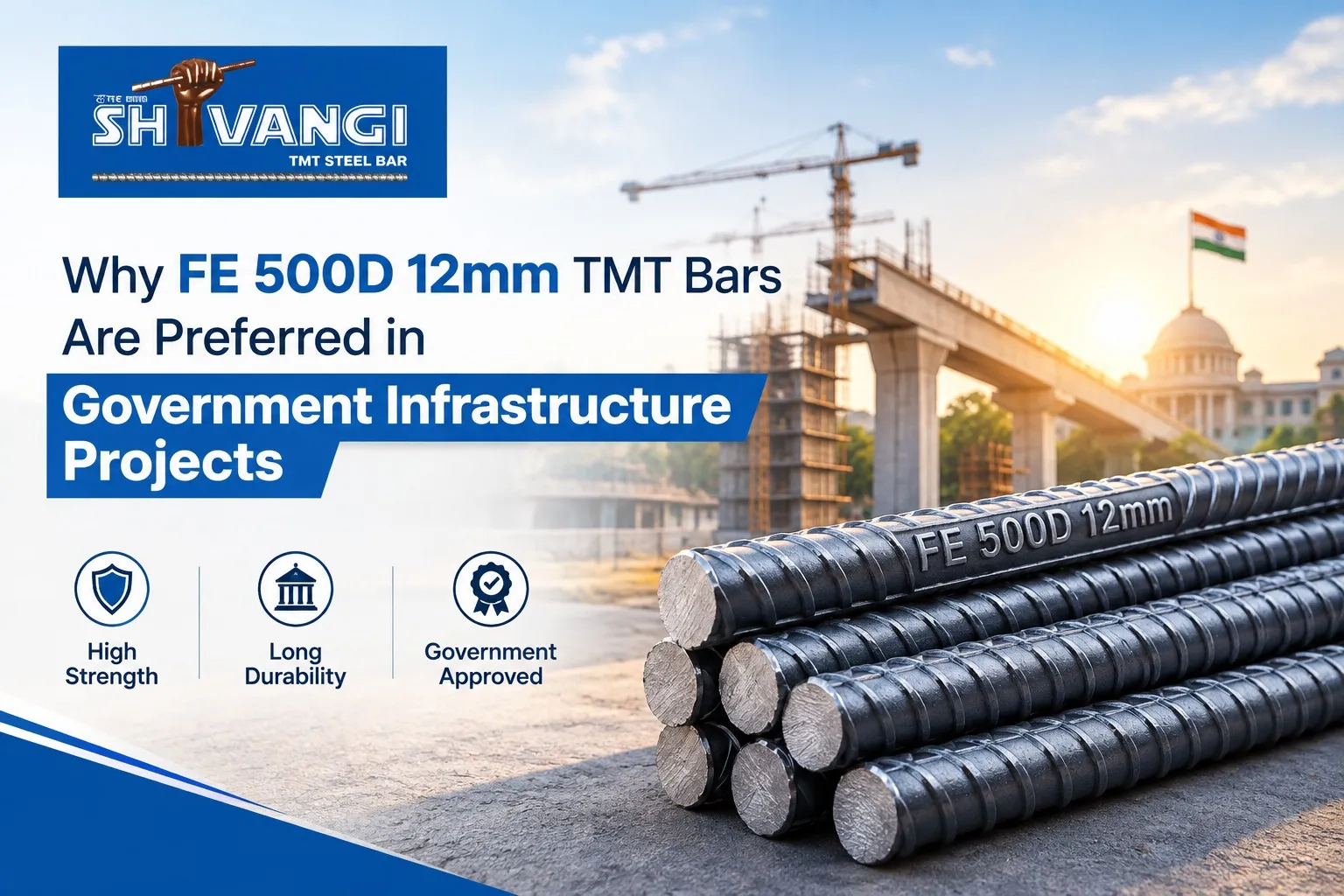
When it comes to government infrastructure projects — highways, bridges, flyovers, metro rail systems, public housing complexes, and irrigation structures — the choice of reinforcement material is never left to chance. Engineers and procurement teams follow strict material specifications governed by national standards, and one grade of reinforcement steel consistently makes it to the approved list: FE 500D 12mm TMT bars.
The 12mm TMT steel bar occupies a unique position in construction. It is versatile enough for slabs, columns, beams, and staircases, yet strong enough to meet the load-bearing demands of large-scale civil structures. Combined with the FE 500D grade specification, it becomes one of the most reliable choices for government contractors working under IS 1786 compliance requirements.
What Makes FE 500D the Standard for Public Works?
The designation “FE 500D” tells a complete story about the steel’s mechanical properties. “FE” stands for iron (ferrum), “500” denotes the minimum yield strength of 500 N/mm², and “D” indicates enhanced ductility — a critical property in structures that must absorb dynamic loads, vibrations, and seismic forces.
Government infrastructure is designed for a service life of 50 to 100 years. Unlike residential buildings, public structures cannot afford material compromises. The BIS certification under IS 1786 mandates specific benchmarks for tensile strength, elongation, and bend-rebend performance — all of which FE 500D 12mm TMT bars consistently meet. This is precisely why procurement guidelines issued by bodies such as CPWD, NHAI, and state PWD departments consistently reference FE 500D as the minimum acceptable grade.
The Role of 12mm TMT Bars in Infrastructure Reinforcement
In structural design, different bar diameters serve different functions. The 12mm steel bar is extensively used in:
- Slab reinforcement — Both primary and distribution reinforcement in RCC slabs of public buildings, underpasses, and platforms rely on 12mm bars for balanced load distribution.
- Beam stirrups and ties — In bridge girders and flyover decks, 12mm bars are used for transverse reinforcement that holds the structural frame together under dynamic traffic loads.
- Column ties — Government buildings with multi-storey configurations use 12mm bars as lateral ties around vertical main bars to prevent column buckling.
- Foundation grids — In large raft foundations and pile caps for metro stations and public institutions, 12mm bars form part of the reinforcement mesh that distributes structural loads into the ground.
- Retaining walls and culverts — Highway and railway projects use 12mm TMT bars in retaining wall panels and box culverts that must withstand soil pressure and heavy vehicular loads.
This wide applicability across structural members makes the 12mm bar one of the most consumed diameters on large government project sites.
Thermex Quenching Technology and Its Impact on Performance
The manufacturing process behind a quality 12mm TMT bar is as important as the steel grade itself. In the Thermex quenching process, hot-rolled bars are rapidly cooled through a controlled water quenching system immediately after rolling. This creates a hard, tempered martensite outer layer while retaining a softer, ferrite-pearlite core. The result is a bar that combines high surface strength with an inner ductility that allows it to bend, weld, and absorb stress without cracking.
For government infrastructure, this matters because structures are routinely subjected to live loads, temperature variations, and seismic activity. A bar that is only strong but not ductile is a liability in such environments. The FE 500D grade specifically demands a higher elongation percentage and a favourable UTS-to-YS ratio compared to standard FE 500, making it superior for earthquake-resistant construction as per IS 13920 guidelines.
Why Contractors and Engineers Choose Shivangi Rolling Mills’ 12mm TMT Bars
Shivangi Rolling Mills manufactures its 12mm steel bars in full compliance with IS 1786 standards, backed by BIS certification and Mill Test Certificates for every production batch. The manufacturing facility uses modern Thermex-based quenching technology to ensure consistent mechanical properties across every coil and straight bar produced.
For government project contractors who require documented material traceability and quality assurance, the availability of Mill Test Certificates is not optional — it is a site requirement. Shivangi Rolling Mills addresses this need directly, supplying 12mm TMT bars with full documentation that satisfies government audits and third-party inspection requirements.
Beyond documentation, the consistent dimensional accuracy and uniform rib pattern of Shivangi’s 12mm bars ensure proper bonding with concrete, which directly translates to structural integrity over the design life of a project.
Conclusion
The preference for FE 500D 12mm TMT bars in government infrastructure is not merely a procurement convention — it is a well-founded engineering decision rooted in the material’s strength, ductility, weldability, and long-term performance under demanding service conditions. Whether the project is a state highway overpass, a railway station, or a public housing scheme, the 12mm TMT bar remains a cornerstone of the reinforcement design.




Sign in to leave a comment.