

Fleet monitoring is becoming a core business function because the data once used mainly to locate vehicles now shapes insurance, maintenance, safety, capital, and compliance decisions across the business through a connected fleet tracking and telematics layer. In 2026, monitoring is no longer simply a back office record of what happened yesterday. It is becoming an operating input for decisions that affect cost, risk, uptime, and future investment.
The change is not about redefining what fleet monitoring actually tracks. It is about how the information is being used, who depends on it, and why leadership teams increasingly need the same monitoring data that dispatchers, technicians, and safety managers use every day.
Key Takeaways
- Monitoring now informs executive decisions. Its data increasingly affects finance, safety, insurance, maintenance, and capital planning.
- Insurance is raising the value of telematics data. Underwriters increasingly want evidence that fleets actively measure and control road risk.
- AI changes the timing of decisions. Monitoring can increasingly identify developing maintenance and safety risks before they become completed events.
- Mixed fleets require a broader data set. Electric, gas, and diesel assets create different operating signals that leaders need to reconcile.
- Single department ownership keeps monitoring tactical. Strategic monitoring moves information across operations, finance, safety, and leadership.
- The transition starts with cadence. Fleets can elevate monitoring without replacing their entire technology stack.
The Shift From Tactical Telemetry to Strategic Operating Input
Five years ago, many monitoring conversations started with vehicle location, route status, or a driver event. Those questions still matter, but they no longer define the value of the data. Monitoring information can now enter insurance renewal discussions, maintenance forecasting, asset utilization reviews, safety exposure meetings, and capital planning. That is a narrower shift than the broader case that fleet management is a core business function. The important change is that monitoring itself is moving upstream, from helping teams respond to individual events to helping leaders decide where cost and risk are likely to develop next.
Four Forcing Functions Pushing Monitoring Onto the Executive Agenda
Four specific pressures have converged in 2025 and 2026 to elevate monitoring from a tactical discipline to a strategic one.
Insurance Underwriting Has Hardened Around Telematics Data
Commercial auto insurance is one of the clearest reasons monitoring now matters beyond the fleet department. A 2025 insurance market update reported that auto liability had experienced rate increases for 55 straight quarters, with a 10.4 percent rate change in the first quarter of 2025. The 2025 commercial insurance market analysis also noted difficult renewals for organizations with large fleets.

The pressure continued into 2026. The American Transportation Research Institute reported that liability insurance premiums rose 18.6 percent from 2021 through 2024 to 10.2 cents per mile. Munich Re also explains that insurers can use telematics inputs such as routes, vehicle location, driving behavior, and operating conditions to understand exposure and customize risk decisions.
That changes the renewal conversation. A loss run tells the underwriter what already went wrong. A credible monitoring program can also show how the organization identifies risky behavior, responds to events, and manages exposure before the next claim. That makes insurance renewal one of the clearest near term financial pathways for monitoring.
AI Has Moved Monitoring From Reporting the Past to Predicting the Next 90 Days
Traditional dashboards told managers what happened after the vehicle returned, the diagnostic code appeared, or the unsafe event was recorded. AI assisted monitoring increasingly helps teams prioritize what needs attention next by combining diagnostic severity, maintenance history, utilization, and behavior patterns.
That does not mean every AI prediction should automatically trigger maintenance or disciplinary action. The practical value is better prioritization. The distinction between useful applications and inflated claims is covered in what AI in fleet management is actually doing today. For monitoring teams, the shift is from reviewing every signal equally to identifying which signals deserve action first.
Electric Vehicles and Mixed Fleets Have Raised the Data Bar
A mixed fleet creates monitoring questions that location alone cannot answer. Gas and diesel assets still depend heavily on mileage, engine condition, fuel use, service intervals, and diagnostic information. Electric vehicles introduce battery state, charging activity, range behavior, and energy consumption.
Leadership therefore needs a monitoring layer that can preserve asset context while combining different operating signals. The objective is not more data. It is a consistent view of availability, utilization, maintenance exposure, and operating cost across asset classes.
Sustainability and Compliance Reporting Now Depend on Monitoring Data
Monitoring also matters because operating records increasingly support compliance and audit work. FMCSA states that most commercial motor vehicle drivers within its scope must comply with hours of service requirements under Part 395, which makes accurate duty and operating records important for affected fleets. The agency's current hours of service requirements show how operating data can become part of a formal compliance process rather than an internal fleet record.
The same principle applies to inspections and vehicle condition documentation. Capturing consistent inspection evidence through a digital vehicle inspection process gives teams a stronger record when maintenance, safety, or compliance questions move beyond the fleet department.
How to Tell If Your Organization Still Treats Monitoring as Tactical
Use these signals to diagnose whether monitoring is being treated as an operational input or simply a back office tool.
| Tactical Treatment | Strategic Treatment |
|---|---|
| Dispatch supervisor owns monitoring | Operations or executive leadership has defined ownership |
| Reports are reviewed ad hoc or monthly | Metrics enter a fixed leadership review |
| Data stays inside one dashboard | Finance, safety, maintenance, and operations use the output |
| Renewal preparation depends mostly on loss runs | A monitoring scorecard supports the insurance submission |
| Leadership sees data during a crisis | Monitoring metrics appear in regular operating reviews |
| Cost is bundled into IT or vehicle expense | Monitoring has defined ownership and measurable outcomes |
Ownership is usually the first clue. If nobody outside fleet operations is accountable for how monitoring data influences cost, risk, and investment decisions, the program will tend to remain tactical. The same issue appears in the broader question of whether operations or finance should own fleet management.
How to Elevate Monitoring Without a Platform Overhaul
Raising monitoring's status is a cadence and ownership change first, and a tooling change second. A simple workflow keeps the transition focused.
- Assign a named owner accountable for monitoring outcomes, not only software administration.
- Set a fixed monthly review with finance, safety, and operations at one table.
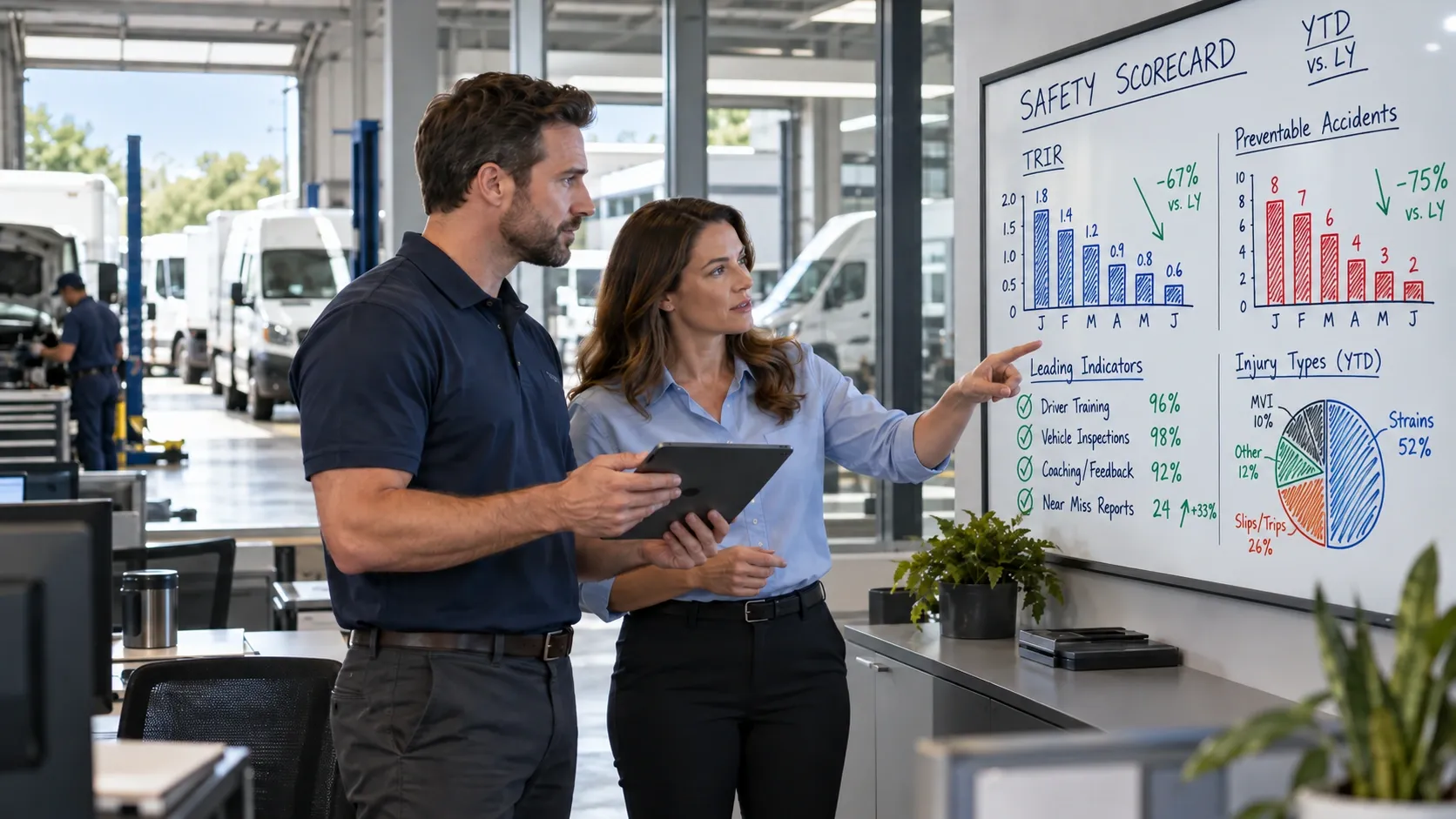
- Package the top five monitoring metrics into a one page executive scorecard.
- Tie one metric to the next insurance renewal and one to the next capital plan.
- Route diagnostic and behavior alerts by severity so critical issues do not sit in a queue.
- Review the same metrics in the same format for at least two quarters before adjusting them.
What Executive Ready Metrics Look Like
Executive metrics should answer business questions, not reproduce every driver or vehicle event. A useful scorecard can track cost per mile trend, unplanned downtime days, a telematics risk score for insurance discussions, preventive maintenance compliance, and utilization by asset class. Those measures let leaders see whether operating risk and cost are moving in the right direction without asking them to interpret raw telemetry.
The principle is similar to choosing the fleet numbers leadership actually needs. The metric belongs on the executive scorecard only when it can change a decision about money, risk, asset availability, or future capacity.
What Boardroom Ready Monitoring Actually Delivers
Boardroom ready monitoring should shorten the distance between a signal and a business decision. Leaders should be able to see whether maintenance exposure is increasing, whether specific asset classes are underused, whether safety risk is improving before renewal, and whether downtime is beginning to affect capacity.
A structured fleet reporting dashboard makes that cadence practical because the same operating measures can be reviewed repeatedly instead of rebuilt for each meeting. Consistency matters more than adding more charts.
The next step is converting the signal into action. If mileage, diagnostic activity, inspection findings, or service history indicate developing maintenance exposure, preventive maintenance scheduling connects monitoring information to planned work rather than waiting for a failure to force the decision.
That is where monitoring becomes an operating discipline. The value is not that leadership can see more data. The value is that finance, operations, safety, and maintenance can work from the same evidence and act earlier.
Making the Transition Without Overwhelming a Smaller Fleet
A 10 vehicle fleet is not exempt from the shift. Insurance exposure, downtime, maintenance cost, and utilization still affect the business even when the organization does not have a dedicated fleet analyst. Smaller fleets simply need a proportionally smaller operating model: one owner, one monthly meeting, one scorecard, and a reliable level of fleet visibility across vehicles and operating records.
For the first pass, smaller teams can skip complexity that does not improve a decision:
- Custom dashboards for every department
- Buying new hardware before the review cadence exists
- Trying to monitor every driver behavior on day one
- Building an executive scorecard longer than one page
Frequently Asked Questions
1. Is fleet monitoring the same as fleet management?
No. Fleet monitoring captures and surfaces operating information about vehicles, equipment, drivers, and activity. Fleet management uses that information along with maintenance, financial, staffing, and policy decisions to run the overall operation.
2. Why has fleet monitoring become a boardroom level topic in 2026?
Monitoring data now affects decisions involving insurance, safety, maintenance exposure, asset utilization, compliance, and capital planning. That gives the data financial and risk implications beyond day to day fleet operations.
3. How does telematics data affect commercial auto insurance renewals?
Telematics can give underwriters evidence about driving exposure, vehicle use, risk patterns, and how the fleet responds to unsafe behavior. A well managed program can strengthen the risk story presented during renewal.
4. Who should own fleet monitoring inside a company?
One person should have clear accountability, but the output should be shared across operations, finance, safety, and maintenance. Strategic monitoring becomes weaker when both ownership and use stay inside a single department.
5. Does a small fleet need to treat monitoring as a strategic function?
Yes, but the process can remain simple. A small fleet may only need one accountable owner, one monthly review, and a short scorecard tied to cost, uptime, safety, and insurance.
Frequently Asked Questions
Is fleet monitoring the same as fleet management?
No, fleet monitoring focuses on capturing and presenting operational data about vehicles, drivers, and activities. In contrast, fleet management utilizes this information, alongside maintenance and financial considerations, to oversee the entire fleet operation.
Why has fleet monitoring become a boardroom-level topic in 2026?
Fleet monitoring has gained prominence in executive discussions because its data now influences critical areas such as insurance, safety, maintenance, and capital planning. This shift highlights the financial and risk implications of monitoring beyond routine fleet operations.
How does telematics data affect commercial auto insurance renewals?
Telematics data provides underwriters with insights into driving behavior, vehicle usage, and risk patterns, which helps in assessing the overall risk profile of a fleet. A robust monitoring program can demonstrate proactive risk management, enhancing the fleet's position during insurance renewals.
Who should own fleet monitoring inside a company?
Ideally, one individual should be accountable for fleet monitoring, but the insights should be shared across multiple departments, including operations, finance, and safety. This cross-departmental approach strengthens the strategic impact of monitoring data.
Does a small fleet need to treat monitoring as a strategic function?
Yes, even small fleets should treat monitoring strategically, but the implementation can be simplified. They may only require one designated owner, a monthly review meeting, and a concise scorecard focused on key metrics like cost and safety.
What are some key metrics for effective fleet monitoring?
Effective fleet monitoring metrics include cost per mile trends, unplanned downtime days, telematics risk scores, preventive maintenance compliance, and asset utilization rates. These metrics help leadership make informed decisions regarding risk and operational efficiency.
How can organizations elevate their fleet monitoring practices?
Organizations can enhance their fleet monitoring by assigning clear ownership, establishing regular review meetings with key stakeholders, and focusing on a concise set of metrics that directly influence decision-making. This structured approach can lead to more proactive management of fleet operations.
What role does AI play in fleet monitoring?
AI transforms fleet monitoring by enabling predictive analytics that can identify potential maintenance or safety issues before they occur. This shift allows teams to prioritize their responses based on the severity of signals, improving overall fleet management efficiency.

























Sign in to leave a comment.