

For many businesses, securing IPv4 addresses is treated as a procurement task. The organization identifies the required number of addresses, compares prices, signs an agreement, and deploys the selected block.
That approach may be sufficient for temporary or easily replaceable workloads. It becomes risky when the addresses support production systems, customer services, APIs, security controls, or long-term network identity.
The important question is no longer only whether an organization can obtain IPv4 addresses.
It is whether the organization can continue using the same addresses for as long as its business depends on them.
This distinction is turning IPv4 continuity into an important consideration for Internet service providers, hosting companies, data centers, cloud platforms, and enterprises operating public-facing infrastructure.
IPv4 Addresses Become Part of the Business
An IPv4 address begins as a technical identifier. Over time, it can become connected to a much larger operational environment.
A production prefix may be referenced by:
- Customer allowlists
- DNS records
- Email systems
- Firewall policies
- API access controls
- Payment platforms
- Monitoring services
- Geolocation databases
- Security and fraud-prevention systems
- Partner integrations
- Software licensing
- Compliance documentation
The longer an address remains in use, the more external dependencies can develop around it.
This creates an important economic reality: the operational value of an established IPv4 block may become much greater than its original acquisition or leasing cost.
Changing the block may require customers to update allowlists, administrators to modify security rules, engineers to migrate DNS records, and operations teams to rebuild reputation and geolocation data.
For a business-critical deployment, the real cost is therefore not simply the monthly price per address. It also includes the potential cost of losing or replacing those addresses.
Address Capacity and Network Identity Are Different
Not every workload requires permanent network identity.
Testing environments, short-term campaigns, disposable compute jobs, and easily migrated services may need address capacity without requiring long-term continuity. If the address block changes, the organization can update its configuration and continue operating.
Other systems are much harder to renumber.
Examples include:
- Public APIs used by external customers
- Payment and financial systems
- Enterprise VPN gateways
- Secure access services
- Email delivery infrastructure
- Hosting platforms with many downstream users
- Authoritative DNS infrastructure
- Regulated systems
- Partner-facing network services
- Customer equipment installed at remote locations
For these environments, an IP address can become part of the organization’s public network identity.
Lu Heng’s discussion of network identity and customer continuity describes this principle in economic terms: as more systems rely on a set of addresses, the cost of changing them increases.
This suggests that organizations should classify workloads by continuity requirements before choosing an IPv4 service.
The Hidden Cost of Renumbering
Renumbering is frequently described as a technical configuration change. In reality, it can become a multi-department business project.
A migration may require the organization to:
- Identify every service using the existing addresses.
- Update customer and supplier allowlists.
- Modify DNS records.
- Change firewall and security policies.
- Reconfigure routing and monitoring systems.
- Update reverse DNS.
- Submit geolocation corrections.
- Rebuild email and address reputation.
- Notify customers and business partners.
- Operate old and new addresses simultaneously.
- Monitor for services that were missed.
- Decommission the former block safely.
Some dependencies may not be documented internally. A customer could have added an address to a security policy years earlier without notifying the network operator.
These hidden dependencies make renumbering difficult to estimate. The technical work may be completed quickly, while customer-facing disruption continues for weeks.
Continuity Should Be Matched to Workload Risk
An organization should not pay for the highest level of continuity for every address it uses. It should select the protection that matches the operational importance of each workload.
A useful classification model includes four categories.
Flexible capacity
These addresses support temporary, experimental, or easily migrated services.
The organization manages most address operations internally and accepts that the block may change at the end of the agreed term.
Production workloads
These addresses support active customer or business services.
The organization needs dependable routing, reverse DNS, geolocation assistance, reputation management, and a defined renewal process.
Business-critical infrastructure
These addresses support services with material financial or operational consequences.
Priority support, faster escalation, renewal protection, and clear operational responsibility become more important.
Identity-critical infrastructure
These addresses support systems for which renumbering would be exceptionally disruptive or unacceptable.
The organization needs the strongest available renewal assurance, documented escalation paths, and continuity planning covering both technical and institutional risks.
This approach allows IPv4 spending to follow business impact rather than treating every address as equally important.
Supply Chains Create Continuity Risk
The source of an IPv4 block also matters.
A fragmented leasing arrangement may involve several independent parties:
- The registered resource holder
- A broker
- A reseller
- A network provider
- A routing operator
- A technical support company
- The customer using the addresses
Each additional party can introduce another contract, dependency, support queue, or renewal decision.
When something goes wrong, the customer may not know which organization can make the necessary change.
For example:
- The network provider may control routing but not the resource.
- The broker may manage the commercial relationship but not technical operations.
- The resource holder may decide whether to renew.
- A separate team may control RPKI or reverse DNS.
- Abuse and reputation requests may move through multiple companies.
A low initial price can therefore conceal a high coordination cost.
The risk becomes more significant when the addresses support services that cannot tolerate delay or forced migration.
Why a Direct Provider Relationship Matters
A direct relationship can reduce uncertainty by keeping commercial and operational responsibilities closer together.
Organizations evaluating an IPv4 provider should ask:
- Does the provider control the address supply?
- Who decides whether the block will be renewed?
- Who can update RPKI and routing information?
- Who manages reverse DNS?
- Who handles geolocation corrections?
- Who responds to reputation problems?
- Who investigates abuse reports?
- Who provides emergency escalation?
- Is another party able to withdraw the addresses?
- What happens if an intermediary exits the market?
A provider should be able to explain the complete path from address supply to production operation and renewal.
LARUS IPv4 presents its model around direct supply, connected address operations, and different levels of continuity protection. The underlying principle is useful for any buyer: the fewer unresolved handoffs between supply, routing, support, and renewal, the easier it is to assign responsibility.
Continuity Requires More Than a Contract
A long contract does not automatically guarantee operational continuity.
The addresses must remain technically usable throughout the term. That requires ongoing management of several systems.
BGP routing
The prefix must be announced correctly through the intended Autonomous System. Upstream providers may need accurate routing information before accepting it.
RPKI and Route Origin Authorizations
RPKI allows a resource holder to authorize an ASN to originate a prefix. The origin-validation process described in RFC 6811 can classify an announcement as Valid, Invalid, or NotFound.
An incorrect authorization can make a legitimate route appear invalid to networks enforcing Route Origin Validation.
Reverse DNS
Reverse DNS is important for email, security analysis, logging, and troubleshooting. The provider must have a reliable process for creating and changing delegations or records.
Geolocation
Commercial databases may continue associating a newly deployed prefix with its previous location. Correction requests may need to be submitted to multiple providers.
Reputation
An address block can carry signals from its prior use. Monitoring and remediation may be necessary before the addresses are suitable for customer-facing applications.
Abuse handling
Providers need a clear process for receiving, investigating, and resolving reports. Poorly managed abuse can affect the reputation or availability of an entire range.
IPv4 continuity depends on keeping all these operational layers aligned.
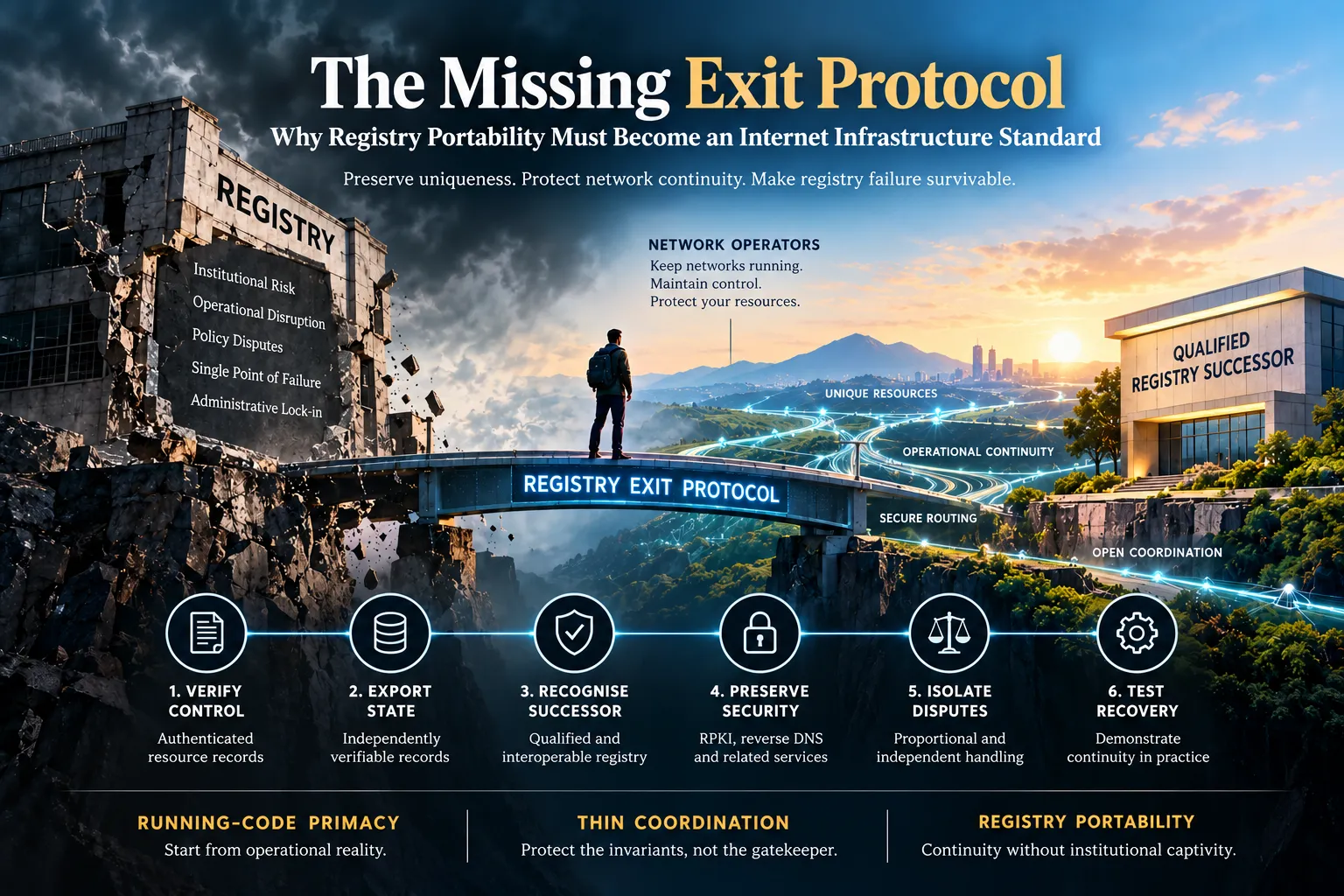
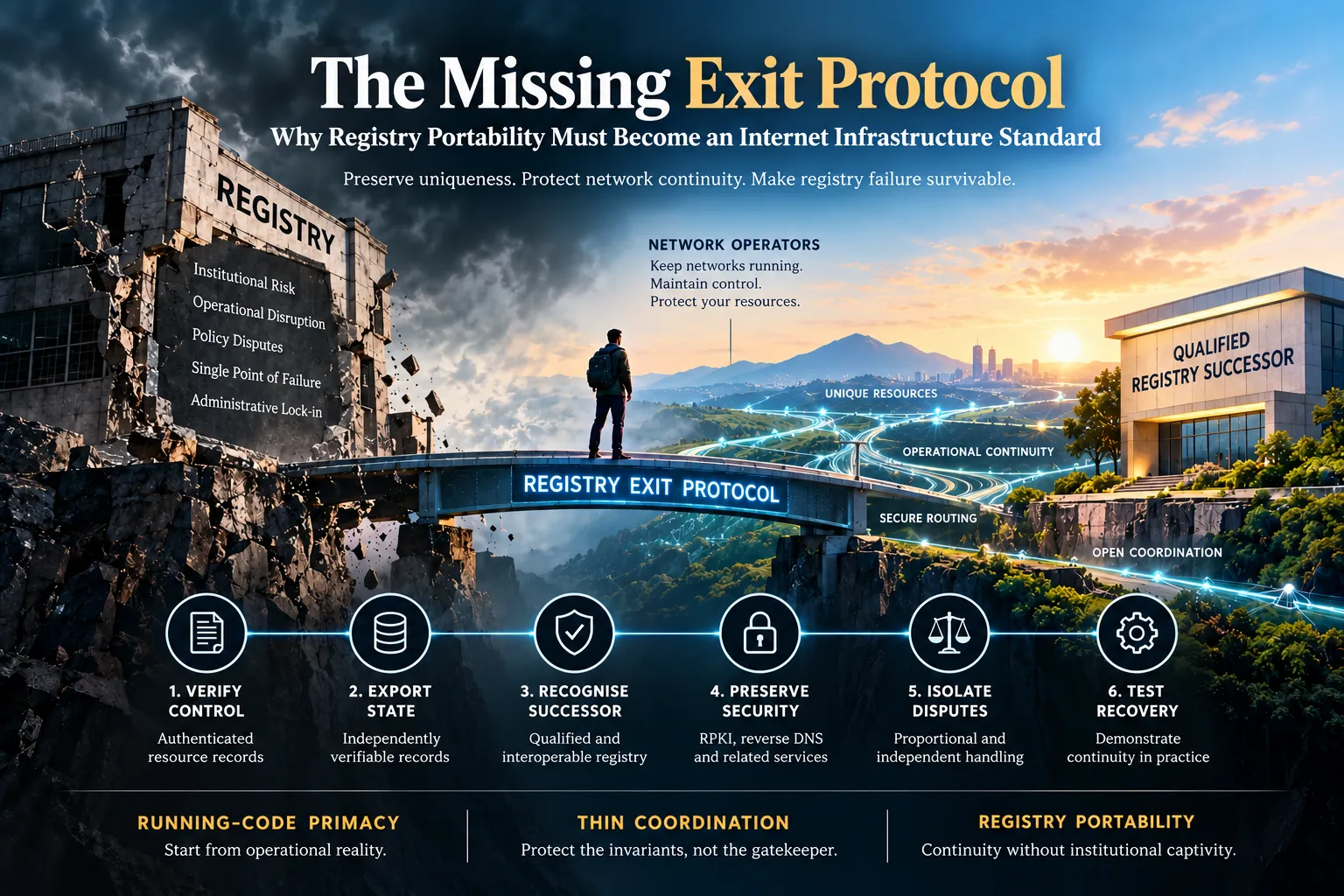
Registry Continuity and Network Continuity Are Not Identical
Internet number resources are coordinated through a global registry system.
At the highest level, IANA coordinates global IP address and ASN pools. Regional Internet Registries administer resources within their respective service regions.
Registry services help maintain uniqueness, registration information, reverse DNS delegations, and resource-certification systems. These functions are important, but continuity of a registry institution should not be confused with continuity of every network using its records.
In his essay on protecting the ledger rather than the gatekeeper, Lu Heng argues that the essential objective should be preserving accurate records, unique resources, security assertions, and operational networks.
Whatever position a reader takes on registry governance, the operational lesson is clear: a continuity plan should consider institutional dependencies as well as technical ones.
Organizations should know:
- Which registry administers their resources
- Which legal entity is registered
- Who controls the registry account
- Which contracts govern continued use
- What procedures apply to updates and transfers
- How RPKI and reverse DNS are maintained
- What escalation options exist
- What would happen during a dispute or service disruption
Ownership Does Not Eliminate Every Risk
Buying IPv4 addresses may appear to provide maximum control. It can remove renewal dependence on a lessor, but it also moves other responsibilities onto the buyer.
A buyer may need to manage:
- Registry agreements
- Transfer approval
- Membership or service fees
- Corporate documentation
- RPKI
- Routing Registry objects
- Reverse DNS
- Geolocation
- Reputation
- Abuse handling
- Security monitoring
- Future transfer or disposal
Ownership can be appropriate for organizations prepared to manage these responsibilities and commit capital to the acquisition.
Leasing may be more appropriate when the organization wants to preserve capital, scale capacity more flexibly, or place address operations with a specialized provider.
The decision should not be reduced to “buying means control” and “leasing means risk.” Both structures create different forms of responsibility.
The better question is which arrangement provides the clearest authority, accountability, operational support, and continuity for the intended workload.
What to Review Before Leasing IPv4
Before placing a production service on leased addresses, an organization should review the following areas.
Resource authority
- Which organization is associated with the address space?
- Does the provider have documented authority to supply it?
- Is the exact prefix identified in the agreement?
Routing
- Which ASN will announce the prefix?
- Who creates the required route objects?
- Are provider filters prepared?
- How will global propagation be monitored?
RPKI
- Who creates the ROA?
- Which origin ASN will be authorized?
- Which prefix lengths are permitted?
- How quickly can an authorization be changed?
Address quality
- Has the block’s routing history been reviewed?
- Are there relevant blocklist entries?
- Does the current geolocation match the deployment?
- Has previous abuse activity been investigated?
Operations
- Who manages reverse DNS?
- Who handles geolocation and reputation requests?
- What support response is available?
- Is there an emergency escalation contact?
Renewal
- When must renewal decisions be made?
- Is continued use subject to availability?
- Does the customer receive priority or guaranteed renewal?
- What happens if the block cannot be renewed?
Exit planning
- How much notice is provided?
- Who removes routing and security objects?
- Is migration support available?
- How will customer dependencies be identified?
These questions reveal whether the service is simply providing address capacity or supporting a production network.
Building an IPv4 Continuity Plan
An effective continuity plan should begin before deployment.
1. Classify the workload
Determine the operational, financial, and customer impact of losing or changing the addresses.
2. Document dependencies
Record every system, customer, partner, and security control that relies on the prefix.
3. Assign responsibility
Identify who manages routing, RPKI, reverse DNS, geolocation, reputation, abuse, contracts, and renewal.
4. Define support expectations
Match response times and escalation procedures to the importance of the service.
5. Review renewal early
Do not wait until the final weeks of a lease to determine whether the same addresses will remain available.
6. Monitor continuously
Track route visibility, RPKI validity, reverse DNS, reputation, geolocation, and abuse reports.
7. Prepare a migration option
Even when continuity is the goal, the organization should maintain a documented emergency-renumbering plan.
8. Test the process
Conduct an exercise covering an invalid route, lost registry access, provider failure, or unexpected non-renewal.
Choosing IPv4 Around Business Impact
Price remains important, especially when an organization operates large address estates.
However, comparing providers only by cost per IP can produce a misleading result.
The total risk-adjusted cost should include:
- Deployment work
- Routing support
- RPKI management
- Reverse DNS
- Geolocation correction
- Reputation remediation
- Abuse handling
- Support responsiveness
- Renewal certainty
- Potential renumbering
- Customer disruption
- Lost revenue during migration
A service that costs slightly more but reduces operational fragmentation may be less expensive over the complete lifecycle.
Organizations can compare options through IPv4 leasing built around continuity and then match the available protection to the importance of their workloads.
Conclusion
Obtaining IPv4 addresses solves a capacity problem. Maintaining the same usable addresses over time solves a continuity problem.
The difference matters when addresses support customers, APIs, security policies, payment systems, partner connections, or other infrastructure that cannot be changed casually.
Organizations should determine which workloads need only temporary capacity and which depend on stable network identity. They should also examine the complete supply chain, operational support model, registry dependencies, and renewal terms behind every address block.
IPv4 continuity is not created by a contract alone. It depends on direct responsibility, reliable routing, accurate security information, ongoing address operations, and a credible plan for renewal or migration.
When a business builds services around an IPv4 block, the address is no longer merely a number. It becomes part of the infrastructure—and part of the business—that must be protected.























Sign in to leave a comment.