

A bearing does not fail politely. It heats up, damages nearby parts, and turns a lubrication miss into downtime. A Pneumatic Grease Pump tackles one basic cause: inconsistent grease delivery to points that are difficult or repetitive to service by hand. SKF reports that poor lubrication causes about 36% of premature bearing failures; with contamination included, the figure rises above 50%.
What Should You Check Before Buying a Pneumatic Grease Pump?
Pressure, Discharge and Reservoir Capacity
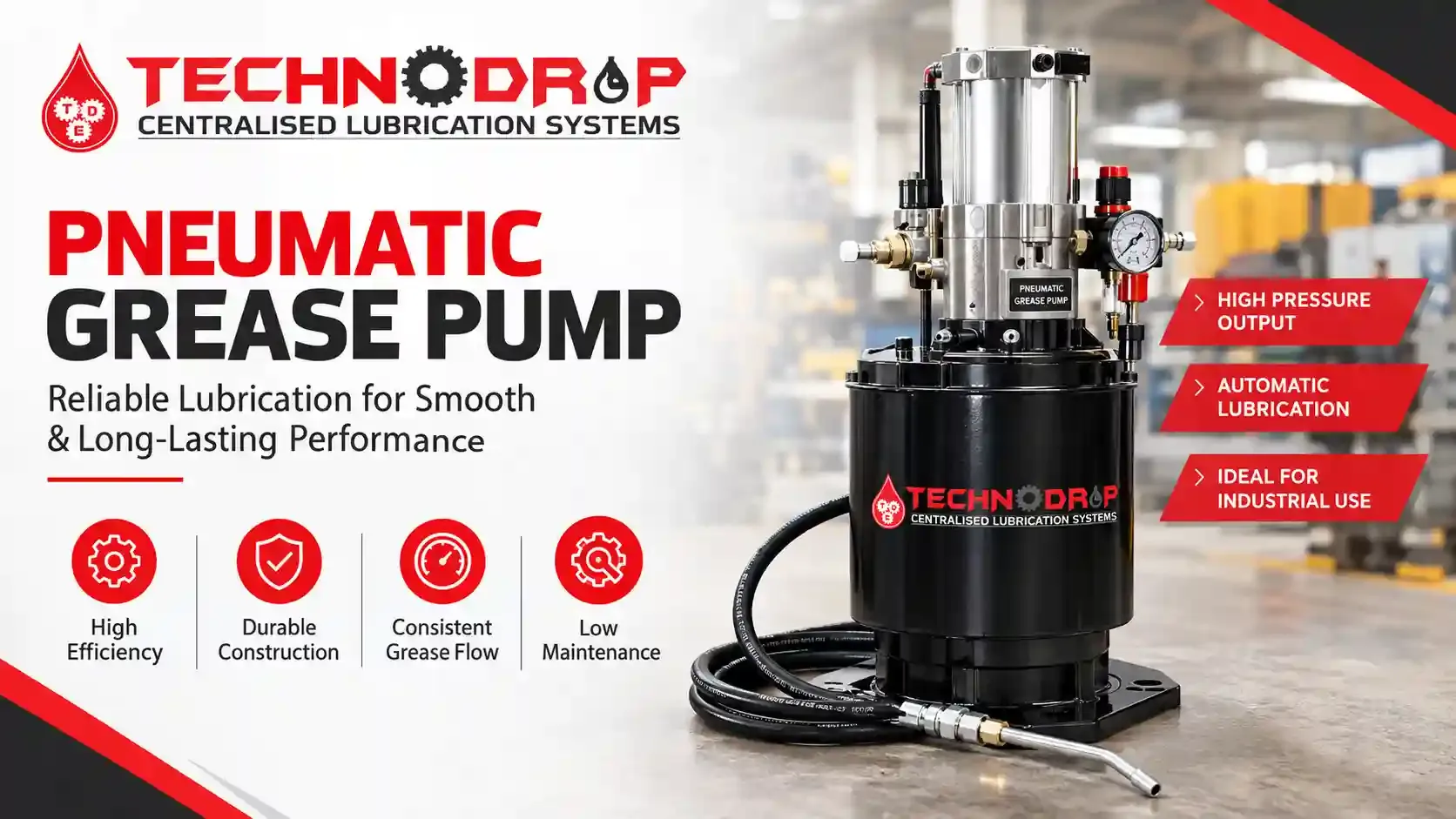
Technodrop lists 1,500 cc, 3,000 cc, and 5,000 cc reservoir models. Published discharge ranges are 0–4, 0–6, and 0–10 cc per stroke, with maximum pressure up to 150 kg/cm² and a 1/4-inch BSP outlet.
Here’s what buyers skip: maximum pressure is not the same as grease delivered at the bearing; hose length, grease consistency, temperature, and restriction change actual flow.
Air Supply and Grease Consistency
One Technodrop model lists a 6 kg air requirement and 8 kg weight. NLGI grades run from 000 to 6; grade 2 has a worked penetration range of 265–295 at 25°C.
If you are comparing a Pneumatic Grease Pump 20kg unit, ask what grease grade and hose length were used during testing.
Five Supplier Checks That Prevent a Bad Purchase
1. Ask for Model-Specific Output
Demand pressure, discharge, and outlet data. “It is heavy-duty; it works everywhere” is a bad answer. Technodrop publishes pressure up to 150 kg/cm² along with model-specific discharge figures.
2. Confirm Grease Compatibility
Most buyers ask only, “Will it pump grease?” Too vague. A bad supplier ignores NLGI grade, ambient temperature, and line length. NLGI itself classifies grease across nine consistency grades from 000 through 6.
3. Check Drum Fit
For a Pneumatic Grease Pump 20kg setup, confirm follower plate size, drum dimensions, and seals. “20 kg is standard” is not enough.
4. Ask What Is Tested
Check pressure holding, leakage, air operation, and discharge consistency. If a supplier cannot explain test points, you may find defects on your plant floor rather than at their test bench.
5. Demand Spare-Part Clarity
Pneumatic Grease Pump Suppliers should state whether seals, hoses, and air-line parts are available. “Call us if something happens” is not an after-sales policy.
Why Pneumatic Grease Pumps Make Commercial Sense
Lower Lubrication Risk
SKF attributes roughly 36% of premature bearing failures to poor lubrication. More controlled grease delivery reduces dependence on memory and manual effort.
Faster Maintenance
SKF says automatic lubrication can typically save 15–20 minutes per machine and maintenance cycle in construction applications. Pneumatic transfer can still cut repetitive greasing effort, even when the complete lubrication process is not fully automatic.
Better Reach
A hose-fed system can serve awkward lubrication points without forcing a technician beside every fitting.
More Controlled Grease Use
Technodrop publishes adjustable discharge up to 10 cc per stroke. Matching output to the job helps reduce careless over-greasing.
No Electric Motor at the Pump
Compressed air powers the unit, useful where an electrical connection at the lubrication point is inconvenient. Technodrop specifically positions pneumatic pumps for environments where electrical connections may be unsuitable or unreliable.
And yet, buying the cheapest unit is a common mistake. Pressure loss, seal leakage, or poor grease compatibility can wipe out the saving through downtime and waste.
Sourcing Pneumatic Grease Pumps Across India
Technodrop manufactures in Faridabad-121004, Haryana, and states that it supplies lubrication equipment across India; its market pages include Noida, Greater Noida, Ghaziabad, Kanpur, Lucknow, and Meerut.
For buyers comparing Pneumatic Grease Pump Manufacturers in India, location affects freight, spares, and service response. Plants farther away should ask how replacement parts will actually reach the site.
Pneumatic Grease Pump Suppliers who discuss freight but not service coverage are solving only half the purchase.
What We Check Before Dispatch
We have manufactured industrial lubrication systems since 1999 in Faridabad, covering centralized, grease, oil, dual-line, and pneumatic equipment. We inspect raw-material procurement through final inspection because small faults become maintenance complaints after installation. A pump can look fine on a bench and still be wrong for the grease grade, hose run, or duty pattern. That matching is harder than many buyers expect. We would rather settle those details before dispatch than argue about them after installation.
We can review grease grade, pressure, drum size, hose length, quantity, and delivery location before quoting. For a Pneumatic Grease Pump 20kg requirement, we also need drum dimensions; capacity alone does not confirm follower-plate fit. Our website promises a quick response but publishes no numeric response-time SLA or fixed MOQ. We confirm response timing, MOQ, price, and dispatch schedule against the exact model and quantity in our quotation rather than inventing a number that may not apply to your order.
Send us the machine type, grease specification, quantity, and delivery PIN code for a model-specific offer.
Conclusion
A Pneumatic Grease Pump makes sense where grease must be delivered repeatedly, under pressure, and with less manual effort. Technodrop models publish pressure up to 150 kg/cm², while SKF’s 36% lubrication-related bearing-failure figure shows why grease delivery deserves engineering attention. Choose around grease, pressure, capacity, and service support—not price alone. The right pump should still fit the job months after commissioning.
FAQs
1. What is a Pneumatic Grease Pump used for?
It utilizes compressed air pressure to drive grease into bearings, joints and lubrication points, when manual greasing can be slow and uneven. Pneumatic types of Technodrop are exclusively specified for industrial lubrication.
2. Is a 20 kg pneumatic grease pump suitable for factory maintenance?
Yes, most of the time. Caveat: bigger drum size is not enough; grease grade, hose length, pressure demand, and the fit between follower-plate and drum still counts.
3. What pressure should buyers check before ordering?
The maximum pressure tops out at 150 kg/cm 2 for any of the pneumatic models that Technodrop lists. For application however, it still hinges on the properties of the grease, the line backpressure, and the lubrication point.:
4. How do I compare Pneumatic Grease Pump Manufacturers?
Compare pressure, discharge, grease compatibility, testing, spares, and support. Don‘t consider suppliers who replace the actual figures with “heavy duty”!
5. What should I ask Pneumatic Grease Pump Suppliers before placing a PO?
Request model, pressure, discharge, grease grade, drum fit, hose length, size outlet, spares, warranty, dispatch schedule and minimum order quantity if any(oth).


























Sign in to leave a comment.