

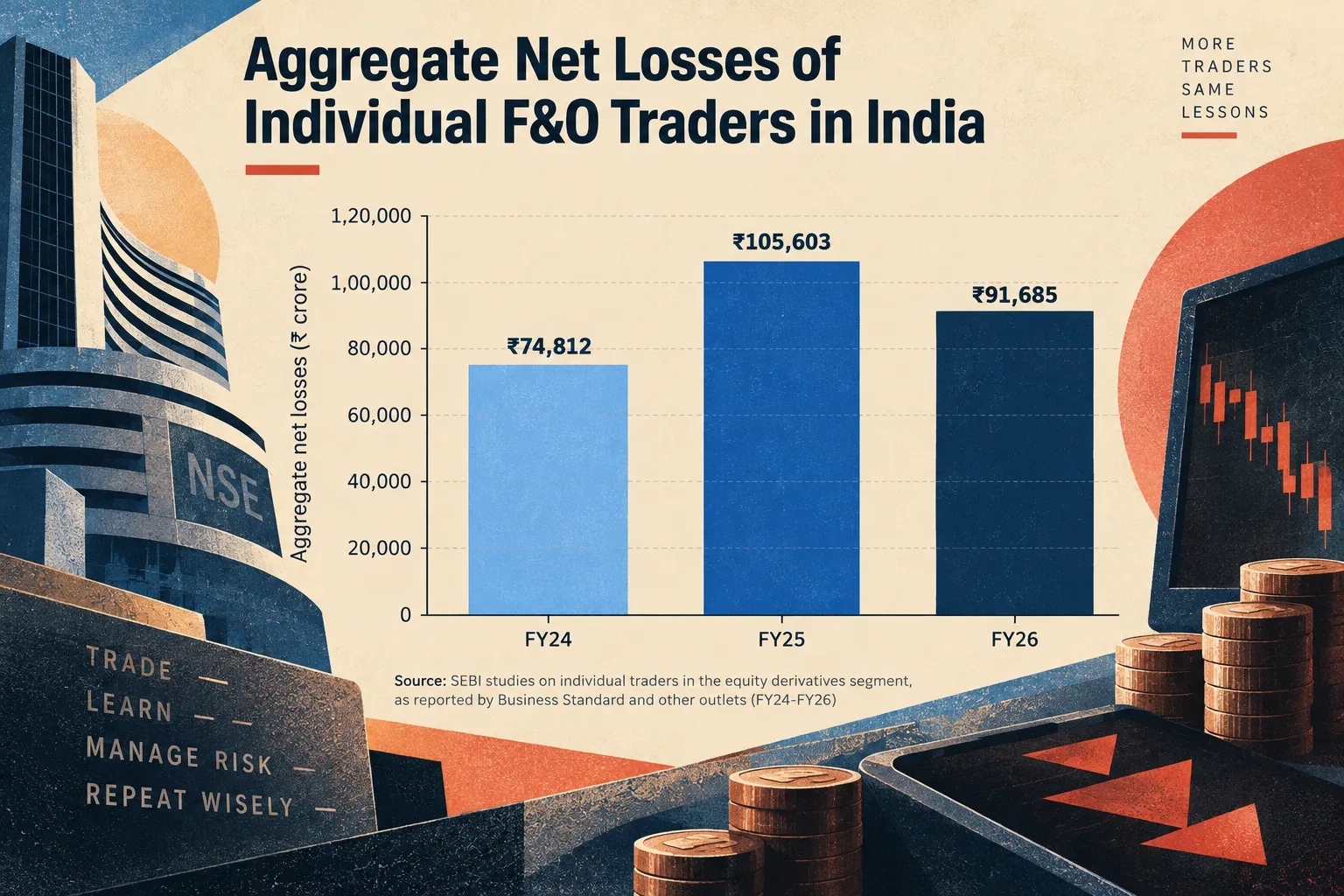
In August 2026, the Securities and Exchange Board of India published its latest set of studies on individual participation in the equity derivatives segment. The headline number looked, at first glance, like good news: aggregate net losses among retail futures and options (F&O) traders fell to roughly ₹91,685 crore in FY26, down from about ₹1.05 lakh crore in FY25. Participation also dropped by close to 20 percent over the same period.
Read a layer deeper, and the improvement looks less like traders getting better at trading and more like fewer people staying in a game most of them were losing. Close to 88 to 89 percent of individual F&O traders still lost money in FY26. That figure has barely moved across four consecutive SEBI studies going back to one published in January 2023, which first found that roughly 9 out of 10 individual traders lost money in the segment during FY22. What has changed is the number of people willing to keep playing, not the odds they are playing against.
The numbers, plainly
The scale of this is worth stating without softening it. SEBI's studies, covering the country's largest stock brokers and tens of lakhs of unique traders, have consistently found that around 9 in 10 individual F&O traders end a year with a net loss after transaction costs. Aggregate losses across FY22 to FY24 alone exceeded ₹1.8 lakh crore. FY25 losses widened by roughly 41 percent year on year to about ₹1.05 lakh crore, before easing to ₹91,685 crore in FY26 alongside the drop in participation.
The FY26 data also lets SEBI look at behaviour, not just outcomes, in more detail than before. Two findings stand out. First, loss concentration is heavily skewed by trading intensity: traders with turnover above roughly ₹1 crore made up only about 17 percent of the trader base but accounted for around 81 percent of aggregate losses, while low-turnover traders, who make up the large majority of participants, contributed less than 1 percent of total losses. Second, persistence looks almost compulsive in places. Among traders who lost money for two consecutive years and kept participating, roughly 90 percent went on to lose again in the third year. Separately, an examination of the SEBI evidence found that about 76 percent of loss-making traders continued trading even after experiencing a loss, rather than stepping back to reassess.

Why "market knowledge" is not the constraint
It would be convenient to explain this away as a knowledge gap, the idea that most retail traders simply do not understand options pricing, expiry mechanics or technical setups well enough. The data does not really support that. SEBI's studies describe a fairly literate, high-turnover trader base that keeps returning to the market after losses, not a group of people confused about what a strike price is. What repeats across the findings is a set of behavioural patterns: continued participation after a loss driven by a hope of recovery, occasional wins that feel more memorable than a longer run of smaller losses, low visible entry costs on options making it easy to re-enter quickly, and the speed at which trading apps let a new position be opened within seconds of the last one closing.
This is a useful distinction for anyone trying to make sense of the gap between "understanding the market" and "trading it well." One is a body of concepts (derivatives, indicators, macro drivers) that can be learned from a book, a course or a YouTube video in a matter of weeks. The other is a set of habits (position sizing, a written trading plan, the discipline to walk away after a bad trade) that generally only develops through structured practice, feedback and time. Educational material that covers common mistakes in online share trading tends to circle back to this same point: it is rarely a single wrong technical call that damages an account, but a repeated pattern such as overtrading, absent stop-losses or entering positions without a clearly defined plan.
The SIP disconnect
One more data point from the broader retail-education conversation is worth pulling in here, because it illustrates the same gap from a different angle. Separate analysis of SEBI's F&O data has found that only around 10 percent of individual F&O participants also invest through Systematic Investment Plans (SIPs) in mutual funds. In other words, the overwhelming majority of people speculating in derivatives are not simultaneously building a long-term investment habit alongside it.
That is a meaningful signal about how F&O is being treated by most participants: as a stand-alone, short-term activity rather than one part of a broader financial plan that also includes long-term, lower-risk instruments. Courses that walk through SIP and mutual fund basics are usually framed around patience and compounding over years. F&O trading, particularly short-expiry options trading, operates on almost the opposite time horizon, often measured in hours or a single trading session. Very few investor-education pathways currently help someone hold both mindsets deliberately, choosing when each tool is appropriate rather than drifting entirely into one.
What regulation has done, and what it has not
SEBI has not been passive in the face of this data. Measures introduced from November 2024 onward, including higher contract sizes, restrictions on weekly expiries and increased margin requirements, were specifically designed to curb excessive speculation and reduce the frequency with which smaller traders could enter and exit positions. The effect shows up clearly in the participation numbers: individual F&O participation fell from a peak of around 5.26 million in June 2024 to roughly 3 million by March 2025, a 23-month low, and turnover from smaller accounts declined even more sharply than the overall trader count, according to rating agency ICRA.
What these measures have not done, and were arguably never designed to do on their own, is change the underlying behavioural pattern for those who remain. The persistence data, that roughly 9 in 10 traders who lose two years running lose a third year too, was captured in the FY26 study, after most of these regulatory changes had already taken effect. A speed bump can reduce how often someone trades. It does not automatically change why they keep coming back after a loss.
Where structured education actually fits
This is the gap that a purely conceptual, one-time course struggles to close, and it is also why the more recent shift in financial education, toward multi-month, mentor-led trading formats with live sessions, trade reviews and ongoing accountability rather than a single video series, is worth understanding on its own terms. The distinction is not about the accuracy of the underlying strategy taught but about the format: recurring feedback on live trades and drawdown decisions is a meaningfully different tool for changing behavior than a static explanation of options theory. Elearnmarkets' own trading psychology resources describe this directly, framing fear, greed, hope and regret as the four emotional states that most consistently distort decisions once real money is at risk, regardless of how sound the underlying strategy is on paper. A related piece on trading psychology and money management makes a similar point about position sizing rules, such as capping risk per trade, existing specifically to remove decisions from the heat of the moment rather than to guarantee any particular return.
None of this changes the base rate SEBI has documented. Derivatives trading carries real, well-quantified risk, and no amount of education converts a structurally difficult activity into an easy one. What the data does suggest is that India's retail F&O problem is now better described as a discipline and process gap than a pure information gap. Traders searching for concepts can find them in minutes online. What is harder to find, and what the persistence statistics suggest is actually missing, is a structured, ongoing framework for managing risk, sizing positions and stepping away after a loss, something that platforms tracking positioning data such as open interest and long or short build-up through tools like derivatives analytics scanners can support, but cannot substitute for on their own.
This article is for informational and educational purposes only. It is not investment or trading advice. Futures and options trading carries a high degree of risk and may not be suitable for all investors. Figures cited are drawn from SEBI's published studies on individual traders in the equity derivatives segment (FY22 to FY26) and related media reporting, current as of September 2026.





























Sign in to leave a comment.