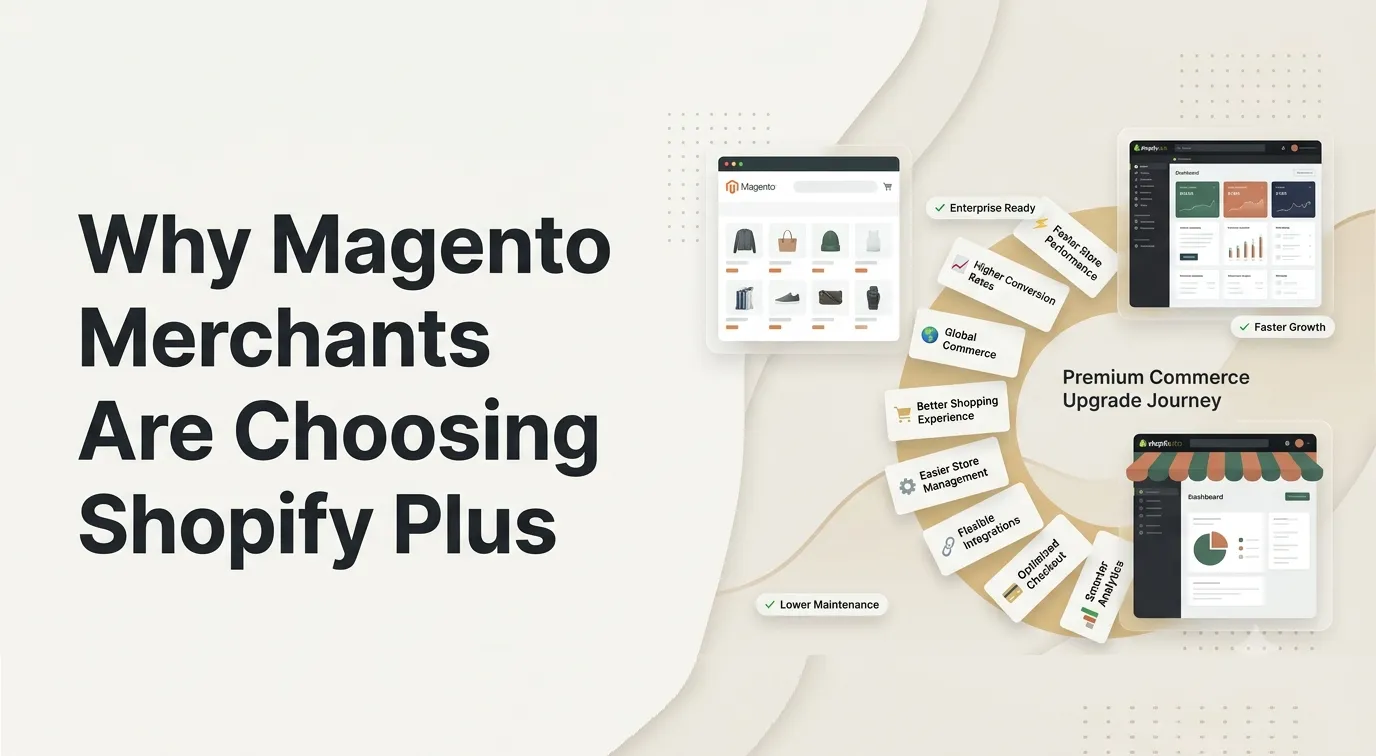

Magento to Shopify Plus migration is no longer a decision brands can defer comfortably. Adobe Commerce support deadlines have passed or are imminent, self-hosted Magento costs two to five times more per month than Shopify Plus, and Shopify Scripts retired on June 30, 2026, creating mandatory checkout rebuilds for thousands of brands regardless of migration plans. The brands that stay on Magento in 2026 are not avoiding the cost of change. They are paying for compliance exposure, infrastructure overhead, and a platform that slows down every commercial initiative while competitors on modern infrastructure move faster. This blog covers what is driving that shift, what the migration involves technically, and what brands achieve on the other side.
What Made Staying on Magento Untenable in 2026
Magento gave ecommerce brands something valuable for over a decade: genuine flexibility and deep customization capability. That flexibility always came at a cost, infrastructure ownership, security patching, PCI compliance overhead, and engineering resources dedicated to platform maintenance rather than growth. For years, brands judged that trade-off acceptable. In 2026, three converging pressures shifted that calculation fundamentally.
Global ecommerce is projected to reach $6.88 trillion by year end, representing 21.1% of all retail worldwide. Brands operating at that scale need platforms that reduce operational friction rather than generate it around every new initiative. The replatforming decision most Magento teams pushed through 2024 and 2025 has become structurally unavoidable for the majority of them in 2026, not because they chose to act but because the deadlines and costs made inaction more expensive than migration.
Five Triggers Forcing the Migration Decision Right Now
Adobe's Licensing Push Eliminated the Free Magento Option
Adobe spent 2026 consolidating Magento Open Source users toward paid Adobe Commerce Cloud licensing. Brands that originally adopted Magento because it was free now face a mandatory licensing layer on top of all existing infrastructure costs. The economic case for staying on Magento weakened significantly when the open-source advantage, the primary reason many brands chose it, disappeared as a practical option.
Support Deadlines Created Unacceptable Compliance Risk
Adobe Commerce 2.4.4 extended security support ended April 2026. Adobe Commerce 2.4.5 extended support ends August 2026. Brands on either version after those dates operate without official patches and carry direct PCI compliance exposure. The situation is more acute for the approximately 14% of Magento stores still running Magento 1, which Adobe ended support for in June 2020, a compliance gap that has been compounding silently for years with no official remediation path available.
Shopify Scripts Retirement Forced Immediate Checkout Action
Shopify Scripts reached full end-of-life on June 30, 2026. Any brand with checkout customization, promotional discount mechanics, bundle pricing logic, or shipping rules built in Scripts had to rebuild those functions in Shopify Functions regardless of any migration timeline. For many brands, executing a mandatory checkout rebuild on a platform they already planned to leave made the case for immediate full migration rather than investing rebuild effort twice.
The Monthly Cost Gap Stopped Being Justifiable
Shopify Plus costs approximately $2,300 to $2,500 per month on a multi-year contract. Running a comparable self-hosted Magento environment costs $4,000 to $15,000 or more per month when hosting, security, and development maintenance are fully counted. For most brands under $25 million in annual revenue, the monthly savings from moving to Shopify Plus recover the migration investment within the first operating year, before any performance or conversion improvement is factored in.
2026 Migration Volume Confirms This Is a Structural Market Shift
One March 2026 industry report recorded a single Magento-to-Shopify data transfer of 267,626 entities in one month. Forty-six percent of all migrations tracked that month came from stores that had been operating for eight or more years. Established brands with complex catalogs, long operating histories, and sophisticated integration environments are executing these moves now, not deferring them into future planning cycles.
What the Architectural Translation From Magento to Shopify Plus Actually Involves
A Magento-to-Shopify-Plus migration is not a data export and import. It is an architectural translation between two platforms built on fundamentally different structural logic. Teams that approach it as a lift-and-shift project discover scope problems during the build when correcting them is costly and time-consuming. Understanding what translates to what before scoping eliminates most of those surprises before they become project risks.
Core architectural translations that every migration must address:
- EAV attributes → Metafields and Metaobjects: Magento's Entity-Attribute-Value database structure has no direct equivalent in Shopify. Custom product attributes translate onto metafields and metaobjects that achieve the same merchandising outcomes through a different structural approach requiring deliberate mapping at the field level.
- Multi-store setup → Shopify Markets: Magento's multi-website architecture maps to Shopify Markets, handling regional pricing, currency, language, and localization from a single Shopify Plus organization with up to nine expansion stores under shared billing and reporting.
- Customer groups → Native B2B catalogs: Company accounts, custom pricing lists, net payment terms, and a dedicated B2B storefront all come native in Shopify Plus. Features requiring third-party applications or custom backend development on Magento run as standard platform configuration on Shopify Plus.
- Custom checkout scripts → Checkout Extensibility and Shopify Functions: All checkout customization moves to Shopify's Checkout Extensibility framework built on Rust and JavaScript. Everything previously in Magento's backend or in Scripts must be rebuilt here before cutover, not after.
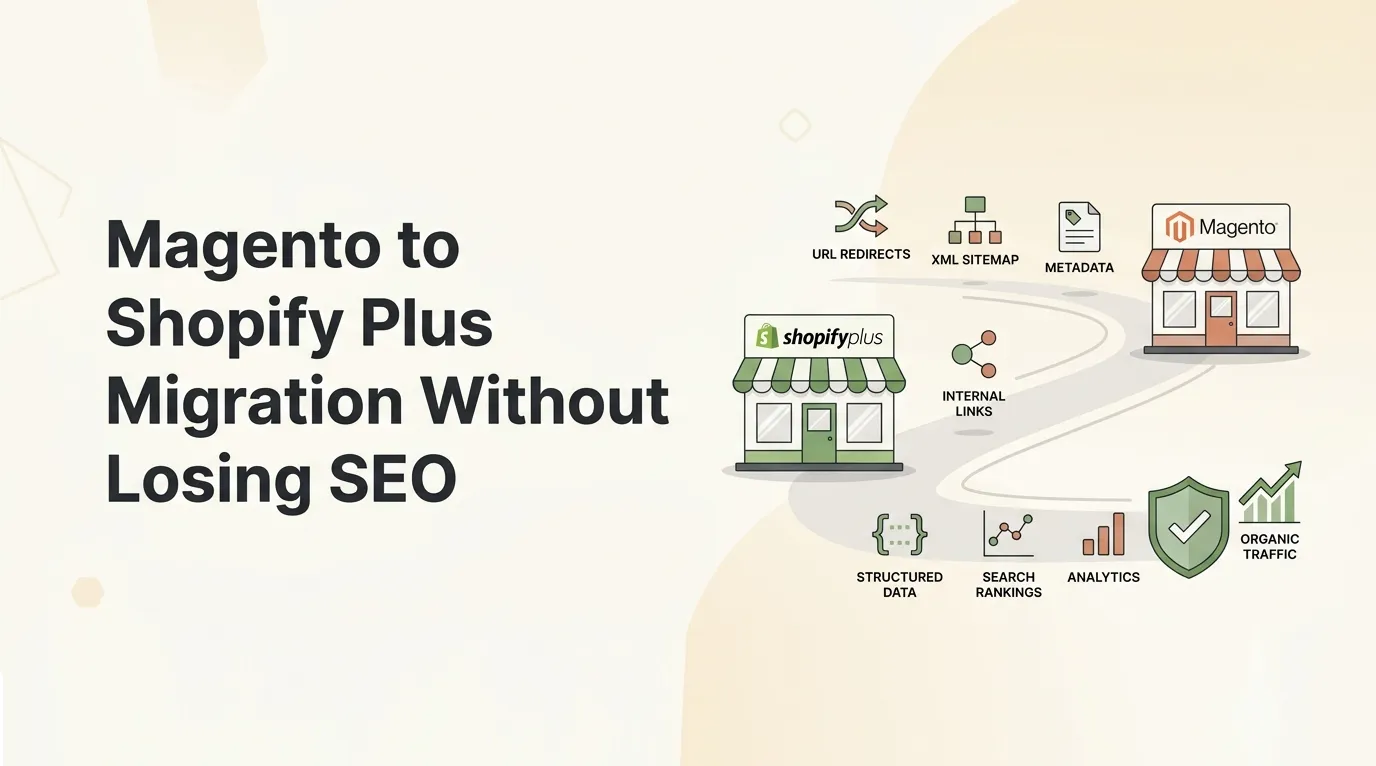
- URL structure: Shopify enforces fixed /products/ and /collections/ URL patterns that almost never match Magento's existing structure. Every legacy URL requires a documented 301 redirect. Missing redirects produce direct organic ranking losses at cutover that take months to recover from rather than days.
The 7-Step Migration Process That Protects Rankings, Data, and Conversion
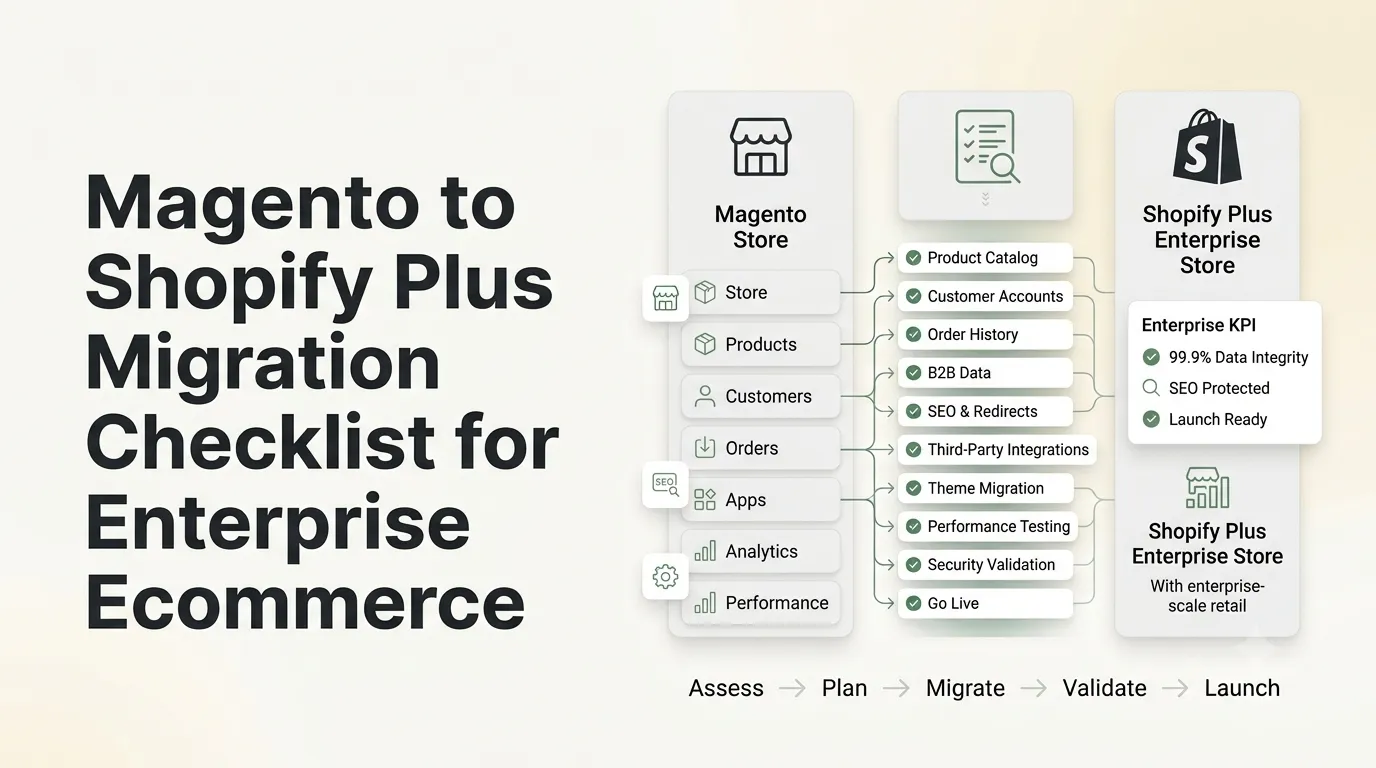
Most migration failures trace back to steps that were compressed or skipped under schedule pressure rather than to technical problems that could not have been avoided. The full ecommerce migration checklist covers 18 specific dependencies, with particular depth on search ranking protection, that most abbreviated migration guides skip entirely and that most migration project failures can be traced back to.
Step 1: Discovery and Audit
Document catalog complexity, EAV attribute volume, and every integration across ERP, 3PL, ESP, loyalty, and analytics systems before anything moves. Produce a rollback plan with defined triggers and recovery procedures at this stage. Teams that skip discovery consistently encounter scope problems during the build when changes cost more and take longer to execute than they would have at project outset.
Step 2: Strategy and Scoping
Choose between a Liquid theme build and a headless Hydrogen architecture based on traffic volume, performance requirements, and the team's long-term capacity to support the approach. Map every Magento extension to its Shopify equivalent and document gaps explicitly. Assuming feature parity without auditing produces scope surprises that surface during development rather than during planning.
Step 3: Data Migration
Transfer products, customers, complete order history, blog content, and CMS pages with structured validation at every stage. Running data migration without validation creates catalog and customer record errors that surface post-launch where correcting them disrupts live operations and costs substantially more than catching them during the migration itself.
Step 4: SEO Redirect Mapping
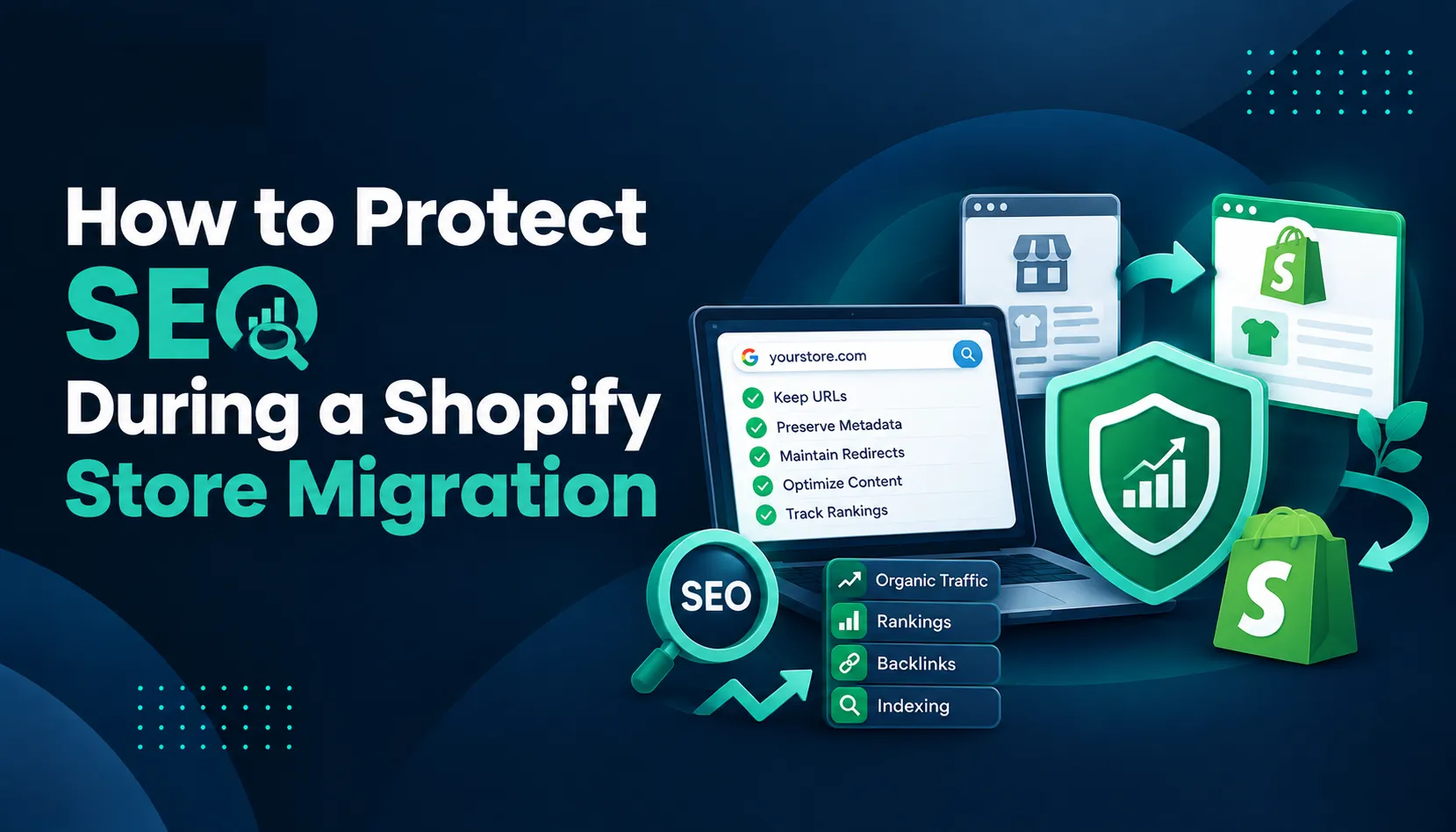
Build 301 redirects covering every legacy Magento URL. Carry over meta titles, descriptions, and schema markup without modification. Shopify Plus SEO execution runs as a dedicated parallel workstream alongside the technical build in every migration that prioritizes organic traffic continuity. Organic recovery after a cutover that damaged rankings is substantially more expensive and slower than protection executed correctly during the build phase.
Step 5: Storefront and Checkout Build
Develop the storefront theme against Core Web Vitals targets, LCP under 2.5 seconds and INP under 200ms on mobile. Configure Checkout Extensibility and activate Shopify Plus features including Shop Pay, native B2B tools, and Shopify Markets during this phase. Deferring these to post-launch creates additional project cycles that delay the commercial improvements the migration was scoped to produce.
Step 6: Soft Cutover
Route a defined percentage of live traffic to the new Shopify Plus store while keeping Magento running for approximately two weeks. This controlled overlap window catches order-routing failures, webhook errors, and integration gaps at low traffic exposure before full DNS cutover commits every customer interaction to the new environment where problems reach their maximum commercial impact.
Step 7: Post-Launch Monitoring
Run daily Google Search Console checks for the first 14 days covering crawl errors, indexing status, and Core Web Vitals performance against pre-migration baselines. Follow with a full 60-day benchmark review. The migration to GA4 should run as a parallel workstream so historical performance data remains intact rather than disappearing in the same window as the platform transition.
What Brands Actually Achieve After a Successful Migration to Shopify Plus
Infrastructure Overhead Drops and Engineering Capacity Returns to Growth Work
Shopify Plus removes server management, patching cycles, and infrastructure scaling decisions entirely. Development capacity previously consumed by platform maintenance redirects toward commercial features and growth initiatives. That capacity reallocation compounds directly into site performance, and site speed remains one of the most consistent levers available in conversion rate optimization regardless of category or traffic volume.
B2B and Multi-Market Functionality Runs Without Application Dependencies
Company accounts, custom pricing, net payment terms, and regional market configuration all operate natively inside Shopify Plus. Features that required third-party applications, custom development, and complex integration chains on Magento become standard configuration on Shopify Plus, reducing direct cost, eliminating application dependency risk, and removing the maintenance overhead those dependencies created across the previous platform setup.
Checkout Performance Improves Immediately Without Additional Build Work
Shop Pay and Shopify's mobile-optimized checkout deliver faster completion rates than most custom Magento checkout implementations without requiring additional development investment to achieve. For brands where checkout abandonment represents a meaningful revenue gap, post-migration checkout improvement typically delivers a measurable ROI faster than any other single outcome from the migration. Structured conversion funnel analysis after launch identifies remaining friction points rather than assuming the platform switch resolves every conversion challenge on its own.
Documented Client Results Confirm the Commercial Impact
Southern Season moved from Magento Cloud to Shopify Plus and recorded a 200% increase in store footfall, over 166% higher average order value, and 150% ROI growth after the migration. These outcomes came from combining the platform capability improvement with deliberate post-migration optimization work, not from the platform change alone.
2026-Specific Factors Changing How Migrations Get Scoped and Delivered
Agentic Commerce Support Is a Day-One Launch Requirement
Migrations in 2026 scope UI extensions and Model Context Protocol support at launch so AI-driven shopping assistants interact with the storefront's product-discovery layer from day one rather than from a future release date. Brands that defer this to post-launch typically rebuild those integrations sooner than anticipated when the capability becomes operationally necessary before the post-launch timeline planned for it.
Headless Hydrogen Builds for Brands Where Performance Is Non-Negotiable
High-volume brands leaving Magento choose Shopify's Remix-based Hydrogen framework when standard themed store performance cannot meet their load time requirements. Shopify Plus development at the headless level achieves sub-second load times while retaining Shopify Plus's managed backend and checkout infrastructure. This is now standard migration scope for brands with the traffic volume and performance requirements that justify the additional build investment.
Shopify Functions Rebuild Is a Hard Pre-Launch Dependency
With Shopify Scripts retired on June 30, 2026, rewriting legacy Ruby-based checkout logic into Shopify Functions is a mandatory technical requirement before DNS cutover on every 2026 migration. Teams that scope this as optional post-launch work discover it blocks cutover when the dependency surfaces close to launch, adding unplanned cost and timeline delay at the most disruptive possible stage in the project.
Regional Configuration Must Be in Scope From the Start
Brands with regional operations build Shopify Markets configuration, local payment gateway integration, and mobile-first design into initial migration scope. Retrofitting regional capabilities after launch consistently costs more and delays commercial performance in those markets compared to scoping them correctly from project initiation.
How Krish TechnoLabs Runs These Migrations End-to-End
As a certified Shopify Plus partner with over two decades of ecommerce experience, Krish executes Magento-to-Shopify-Plus migrations covering discovery and audit, SEO-safe data migration, storefront and checkout build, B2B and Markets configuration, and post-launch monitoring through the full 60-day performance review period.
Beyond initial migrations, the team supports brands through Shopify migration services for moves from other platforms and Shopify to Shopify Plus migration services for brands already in the Shopify ecosystem that have scaled past what standard Shopify supports.
The complete Magento to Shopify Plus migration guide covers the full process at the technical depth and sequencing detail that enterprise migrations require, including the dependencies and edge cases that standard migration timelines underestimate and that compressed project schedules consistently encounter as late-stage blockers.
A Magento to Shopify Plus migration executed correctly in 2026 closes compliance exposure, reduces monthly operating costs, improves site performance, and positions the brand on infrastructure aligned with where ecommerce capability is heading over the next several years. The same migration executed with compressed discovery, deferred SEO work, or insufficient post-launch monitoring produces a different platform with the same categories of operational problems. In 2026, the cost of executing this migration correctly the first time is substantially lower than the cost of executing it twice.




























Sign in to leave a comment.