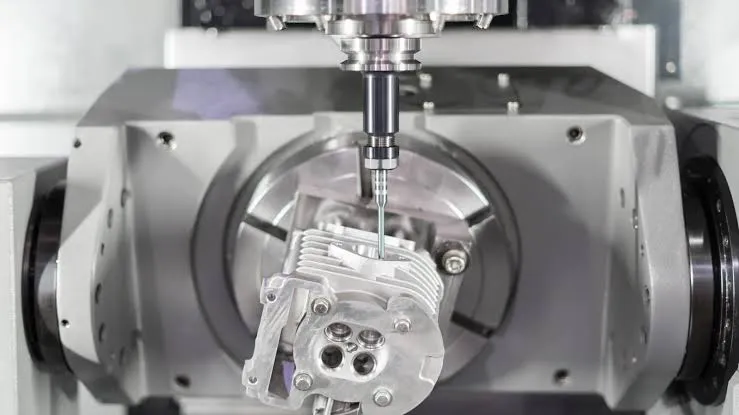

If you've ever wondered how a single block of aluminum turns into a flawless aerospace bracket with dozens of angled holes and contoured surfaces, the answer usually comes down to one thing: a multi-axis CNC milling machine.
These machines have quietly become the backbone of modern manufacturing. They cut setup time, tighten tolerances, and let shops produce parts that would be nearly impossible on older equipment. Whether you're an engineer sourcing a new supplier or a business owner trying to understand what you're paying for, this guide breaks it all down in plain language.
By the end, you'll know exactly what a multi-axis CNC milling machine does, why it matters, and how to choose the right CNC milling services partner for your next project.
What Is a Multi-Axis CNC Milling Machine?
A multi-axis CNC milling machine is a computer-controlled cutting tool that can move a workpiece or cutting head along more than three directions at once. A standard machine moves on three axes — X, Y, and Z (left-right, front-back, up-down). A multi-axis machine adds rotational movement, letting the tool approach a part from angles a basic 3-axis setup simply can't reach.
In plain terms: instead of flipping and re-clamping a part five times to cut it from different sides, a 4-axis or 5-axis machine can often do it in one setup.
The Different Types of Multi-Axis Machines
- 3-axis milling – Moves along X, Y, and Z. Great for flat surfaces, pockets, and simple geometry.
- 4-axis milling – Adds a rotational axis (usually around the X-axis), allowing the part to rotate while being cut.
- 5-axis milling – Adds two rotational axes, giving the cutting tool near-total freedom to approach a part from almost any angle.
According to you, the type of axis needed really depends on the part's complexity — not every job needs 5-axis power, and a good machine shop will tell you that honestly instead of upselling you.
Why Multi-Axis Milling Matters in Modern Manufacturing
Manufacturing has changed a lot over the past two decades. Parts are getting more complex, tolerances are getting tighter, and lead times are getting shorter. Multi-axis milling exists to meet all three demands at once.
Here's why it's become the standard for industries like aerospace, medical, and defense:
- Complex parts often require angled holes, curved surfaces, and undercuts that 3-axis machines can't reach without repositioning.
- Fewer setups mean fewer chances for human error or misalignment.
- Tighter tolerances are easier to hold when a part doesn't move between operations.
Step-by-Step: How Multi-Axis CNC Milling Works
Understanding the process helps you ask better questions when choosing a machining partner. Here's a simplified walkthrough.
Step 1: Design and CAD Modeling
The process starts with a 3D CAD model of the part. This model defines every surface, hole, and dimension the machine will need to produce.
Step 2: CAM Programming
Next, CAM software converts the CAD model into machine-readable instructions, known as G-code. This step tells the machine exactly how the tool should move, at what speed, and in what order.
Step 3: Machine Setup
The workpiece — usually a block of metal like aluminum, stainless steel, or titanium — is secured into the machine using fixtures or clamps.
Step 4: Cutting Operations
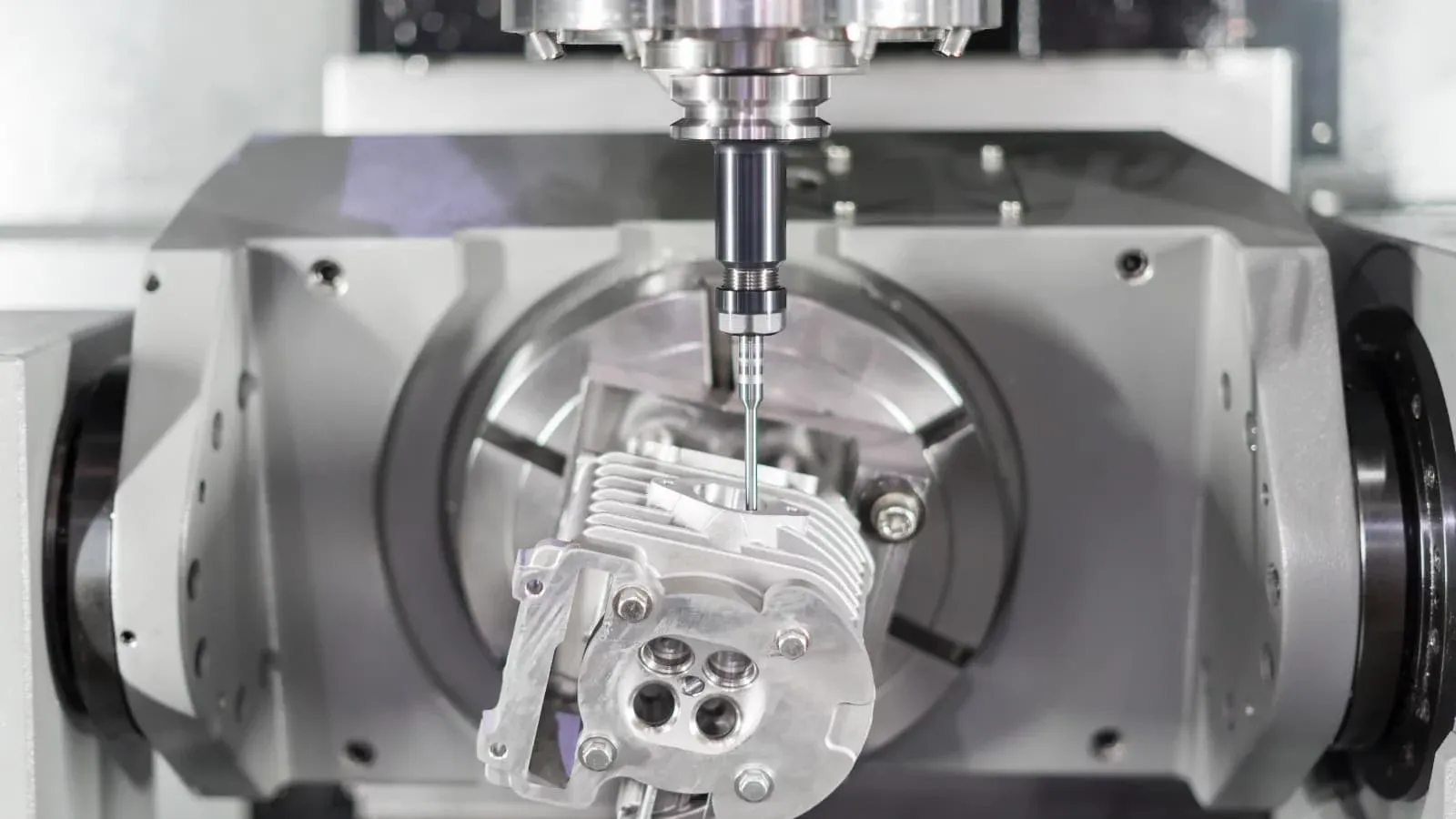
The machine executes the program, using tools like end mills, drills, face mills, and reamers to remove material. On a 4- or 5-axis machine, the part rotates or tilts as needed, so the tool can reach multiple faces without stopping.
Step 5: Inspection and Quality Control
Once machining is complete, the part goes through inspection using precision metrology equipment to confirm it meets the required tolerances — sometimes as tight as 0.0002 inches for metal components.
Step 6: Finishing
Depending on the application, parts may go through anodizing, plating, painting, or other finishing processes to meet appearance or durability requirements.
Real-World Examples of Multi-Axis Milling in Action
Numbers and definitions only go so far. Here's what multi-axis milling actually looks like in practice.
Aerospace Brackets
Aircraft brackets often need angled mounting holes, thin walls, and curved surfaces to save weight without sacrificing strength. A 5-axis machine can cut all these features in one setup, keeping every hole perfectly aligned relative to the others.
Medical Device Components
Surgical instruments and implant components demand extremely tight tolerances and smooth surface finishes. Multi-axis milling allows manufacturers to produce complex geometries — like contoured bone plates — without introducing the small errors that come from repositioning a part multiple times.
Defense Hardware
Defense components frequently combine hard metals like titanium or alloy steel with complex geometry. Multi-axis machining reduces the number of operations needed, which matters when a program requires full traceability and documentation for every part.
Automotive Prototyping
When automotive engineers need a working prototype fast, multi-axis milling can produce a functional part directly from CAD data in days rather than weeks, letting teams test and iterate quickly.
Key Benefits of Multi-Axis CNC Milling
Here's a quick breakdown of what makes multi-axis milling worth the investment for complex parts.
- Fewer setups, faster turnaround – Completing more operations in one clamping reduces total production time.
- Higher accuracy – Less handling means less opportunity for misalignment between features.
- Complex geometry made possible – Undercuts, compound angles, and curved surfaces become achievable.
- Better surface finish – Continuous tool paths often produce smoother finishes than multiple repositioned cuts.
- Lower long-term cost – Fewer labor hours and less scrap can offset the higher upfront machine cost.
- Consistency across production runs – Once a program is dialed in, part-to-part variation stays low.
Common Mistakes to Avoid When Choosing Multi-Axis CNC Milling Services
Even experienced buyers make mistakes when sourcing CNC milling services. Here are the ones to watch for.
Choosing on Price Alone
The cheapest quote isn't always the best value. A lower price sometimes means older equipment, less experienced operators, or corners cut on inspection.
Skipping Certifications
For aerospace, defense, or medical parts, certifications like AS9100 and ISO 9001:2015 aren't optional extras — they're proof the shop follows a documented quality system. Skipping this check can cause serious problems down the line.
Not Asking About Material Experience
Not every shop has deep experience with every material. Titanium, for example, behaves very differently under a cutting tool than aluminum. Ask specifically about experience with your material.
Ignoring Lead Time Realities
Some shops promise fast turnaround they can't actually deliver once a project starts. Ask about typical lead times for parts similar to yours, not just best-case scenarios.
Overlooking Volume Flexibility
If your project might scale from a single prototype to a production run of a thousand units, make sure your shop can handle both without forcing you to switch suppliers midway.
Professional Tips for Getting the Best Results
- Involve your machinist early. Sharing your design before it's finalized can catch manufacturability issues before they become expensive.
- Ask for a first-article inspection report. This gives you documented proof the first part off the line meets spec.
- Request material certifications. Especially important for regulated industries like aerospace and medical.
- Clarify tolerance requirements upfront. Overly tight tolerances where they aren't needed can drive up cost unnecessarily.
- Confirm post-machining finishing options. Anodizing, plating, and other finishes should be planned into the timeline, not added as an afterthought.
Why Choose EGM Manufacturing
EGM Manufacturing has been running a full-service CNC machine shop out of Sunrise, Florida since 2005, and multi-axis milling sits at the center of what we do every day.
Here's what sets us apart:
- 3-, 4-, and 5-axis machining centers capable of holding tolerances as tight as 0.0002 inches for metal components and 0.001 inches for plastics.
- AS9100 and ISO 9001:2015 certification, plus ITAR registration and JCP (DD2345) certification — the credentials aerospace and defense programs require.
- 50+ years of combined machining experience across our team of operators and engineers.
- No volume minimums, so we support everything from a single prototype to production runs of 1,000+ units.
- Broad material expertise, including aluminum, stainless steel, mild steel, alloy steel, tool steel, titanium, and brass.
- Industries served include aerospace, medical, defense, marine, automotive, and commercial sectors.
- Fast, honest turnaround, with lead times as short as 1 to 3 days on many jobs, backed by a rigorous inspection process at every stage.
We don't just run machines — we partner with engineers and program managers to solve real production problems, from first-article prototypes to long-term supply agreements.
Conclusion
Multi-axis CNC milling has changed what's possible in precision manufacturing. It lets shops produce complex, tightly toleranced parts faster and more accurately than older methods ever could. But the technology is only as good as the team running it.
Choosing the right partner for your CNC milling services means looking past the price tag and asking about certifications, material experience, and real-world lead times. That diligence upfront saves headaches — and money — later.
Ready to Get Started?
If you have a part that needs precision, complexity, or a fast turnaround, EGM Manufacturing is ready to help. Contact our team today to discuss your multi-axis CNC milling project, request a quote, or ask about our certifications and capabilities. Let's build something great together.
Frequently Asked Questions
1. What's the difference between 3-axis, 4-axis, and 5-axis CNC milling?
A 3-axis machine moves along three straight-line directions (X, Y, Z). A 4-axis machine adds one rotational axis, and a 5-axis machine adds two, allowing the cutting tool to reach a part from nearly any angle in a single setup.
2. Is 5-axis milling always better than 3-axis?
Not necessarily. 5-axis machining is ideal for complex geometry, but simpler parts can often be made just as accurately and more affordably on a 3-axis machine. The right choice depends on the part's design.
3. What materials can multi-axis CNC milling machines work with?
Most multi-axis mills can handle a wide range of metals and plastics, including aluminum, stainless steel, mild steel, alloy steel, tool steel, titanium, and brass, along with various engineering plastics.
4. How tight can tolerances be on a multi-axis CNC milling machine?
Modern multi-axis machines can hold tolerances as tight as 0.0002 inches on metal parts and around 0.001 inches on plastics, depending on the part geometry and material.
5. Why do aerospace and medical industries rely so heavily on multi-axis milling?
These industries need complex, high-precision parts with strict traceability. Multi-axis milling reduces the number of setups required, which lowers the risk of error and helps maintain consistent quality across every part produced.





















Sign in to leave a comment.