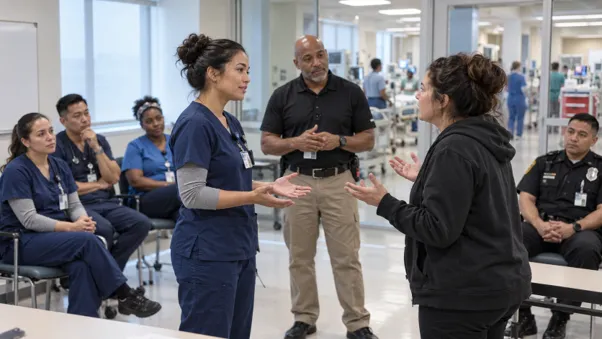

Healthcare and social assistance workers face more workplace violence than anyone else in the private sector. The Bureau of Labor Statistics reports 14.2 cases of workplace violence per 10,000 full-time healthcare and social assistance workers, nearly five times the private-industry average of 2.9, and the sector accounted for 72.8% of all workplace violence cases across private industry during that period. The workforce is about 78% women, who absorb most of that risk.
OSHA's own guidance for healthcare employers calls for a written, zero-tolerance workplace violence prevention program built around regular risk assessments specific to each facility, combined with physical security measures and staff training, instead of a generic policy that looks the same at every location.
New York's New Hospital Safety Law Just Took Effect
New York's Public Health Law Section 2832 took effect on September 18, 2026, requiring general hospitals statewide to maintain a physical security presence, either an off-duty law enforcement officer or trained security staff, in or near emergency departments at all times. Starting January 1, 2027, hospitals also have to complete a workplace violence risk assessment specific to each facility's size, layout, and location, and a full written prevention program is required for both hospitals and nursing homes by September 18, 2027.
The law is specific about what a real assessment covers: entry points, visitor management, communication systems, and input from the staff and union representatives who actually work the floor, not management's read on the risk from an office upstairs. It also blocks hospitals with multiple locations from applying one plan system-wide, since a Manhattan emergency department and a rural upstate one face different risks entirely.
What This Looks Like Inside a Busy NYC Emergency Department
New York City runs some of the busiest emergency departments in the country, and a crowded waiting room with a long wait creates exactly the kind of frustration that OSHA's guidance identifies as a common trigger for workplace violence in healthcare settings. A nurse or security guard working triage deals with that tension directly, often before a doctor is even in the room.
A hospital with multiple NYC locations, each with its own layout and patient population, can't rely on one plan written at a corporate office. The new law effectively requires what safety-conscious hospital systems were already doing at their better-run locations: a plan built from what actually happens on that specific floor.
Why Emergency Departments Carry More Risk Than Other Hospital Floors
Emergency departments see patients in crisis, in pain, or scared, often without any existing relationship with the staff treating them, unlike an inpatient floor where the same nurses have cared for a patient for days. OSHA's healthcare guidance specifically flags emergency and psychiatric units as higher-risk areas within a hospital, which is part of why the new state law singles out emergency departments for the physical-security requirement first, ahead of the rest of the building.
A security guard or off-duty officer stationed at the emergency department door only covers the entrance. Once a situation develops in a treatment bay or hallway, the nurse or tech in that room is the first, and often only, person there before help arrives. The physical distance between the front door and a treatment bay several hallways back can be a minute or more, which is a long time to wait when something's already escalating.
Training Staff to Recognize and De-escalate Before It Escalates
A written policy and a trained response are different things. The law requires training that covers recognizing warning signs, de-escalation, incident reporting, and emergency procedures, a longer list than the slide deck and signature line that satisfies most workplace policies. Practicing how to read a raised voice or a clenched fist before it turns into a swing is what actually builds that skill.
Staff who've rehearsed a de-escalation scenario firsthand react differently when a real one starts than staff who've only watched one described in a training video. That gap between knowing what de-escalation looks like and being able to do it under pressure is exactly what hands-on training is built to close.
What Nursing Homes Face Under the Same Law
Nursing homes fall under the same September 2027 deadline but can meet it through existing federal assessment and emergency-preparedness rules instead of building a new program from scratch, provided those assessments specifically address workplace violence. That's a meaningful difference, since a resident's aggression in a nursing home is often tied to dementia or cognitive decline instead of the acute frustration that drives most emergency department incidents.
A nursing aide managing a combative resident with dementia needs de-escalation skills built for that specific situation, a different script than the one used for a frustrated visitor in an emergency department waiting room. The law's flexibility on how nursing homes comply reflects that difference, even though both settings now fall under the same basic legal requirement.
Why This Extends Well Beyond the Emergency Department
Psychiatric units, behavioral health floors, and even routine inpatient care see aggressive incidents tied to dementia, substance withdrawal, or untreated mental illness, not just the trauma-bay scenarios that tend to come to mind first. The new law's risk-assessment requirement covers a hospital's whole footprint, not just the emergency department, which matters given how much of OSHA's own data on healthcare violence comes from outside the ED entirely.
A physical security presence solves part of the problem by putting a trained person at the door. It doesn't put that same person in every patient room, on every floor, at every hour. The law closes that gap by also requiring staff training, instead of treating security staffing alone as the fix.
What Comes Next for NYC Hospital Systems
The rollout gives hospitals a specific sequence to work through: physical security presence in emergency departments starting now, facility-specific risk assessments by January 1, 2027, and a full written prevention program, covering both hospitals and nursing homes, by September 18, 2027. A system running a dozen locations across the city has to repeat that entire sequence at every single site, since the law doesn't allow one network-wide compliance pass.
That timeline puts real pressure on hospital administrators to line up training now instead of waiting until the 2027 deadlines arrive. Facilities that start building staff training into their plan early tend to have an easier time meeting the written-program requirement than ones that treat training as an afterthought once the paperwork is already due.
Budgeting for this also looks different depending on how a hospital approaches it. A system that treats training as a one-time compliance box, run once and filed away, usually ends up repeating the exercise once staff turnover erodes what was taught. A system that builds recurring, hands-on sessions into its ongoing safety program spends more up front but doesn't have to relearn the same lesson every time a new class of nurses and techs comes on staff. Turnover in hospital staffing is constant enough that a one-time session rarely reaches everyone working the floor a year later.
Corporate safety training in NYC at Krav Maga Experts builds that hands-on layer directly, giving hospital and healthcare staff practice reading escalating behavior and de-escalating it before backup arrives, on-site or through Krav Maga Experts, not just a written policy that says they should.
























Sign in to leave a comment.