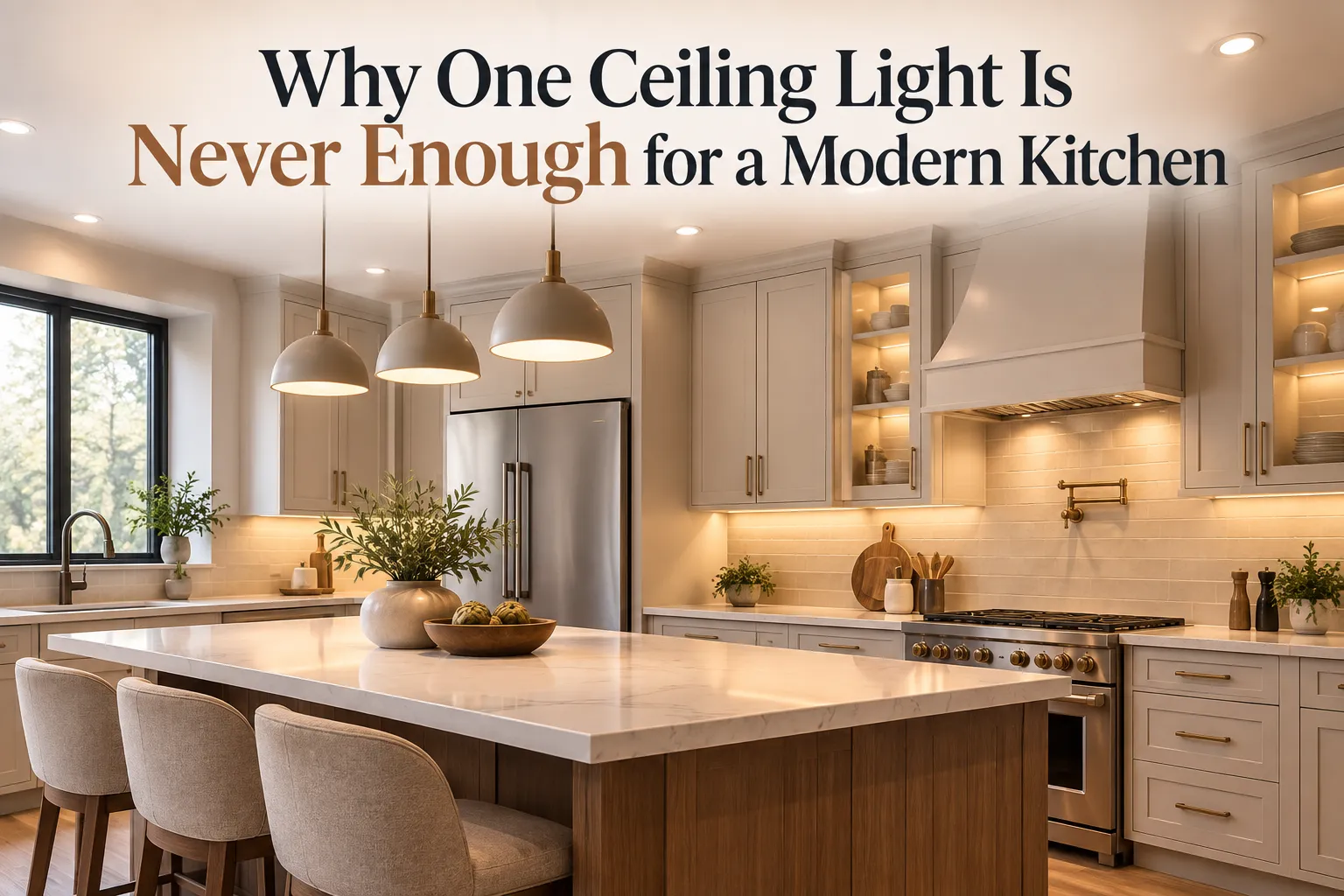


For years, kitchen lighting seemed pretty simple: put one bright fixture in the middle of the ceiling and call it a day.
That might technically light the room, but modern kitchens ask a lot more from lighting.
A kitchen can be a workspace in the morning, a gathering place in the afternoon, and somewhere to eat or entertain at night. One ceiling fixture has a difficult time doing all of those jobs well.
The problem isn't always how bright the light is. It's where the light goes and what you're trying to do underneath it.
A Bright Kitchen Can Still Have Dark Work Areas
This sounds contradictory, but it's surprisingly common.
A powerful ceiling light can make the overall room look bright while leaving the countertops in shadow. If the light is behind you while you're chopping vegetables or preparing food, your own body can block it exactly where you need it most.
That's why brightness alone isn't a very useful measure of good kitchen lighting.
What matters more is whether the important areas receive enough light.
Countertops, the sink, the stove, and food preparation areas all benefit from lighting positioned specifically for those tasks.
Think in Layers Instead of One Light Source
One of the most useful ideas I came across when looking at kitchen design was layered lighting.
Instead of expecting one fixture to do everything, different lights perform different jobs.
Ambient lighting provides the general illumination for the room. Recessed lights, ceiling fixtures, or similar sources often handle this layer.
Task lighting focuses on areas where you actually work. Under-cabinet lighting is probably the easiest example because it puts light directly onto countertops.
Accent lighting is more about atmosphere and design. It might highlight open shelving, architectural details, cabinetry, or another feature you want to emphasize.
None of these layers needs to be particularly complicated. The difference comes from combining them.
Under-Cabinet Lighting Solves a Very Specific Problem
Upper cabinets are useful for storage, but they can block ceiling light from reaching the countertop below.
That's where under-cabinet lighting becomes valuable.
Instead of increasing the brightness of the entire kitchen just to illuminate one dark countertop, you can put light exactly where it's needed.
It can also make the kitchen feel warmer in the evening. Sometimes you don't want every ceiling light turned on just to make coffee or grab something from the kitchen.
A softer secondary light source can completely change the atmosphere.
The Island Deserves Its Own Lighting
Kitchen islands are often some of the busiest surfaces in the room.
People prepare food there, eat breakfast, work on laptops, help kids with homework, and gather around them during conversations.
Yet it's easy to treat island lighting as purely decorative.
Pendant lights can certainly become a visual feature, but their placement and size also affect how useful they are.
Fixtures positioned too high may contribute very little task lighting. Hang them too low and they can interrupt sightlines or simply become annoying.
The goal should be finding a balance between appearance and function.
Lighting Should Be Planned With the Kitchen, Not After It
This is probably the biggest reason I wouldn't leave lighting decisions until the end of a remodel.
The position of cabinets, islands, work surfaces, and appliances determines where light is actually needed. Electrical planning also affects where fixtures, switches, and other lighting elements can go.
Thinking about Kitchen Lighting and Fixtures Application while the rest of the kitchen is being planned makes it easier to position different light sources according to how each part of the room will actually be used.
It's much harder to create an ideal lighting plan once everything else has already been installed.
Color Temperature Changes How the Kitchen Feels
Two bulbs can produce similar amounts of light and still make the same kitchen look completely different.
Warmer light tends to create a softer, more comfortable atmosphere. Cooler light can feel brighter and more focused.
Neither is automatically better.
The important thing is consistency.
If pendant lights produce very warm light while recessed fixtures are noticeably cooler, the kitchen can feel visually disconnected when everything is switched on.
It's worth looking at bulbs and fixtures together rather than choosing each one independently.
More Lights Doesn't Mean Everything Has to Be On
One concern with layered lighting is that it sounds like the kitchen will suddenly have lights everywhere.
But the advantage is actually the opposite.
Multiple lighting zones give you more control.
While cooking, you might use task lighting and brighter overhead lights. During dinner, pendants and softer ambient lighting may be enough. Late at night, under-cabinet lights might provide all the illumination you need.
Dimmer switches can add even more flexibility.
Instead of having two choices, completely bright or completely dark, the kitchen can adapt throughout the day.
Natural Light Still Matters
Artificial lighting shouldn't be considered separately from windows and natural daylight.
A kitchen with large windows might need very little artificial light during the afternoon but require a completely different setup after sunset.
Dark cabinetry and surfaces can also absorb more light, while lighter finishes may reflect it throughout the room.
That's why copying a lighting arrangement from another kitchen doesn't always produce the same result.
The room itself matters.
Good Lighting Is Something You Notice When It's Missing
A beautiful light fixture is easy to notice.
Good lighting design is often less obvious.
You simply have enough light where you're chopping food. You can see inside cabinets. The island feels comfortable to sit around. The room doesn't become harsh at night, and you don't constantly find yourself working in your own shadow.
That's ultimately why one ceiling light rarely does enough for a modern kitchen.
Instead of asking how bright the kitchen should be, it makes more sense to ask where light is needed, what happens in each area, and how the room should feel at different times of day.
Once you start thinking about lighting that way, the kitchen becomes much more than simply bright. It becomes easier and more comfortable to use.
























Sign in to leave a comment.