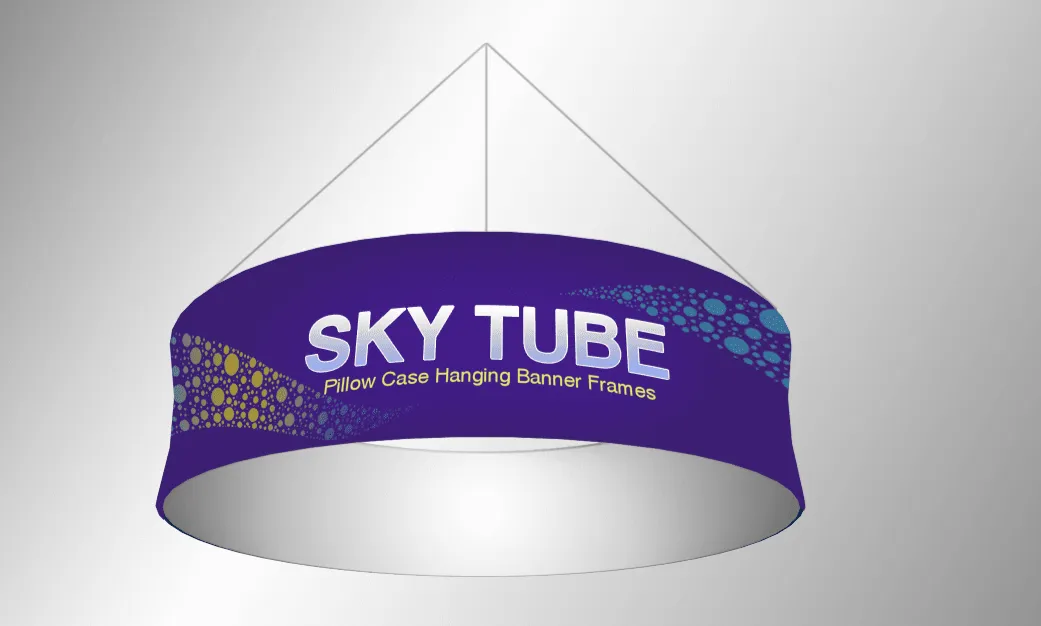

Most event signage competes for attention at eye level, fighting against tables, crowds, and dozens of other visual distractions scattered across a room. But there's one space that almost never gets crowded out: the air above everyone's heads. A sign suspended from the ceiling stays visible no matter how packed a venue gets, no matter how many people are standing in front of a booth, and no matter which direction someone happens to be looking from across a large hall.
Visibility That Crowds Can't Block
Ground-level signage has an obvious weakness: people. The moment a booth gets busy, banners and posters at eye level start disappearing behind bodies, bags, and everyone else trying to see the same thing. Anyone standing more than a few rows back loses sight of exactly the messaging a company spent weeks perfecting. Overhead signage solves this problem entirely, since it sits above the natural sight-line of a crowd, staying visible from every corner of a convention floor or event hall regardless of how many people gather below it.
This is exactly why large conferences, trade shows, and retail environments increasingly rely on suspended signage to guide attention across a busy space. A company logo hanging above a booth helps attendees locate it from across an entire hall, even before they can see the booth itself through the crowd. Retail stores use the same principle to direct shoppers toward specific departments or promotional sections, since a sign hanging from the ceiling remains visible over shelving, displays, and foot traffic in a way that floor-level signage simply cannot match.
What Makes This Format Work So Well
A hanging banner display earns its value through sheer visibility, but getting the execution right requires a bit more thought than simply printing a large graphic and suspending it from the nearest available point. Legibility from a distance matters enormously, since most people will be reading this kind of sign from many yards away rather than standing directly underneath it. Bold, simple typography and high-contrast colors tend to perform far better than dense text or subtle color palettes that might look fine up close but disappear from a distance.
Double-sided printing is worth considering for any overhead placement where people might approach from multiple directions, since a single-sided design leaves half the potential viewing angles with nothing to see. Depending on venue layout, a design might also need to account for viewing angles from below, since text and graphics positioned for a straight-on view can look distorted or cramped when read from directly underneath.
Practical Considerations for Installation
Rigging and installation requirements vary considerably depending on the venue, and this is often the detail that catches companies off guard the first time they try this kind of signage. Some venues have strict rules about ceiling attachment points, weight limits, or require union labor for installation, all of which need to be confirmed well before a design gets finalized. Material weight matters here too, since a heavier substrate might look great on paper but create installation headaches or safety concerns once rigging logistics come into play.
Grommets, reinforced edges, and properly distributed hanging points all help a suspended banner stay level and secure throughout an event, rather than twisting, sagging, or shifting out of position as air currents move through a large venue space. A banner that looks slightly crooked after a few hours of HVAC airflow undercuts the polished impression the signage was meant to create in the first place.
Getting the Right Fit for Your Venue
Every venue presents its own combination of ceiling height, rigging rules, and available mounting points, which means overhead signage rarely works as a simple one-size-fits-all order. Confirming venue specifications ahead of time, choosing the right material weight, and designing with distance legibility in mind all make the difference between a sign that genuinely stands out and one that ends up looking like an afterthought once it's actually hanging in place.
Getting all of these pieces right, from design through installation logistics, is where the right printing partner makes a real difference. Paramount Promotions has built its reputation on handling exactly that combination, helping companies get eye-catching, properly installed overhead signage that keeps their brand visible across the busiest, most crowded events.
Frequently Asked Questions
1. How high should this type of signage typically hang? Height depends on the venue's ceiling and layout, though most overhead signs are hung high enough to clear crowds while staying legible from the floor.
2. Is double-sided printing necessary for every installation? It's recommended whenever attendees might approach from multiple directions, though single-sided designs work fine for signage viewed from just one side.
3. What material works best for overhead installations? Lightweight fabric or vinyl options are common, since they reduce rigging complexity while still holding up well throughout an event.
4. Do venues have specific rules about ceiling-mounted signage? Many do, including weight limits or labor requirements, so it's important to confirm these details with the venue before finalizing a design.
5. How can I prevent a hanging sign from twisting or sagging? Properly distributed hanging points, reinforced edges, and appropriately weighted material all help keep a suspended banner level throughout an event.






















Sign in to leave a comment.