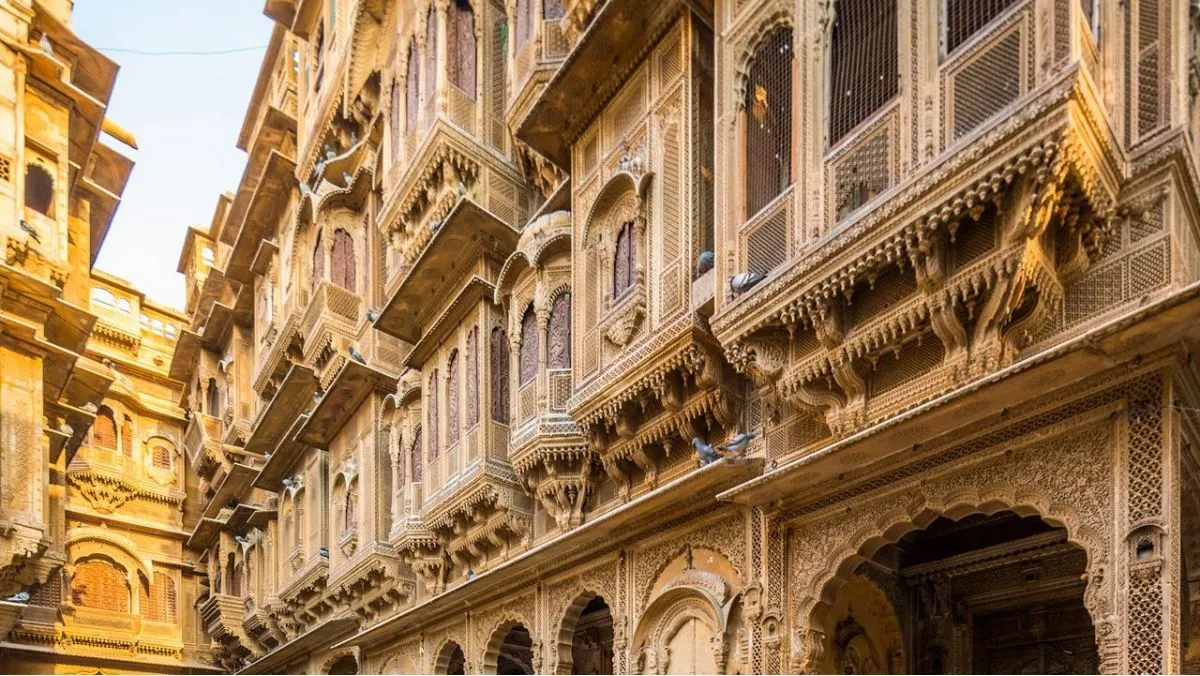

Jaisalmer is globally recognized for its honey-colored ramparts and vast desert expanses, yet its true architectural brilliance is captured in a narrow paved lane within the old settlement. Here stands Patwon Ki Haveli, a monumental cluster of five individual mansions constructed between 1805 and 1860 by the wealthy trader Guman Chand Patwa for his five sons. Rather than being commissioned by royalty or defense strategists, this grand urban structure emerged entirely from private mercantile enterprise. It represents the pinnacle of Thar Desert craftsmanship, reflecting a vibrant era when Jaisalmer functioned as an indispensable trading pivot along the Silk Route connecting India with Persia, Central Asia, and Africa.
A Masterpiece of Sandstone and Climate Engineering
The architectural distinction of the complex relies on indigenous yellow sandstone, quarried locally and assembled using traditional dry-masonry methods without structural mortar. Over sixty individual jharokhas, or overhanging enclosed balconies, adorn the five facades facing the central lane. These elements are far more than ornamental displays. In Rajasthan’s arid environment, where peak summer temperatures routinely exceed 45 degrees Celsius, the geometric stone screens, known as jali work, operate on Bernoulli’s principle. As ambient wind funnels through these perforated apertures, its velocity increases, triggering evaporative cooling that lowers interior ambient temperatures by several degrees.
The layout incorporates deep central courtyards, narrow vertical light wells, and multi-layered lintels that shade adjacent interiors throughout the day. Ground-level spaces historically served as administrative rooms and secure vaults for bullion, while private residential chambers were elevated to catch evening cross-breezes. Walking through these multi-tiered rooms reveals distinct decorative movements: gold-leaf ceilings, mirror work reminiscent of Persian palace styles, and detailed wall murals depicting caravan journeys across treacherous dune corridors.
The Historic Pivot of Silk Road Commerce
Unlike the defense-oriented Jaisalmer Fort, Patwon Ki Haveli symbolizes mercantile opulence. The Patwa family operated extensive brokerage networks dealing in brocades, silver and gold embroidery, precious gems, and opium. Their fortunes mirrored the flourishing overland desert caravan tracks. The haveli interiors reflect this cosmopolitan lifestyle through imported glass mirrors from Belgium, painted ceilings showing early interactions with the British East India Company, and intricate wooden storage chests designed for valuable commodities.
When maritime ports such as Bombay expanded during the late nineteenth century, overland desert trade routes gradually subsided. The preservation of Patwon Ki Haveli—now partly managed by the Archaeological Survey of India (ASI) and partly retained as a private museum—ensured that Jaisalmer's socio-economic identity remained intact. It provides tangible evidence that Jaisalmer was not an isolated desert enclave, but a bustling commercial hub driven by finance, craftsmanship, and international trade.
Curating Your Cultural Itinerary in the Thar
Experiencing the heritage of Jaisalmer requires balancing quiet architectural appreciation with the expansive landscape of the Thar. Navigating the narrow alleys around the haveli is best undertaken during early morning hours or late afternoon, when sunlight illuminates the yellow sandstone without the midday heat.
To gain a complete perspective of the region's heritage, travelers frequently combine city architecture tours with a peaceful desert retreat. After spending the day studying historical stonework in town, settling into a luxury camp in Jaisalmer allows you to experience the natural beauty of the Sam dunes under open desert skies. Authentic local cuisine, traditional folk performances, and quiet starry nights create a restorative contrast to bustling heritage lanes.
For visitors interested in active desert exploration, scheduling high-energy pursuits like camel trekking, dune bashing, and quad biking offers another dimension to the Thar. Choosing curated Jaisalmer adventure activites lets you encounter the rugged terrain that desert traders historically navigated with camel caravans centuries ago.
Preserving the Living Legacy
Patwon Ki Haveli remains the definitive architectural symbol of Jaisalmer because it unites functional vernacular engineering with unparalleled artistic ambition. It stands as a monument to human persistence, where artisans turned hard sandstone into delicate, lace-like screens capable of defying harsh arid conditions. Visiting the haveli provides essential cultural context, deepening your understanding of the desert landscape before you venture out across the golden sands of western Rajasthan.



























Sign in to leave a comment.