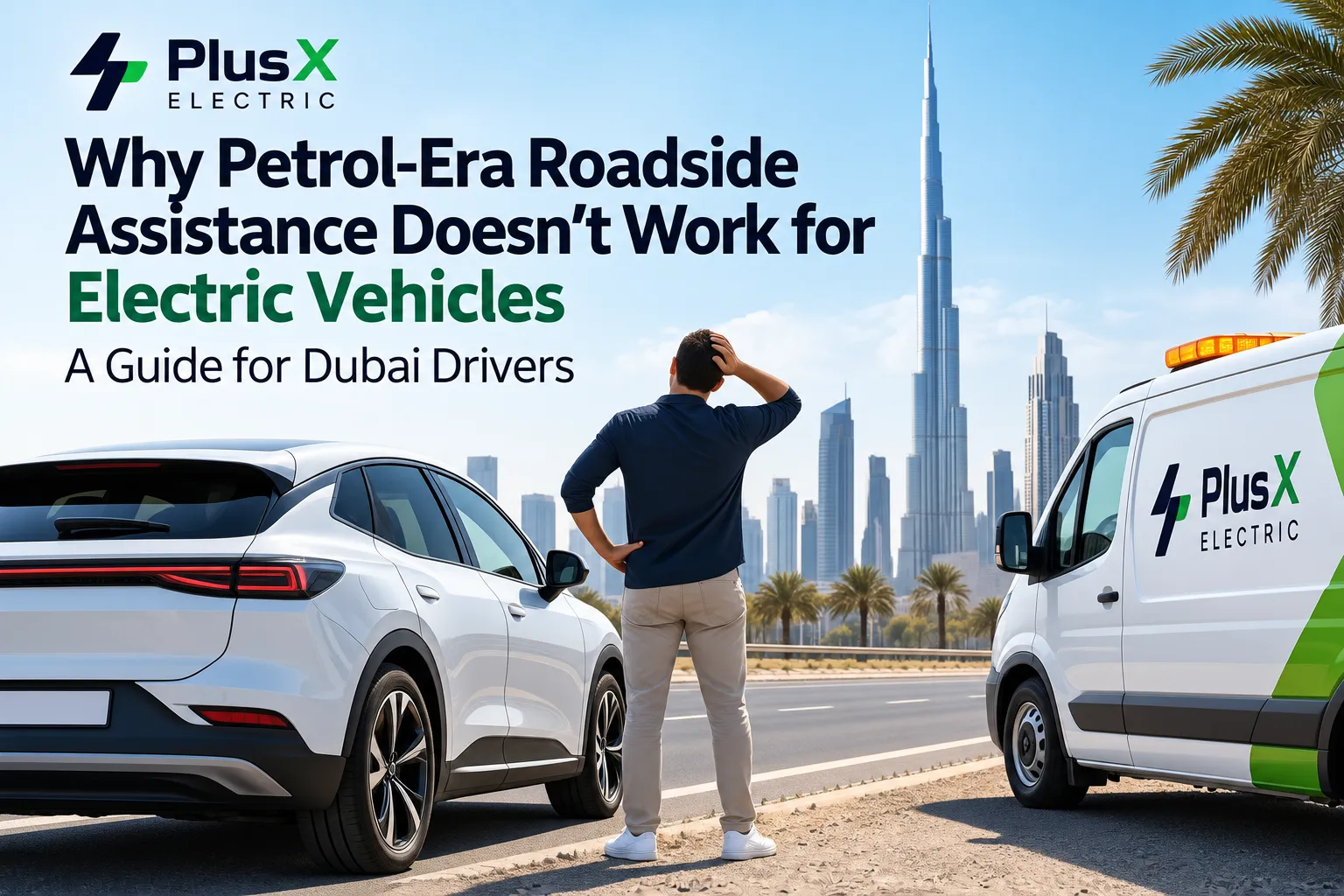

Every EV owner eventually thinks about it: the car slows, the dashboard lights up with warnings, and you roll to a stop on the side of a Dubai road with the midday sun overhead. Most drivers do what they've always done and call roadside assistance.
That's often where things get complicated.
Traditional roadside assistance was designed around petrol and diesel cars. Its tools, training and trucks are built for engines that overheat, fuel tanks that run dry and lead-acid batteries that need a jump. Electric vehicles fail in different ways, and understanding those differences is the best preparation any EV driver can have.
How EVs Actually Break Down
EV breakdowns look very different from petrol breakdowns. Here are the situations Dubai EV drivers most commonly face.
Complete battery drain. This is the EV version of running out of fuel. In Dubai, it usually happens because air conditioning in summer heat uses more range than expected, a trip was longer than planned, or the charger the driver was counting on was busy or out of service. Unlike a petrol car, there's no jerry can option. The car needs electricity delivered to it or needs to be moved to a charger.
12V auxiliary battery failure. Every EV has a small 12V battery that powers the onboard computer, door locks, lights and start-up system. When it fails, the car won't switch on, even if the main battery pack is well charged. Many drivers assume their main battery has died, when the real problem is this much smaller one.
Software and sensor faults. Modern EVs are software-driven. A faulty sensor, a firmware issue or a communication error between modules can trigger reduced-power "limp mode," disable the drivetrain or show warnings that leave the driver unsure whether it's safe to continue.
Flat tyres with no spare. Many EVs don't carry a spare tyre, to save weight and space. A puncture that would be a ten-minute wheel change in an older car can mean a sealant kit or a flatbed.
Charging port and connector problems. Sometimes the car is fine but won't accept a charge. A stuck connector, a faulty port latch or a handshake error between car and charger can leave a driver unable to top up, even at a working station.
Each of these needs EV-specific knowledge and equipment, which is where the traditional model starts to struggle.
Where the Traditional Model Falls Short
Charging isn't part of the toolkit. A conventional roadside van carries fuel, jump leads and tyre tools. Most don't carry a way to put charge into an EV's main battery, so the default answer is a tow.
Towing EVs needs care. Many EVs shouldn't be towed with their drive wheels on the ground, because turning wheels spin the electric motors, which can generate current and risk drivetrain damage. Manufacturers generally recommend flatbed transport. Not every tow operator knows the correct procedure for every model, so it's worth checking your owner's manual for your car's towing guidance.
The 12V system is often misunderstood. A technician used to petrol cars may focus on the wrong battery, or may not know where the 12V battery sits in a particular model. Its location varies widely between manufacturers: under the bonnet, in the boot, beneath a seat or behind a panel.
Standard diagnostic tools can't see everything. A regular scanner can't always read the high-voltage battery management system or the motor controller. Without EV-capable diagnostics, identifying the fault involves more guesswork.
Time adds up. Put these together and an EV breakdown handled the traditional way can take several hours: the wrong truck arrives, a flatbed is called, the car goes to a workshop, and diagnosis only starts there. Many of these problems could have been solved on the spot by someone equipped for EVs.
What to Look For in EV Roadside Support
As EV adoption in Dubai grows, specialist EV roadside services have emerged. Whichever provider you choose, these are the capabilities worth checking for:
- Mobile charging, so a drained battery can be topped up where the car stopped instead of being towed.
- 12V jump-start capability, since this is one of the most common reasons an EV won't start.
- Technicians trained on EV systems, including high-voltage safety, thermal management and auxiliary electrics.
- Flatbed transport with correct EV loading procedures when towing can't be avoided.
- EV-capable diagnostic equipment that can read battery management and motor controller fault codes.
- Multi-brand coverage across the models on Dubai roads, from Tesla and BYD to Hyundai, Nissan, MG, BMW and others.
- Round-the-clock availability across the areas you drive most.
A Note on Manufacturer Roadside Cover
Most EV brands offer some form of roadside assistance, and it's worth knowing exactly what yours includes. Coverage, response times and on-site capabilities vary by brand and by market, and some programmes in the UAE work through centralised dispatch or third-party partners. Read the terms before you need them, and consider whether a local, EV-focused service would be a useful backup.
Why Summer Raises the Stakes
Dubai's summer increases almost every EV breakdown risk. Heavy air-conditioning use and battery cooling reduce available range, high road temperatures put more stress on tyres, and public chargers get busier just when drivers need them most. Drivers who went all winter without an issue can find themselves caught out in July or August, when general roadside services are also at their busiest.
Three Things Every Dubai EV Owner Can Do Today
Save an EV-capable roadside number in your phone. Choose a provider that can charge on the spot and handle 12V failures, such as PlusX Electric's EV roadside service in Dubai, and save the number before you need it rather than searching while stranded with low phone battery.
Get to know your 12V battery. Learn where it sits in your model, how 12V failure differs from main battery drain, and whether your car has a manual release for the charging port. A few minutes with the owner's manual can save hours at the roadside.
Plan for your EV as an EV. It needs different maintenance, different trip planning in summer and different emergency support than a petrol car. Drivers who accept this early tend to have a far smoother ownership experience.
Dubai is fast becoming one of the most EV-friendly cities in the region, and support infrastructure is growing with it. For now, the drivers who get through breakdowns with the least stress are the ones who prepared before anything went wrong.
























Sign in to leave a comment.