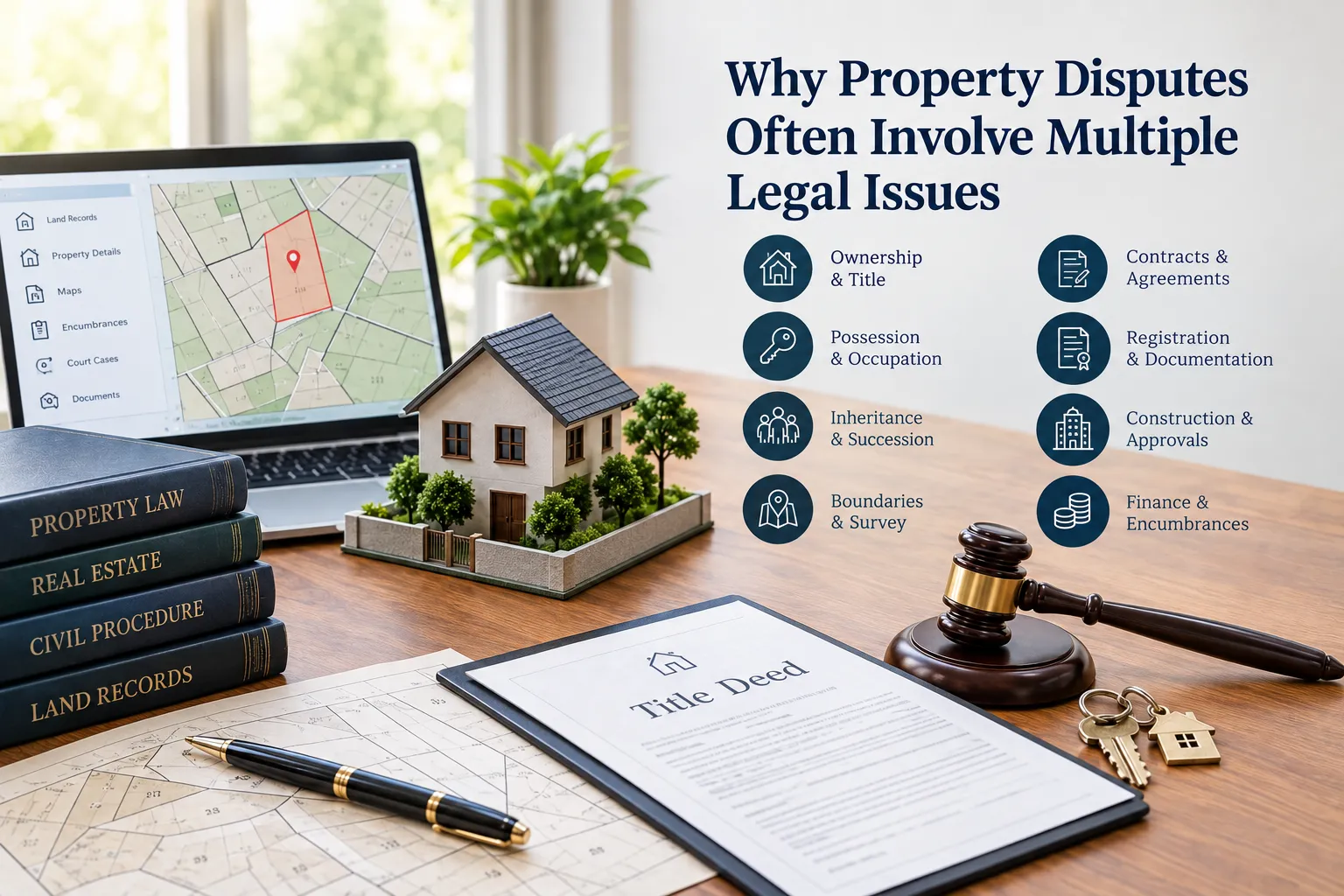

Property disputes are rarely limited to one simple question. A disagreement may begin with ownership but later involve possession, inheritance, contracts, boundaries, construction, registration or financial claims.
This is one reason property litigation can become complicated. Different legal rights may overlap in relation to the same property. A dispute between two parties may also involve documents, transactions and third party interests. Understanding these connected issues is important for property owners, buyers, businesses and investors. Identifying the full legal picture early can help parties assess their position and avoid overlooking an important part of the dispute.
Property Ownership Is Often the Starting Point
Ownership is one of the most common issues in property disputes. Two or more people may claim rights over the same property. One party may rely on a registered sale deed, while another may claim rights through inheritance, a previous transaction or a family arrangement.
The ownership question may require examination of the complete title history. A recent document alone may not provide the entire picture. Previous transfers, gifts, partitions, wills and other documents may need to be examined before the ownership position can be properly understood.
Possession Can Create a Separate Legal Issue
Ownership and possession are related, but they are not always the same issue. A person may claim ownership while another person is physically occupying the property. In other situations, a tenant, licensee or former owner may remain in possession after their legal right to occupy the property has ended.
This can lead to separate questions about who is entitled to possession and what legal remedy may be available. A property dispute can therefore involve both a title question and a possession question.
Inheritance Can Complicate Property Rights
Inherited property often involves several legal interests. When a property passes to multiple heirs, questions may arise regarding the respective rights of each person. A dispute may concern the validity of a will, the applicable succession law, the share of each heir or the division of the property.
Family arrangements and previous partitions may add further complexity. For this reason, inherited property should not be examined only through the latest revenue entry or possession status. The succession history and relevant legal documents may also need careful review.
Boundary Disputes May Overlap With Ownership Claims
A disagreement over the boundary of a property can quickly become an ownership dispute. For example, one owner may claim a neighbouring party has occupied part of the property. Before deciding whether an encroachment exists, the correct boundary may need to be established.
This can require examination of title deeds, survey records, cadastral maps and other evidence. A boundary issue may therefore involve questions of measurement, title, possession and encroachment at the same time.
Registration and Documentation Issues
Property transactions generally involve important documentation and registration requirements. Problems can arise when documents are incomplete, incorrectly described or inconsistent with earlier records.
A sale deed may contain a different property description from an earlier document. A survey number may have changed due to subdivision or administrative processes. A transaction may also require additional documentation depending on the circumstances. These issues can create uncertainty about the legal effect of a transaction and may become relevant during litigation.
Contractual Disputes Can Become Property Disputes
Not every property dispute begins with ownership. A dispute may arise from an agreement to sell, development agreement, lease, licence, construction contract or joint development arrangement.
One party may allege breach of contract while the other party claims ownership or possession rights. The dispute may then require examination of both property law and contract law. This is particularly common where property transactions involve several obligations, payment schedules and conditions.
Construction Can Add Another Layer
Construction related disputes can involve several legal questions. A property owner may allege unauthorised construction on their land. A neighbour may challenge construction because of an alleged encroachment. A purchaser may dispute whether the construction complied with approved plans.
There may also be questions involving local authorities, permissions, building regulations and contractual obligations. As a result, a dispute about a building may involve property rights as well as regulatory and contractual issues.
Financial Claims May Be Connected to Property
Property disputes can also involve money. A party may claim unpaid consideration under a sale agreement. A lender may have an interest in the property. Co owners may disagree over expenses, rental income or proceeds from a sale.
A mortgage or other financial arrangement can create additional rights over the property. The legal dispute may therefore require examination of both the property interest and the financial transaction connected with it.
The Role of Revenue Records
Revenue records can provide useful information about land and recorded interests. However, a revenue entry should not automatically be treated as conclusive proof of ownership. The legal significance of a particular record depends on the applicable law and the circumstances.
A dispute may require comparison of revenue records with registered documents, survey information and other evidence. This is one reason property litigation often requires examination of several categories of documents rather than a single record.
Property Disputes May Involve Third Parties
A dispute between two property owners can sometimes affect other people. A tenant may occupy the property. A lender may have a security interest. A purchaser may have entered into a transaction with one of the parties. A developer may have contractual rights under an agreement.
Third party interests can make the dispute more complicated. The court may need to consider how the rights of different parties interact before determining the appropriate relief.
Why Documentation Matters
Strong documentation can make it easier to understand the history of a property.
Important records may include:
- Sale and conveyance deeds
- Previous title documents
- Gift and partition deeds
- Wills and succession documents
- Lease agreements
- Development agreements
- Revenue records
- Survey maps
- Property tax records
- Registration records
- Construction approvals
- Court orders
- Relevant correspondence
Documents should be reviewed as a connected record rather than in isolation. A document may appear straightforward until it is compared with an earlier transaction or another record relating to the same property.
Multiple Legal Remedies May Be Relevant
The nature of the dispute determines the legal remedy available. Depending on the circumstances, a party may seek a declaration of rights, recovery of possession, an injunction, partition, specific performance or another form of relief.
Different claims can sometimes arise from the same set of facts. For example, a person may dispute ownership while also seeking protection against interference with possession. Another party may seek enforcement of a contractual obligation involving the same property. The appropriate legal approach depends on the facts, documents and applicable law.
Why Early Legal Assessment Is Useful
Property owners often focus on the most visible part of a dispute. A wall may appear to be the problem, while the underlying issue may actually concern title or possession. Similarly, a disagreement over a sale may involve questions about authority, payment, registration and contractual obligations.
A complete legal assessment can help identify these connected issues before a party takes a step which may affect its position. Where several legal questions arise together, civil lawyers for multiple legal issues can review the property documents, transactions and surrounding circumstances as a connected dispute.
Businesses May Face Additional Complications
Property disputes involving businesses can have wider consequences. A disputed commercial property may affect construction plans, leases, financing, business operations or a planned sale. A disagreement involving company owned property may also raise questions about authority and corporate approvals.
A development project may involve several parties, including landowners, developers, contractors, investors and lenders. Where a property dispute affects several commercial arrangements, corporate lawyers for complex legal matters may need to examine the business and contractual consequences alongside the underlying property issue.
Why Property Due Diligence Matters
Many property disputes can be traced to issues which were not identified before a transaction. Buyers should examine title history, ownership records, encumbrances, boundaries and relevant litigation before completing significant transactions.
Businesses should also consider how property rights interact with their contracts and commercial plans. Due diligence cannot eliminate every possible dispute. It can, however, reveal inconsistencies before they become expensive legal problems.
Technology Can Assist With Record Review
Digital land records and online court services can make property information easier to access. Digital maps may assist with boundary verification. Online case records can help identify previous litigation. Electronic document management can also make large collections of property records easier to organise.
However, technology does not replace legal verification. Digital records may contain errors or incomplete information. The legal significance of a record must still be assessed in context.
Why One Property Dispute Can Become Several Legal Questions
The main reason property disputes involve multiple legal issues is simple. Property rights do not exist in isolation. Ownership can be connected with possession. Possession can be connected with tenancy. A sale can be connected with a contract. A boundary can be connected with title. Construction can be connected with regulatory permissions.
When these interests overlap, resolving one question may not resolve the entire dispute.
A complete understanding of the legal and factual background is therefore essential.
Conclusion
Property disputes often become complicated because several legal rights can exist around the same property. A dispute which appears to concern ownership may also involve possession, inheritance, boundaries, contracts, registration, construction or financial interests. Third party rights can add another layer of complexity.
This is why property disputes should be assessed as a complete legal problem rather than through a single document or isolated event. Careful documentation, early due diligence and timely legal assessment can help identify connected issues before they become more difficult to resolve. For property owners and businesses, understanding the full legal picture can be just as important as identifying the immediate cause of the dispute.





























Sign in to leave a comment.