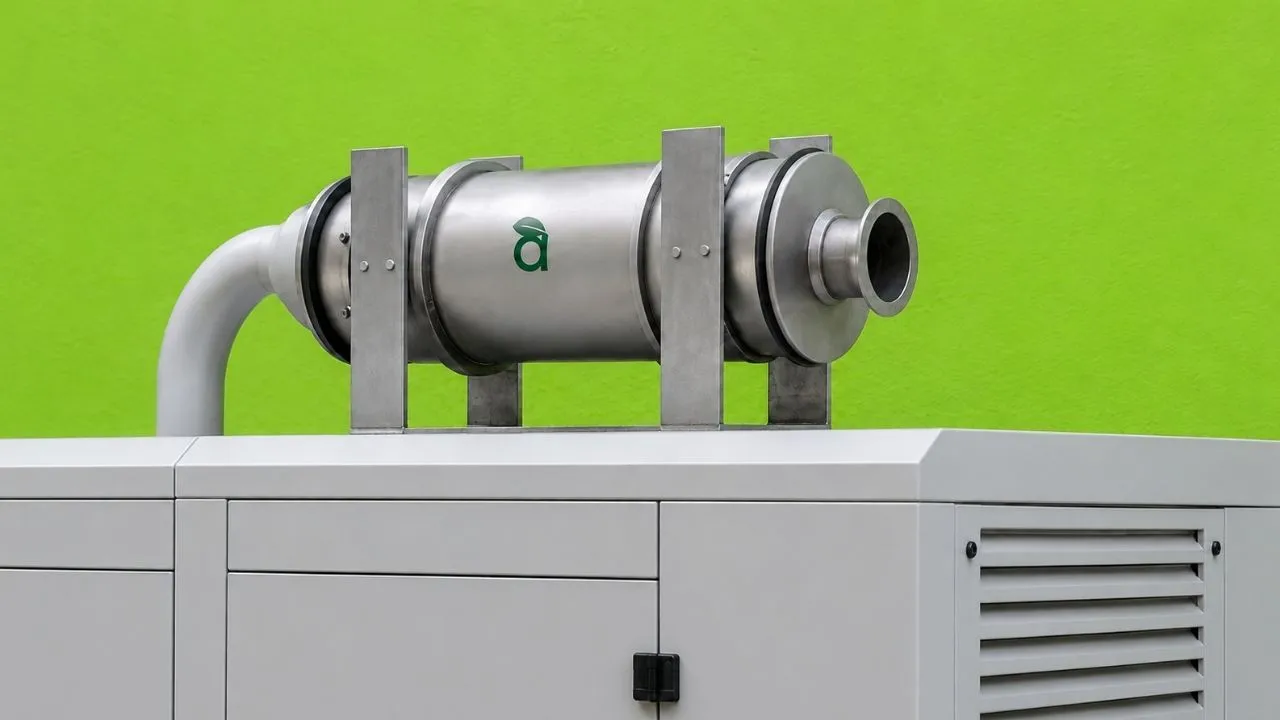

The question of whether RECD mandatory for DG sets India has become increasingly important for factories, commercial buildings, hospitals, institutions, data centres, and other facilities that depend on diesel generator sets for backup power. But the word “mandatory” should not be interpreted as a blanket rule covering every DG set in exactly the same way. Generator owners need to understand the CPCB framework, determine whether it applies to their equipment, and verify any additional requirements imposed by the relevant authorities.
The Central Pollution Control Board (CPCB) has a specific system and procedure for compliance using Retrofitted Emission Control Devices (RECDs) on in-use diesel-operated internal combustion engines used for generator-set applications up to 800 kW gross mechanical power. The stated objective is particulate matter reduction, and the procedure covers applicability, PM requirements, certification, testing equipment, and test procedures.

Why the RECD Requirement Matters
Diesel generators are valuable sources of standby electricity, particularly where uninterrupted power is important. At the same time, their combustion process produces particulate matter and other exhaust pollutants. For older or in-use DG sets, retrofitting an emission-control system can provide a practical way to reduce particulate emissions without replacing the entire generator.
CPCB's RECD framework was developed in connection with directions concerning emission reduction from in-use diesel generator engines. Rather than treating an RECD as an ordinary aftermarket accessory, the framework establishes technical requirements and a certification process for devices intended for applicable genset engines. This is why simply attaching an exhaust device to a DG set should not be considered sufficient. The device, engine application, testing, installation, and performance all need to be considered together.
Does “Mandatory” Mean Every DG Set Must Have an RECD?
This is the most important point for generator owners. There should not be a blanket assumption that every diesel generator in every part of India is automatically subject to one identical RECD installation requirement. CPCB has established the technical framework for applicable in-use DG-set engines, but actual obligations can also depend on applicable government notifications, State Pollution Control Board or Pollution Control Committee directions, environmental permissions, and location-specific conditions.
Therefore, a facility manager should not decide solely on the basis of a website article, supplier advertisement, or an old compliance message. The current requirements relevant to the particular generator and location should be verified directly from official sources. CPCB itself maintains dedicated generator-set resources and publishes regulatory material and updates through its official website. The Board's website currently provides sections for generator-set notifications and guidelines, while its broader regulatory pages are updated as new material is issued.
Understanding the CPCB Scope
The published RECD procedure specifically covers in-use diesel-operated internal combustion engines up to 800 kW gross mechanical power for generator-set applications. This technical threshold is important because generator owners often identify their machines only through kVA ratings.
For example, a company may describe its backup generator as a 500 kVA DG set. That information alone does not establish the engine's gross mechanical power. The owner should also obtain the engine manufacturer's documentation, engine model, rated speed, and other relevant technical details before determining the appropriate RECD application. CPCB's technical framework is therefore better understood through the actual engine rather than the marketing description of the generator.
Certification Is Central to RECD Compliance
An emission-control device should not be purchased simply because a seller describes it as “CPCB approved.” CPCB publishes a list of manufacturers certified for RECDs applicable to diesel genset engines up to 800 kW for specified capacity ranges and phases. The published list dated 09 May 2025 identifies manufacturers, applicable in-use engine power ranges, Phase I or Phase II applicability, and certification agencies.
This illustrates an important principle: certification is connected with a particular product and application. A supplier's general statement about certification is not a substitute for product-specific documentation. Before placing an order, a generator owner should ask for the exact RECD model, certification details, applicable engine range, and relevant testing documentation. The documentation should be compared with the actual engine installed at the site.
The Engine and RECD Must Be Matched Correctly
One of the biggest compliance mistakes is assuming that a certified RECD can be fitted to any generator within a similar kVA category. The appropriate device can depend on engine characteristics, mechanical power, application range, and other technical parameters. CPCB's framework includes certification and testing provisions designed around the RECD and its intended application.
Consider a manufacturing plant operating several DG sets from different engine manufacturers. Two generators may both be rated around 500 kVA, yet their engine models and technical characteristics may differ. Treating them as interchangeable for RECD selection can create technical and documentation problems. A proper engineering review should therefore begin with the engine data plate and manufacturer records.
What About the Compliance Timeline?
Another frequently misunderstood issue is the “RECD deadline.” Generator owners often encounter claims that all DG sets must be fitted with RECDs by a particular date. Such statements need to be checked against the exact notification, order, regional requirement, or regulatory direction from which the deadline supposedly originates.
There is no justification for treating an old or general deadline mentioned online as automatically applicable to every generator in India. Regulatory requirements can evolve, and location-specific measures may introduce additional obligations. CPCB's current website provides regulatory notices, directions, and generator-related resources, so owners should verify the latest official information before making a compliance decision.
Installation Is More Than Fitting a Device
Even when an RECD is appropriate for the engine, the project does not end with purchasing the equipment. The exhaust configuration needs to be evaluated before installation. The supplier or technical team should consider the available mounting space, exhaust-pipe dimensions, routing, supporting structure, sensor arrangement, controller location, maintenance access, and exhaust back pressure.
CPCB's RECD procedure includes technical requirements relating to testing and exhaust back pressure, which reinforces the importance of treating retrofit installation as an engineering activity rather than a simple replacement of an exhaust component. A proper installation plan can also reduce the risk of repeated modifications after commissioning.
Why the Choice of Supplier Matters
Choosing a reliable RECD supplier for DG sets is an important part of the compliance process. A capable supplier should be able to explain exactly which RECD model is proposed, the engine application for which it is intended, and the certification or testing documents supporting the product. The commercial quotation should also make the project scope clear. Controller systems, sensors, exhaust modifications, installation, commissioning, training, maintenance, and future service may or may not be included in the basic equipment price.
A low-cost quotation is not necessarily the lowest-cost solution if important installation or service components are excluded. For critical facilities, after-sales support is particularly valuable because an RECD becomes part of the generator's operating environment and requires appropriate inspection and maintenance.
Maintenance Supports Long-Term Compliance
Installing an RECD should be treated as the beginning of an operating programme rather than the final compliance step.
The facility team should understand the maintenance requirements of the selected system, including inspection, monitoring, fault identification, servicing, and component replacement as specified by the equipment manufacturer. Records of installation, commissioning, servicing, and technical documentation should also be retained. This becomes especially useful when the facility has multiple generators or when different teams are responsible for operations and environmental compliance.
A Practical Compliance Approach for DG Owners
For a generator owner reviewing RECD requirements in 2026, the safest strategy is to start with documented facts. Identify the exact engine manufacturer, model, gross mechanical power, rated speed, generator rating, and existing exhaust arrangement. Then review the latest CPCB RECD procedure and current generator-set regulatory information. CPCB's official website remains the appropriate source for current Board-issued requirements and updates.
The next step is to obtain product-specific information from potential suppliers and verify that the proposed RECD corresponds to the engine application. Certification claims should be checked against official CPCB material wherever applicable. Finally, the facility should confirm whether its State Pollution Control Board, Pollution Control Committee, consent conditions, local environmental directions, or sector-specific requirements impose additional obligations.
Conclusion
The increasing focus on diesel-generator emissions has made RECD a significant consideration for owners of in-use DG sets in India. CPCB has established a defined technical framework for retrofitted emission-control devices intended for applicable diesel genset engines up to 800 kW gross mechanical power, including provisions related to particulate reduction, certification, and testing. For generator owners, the best approach is straightforward: verify the engine, confirm the applicable requirement, select a properly documented RECD, use technically competent installation services, and retain the complete compliance record. Most importantly, regulatory information can change. CPCB's official website and the applicable State or UT pollution-control authority should be checked for the latest requirements before purchasing or installing an RECD.
Frequently Asked Questions
Is RECD mandatory for every DG set in India?
Not necessarily under one universal rule. Applicability depends on the relevant CPCB framework and any applicable government, State/UT, local, consent, or site-specific requirements.
What DG sets are covered by the CPCB RECD procedure?
The published CPCB procedure covers in-use diesel-operated internal combustion engines for generator-set applications up to 800 kW gross mechanical power.
Can an RECD be selected only according to generator kVA?
No. Engine-specific information such as gross mechanical power, engine model, and applicable technical range should also be evaluated before selecting the device.
How can I verify a supplier's CPCB RECD claim?
Ask for the exact RECD model and relevant certification or testing documents, then compare the documented application with the engine installed at your facility. CPCB also publishes information on certified RECD manufacturers and their applicable capacity ranges.
Is there one nationwide deadline for RECD installation?
Generator owners should not assume that one deadline applies to every DG set across India. Any deadline should be verified against the current official notification or direction applicable to the specific generator and location.























Sign in to leave a comment.