Why Should Machinery Firms Hire AI Engineers for Computer Vision Applications?


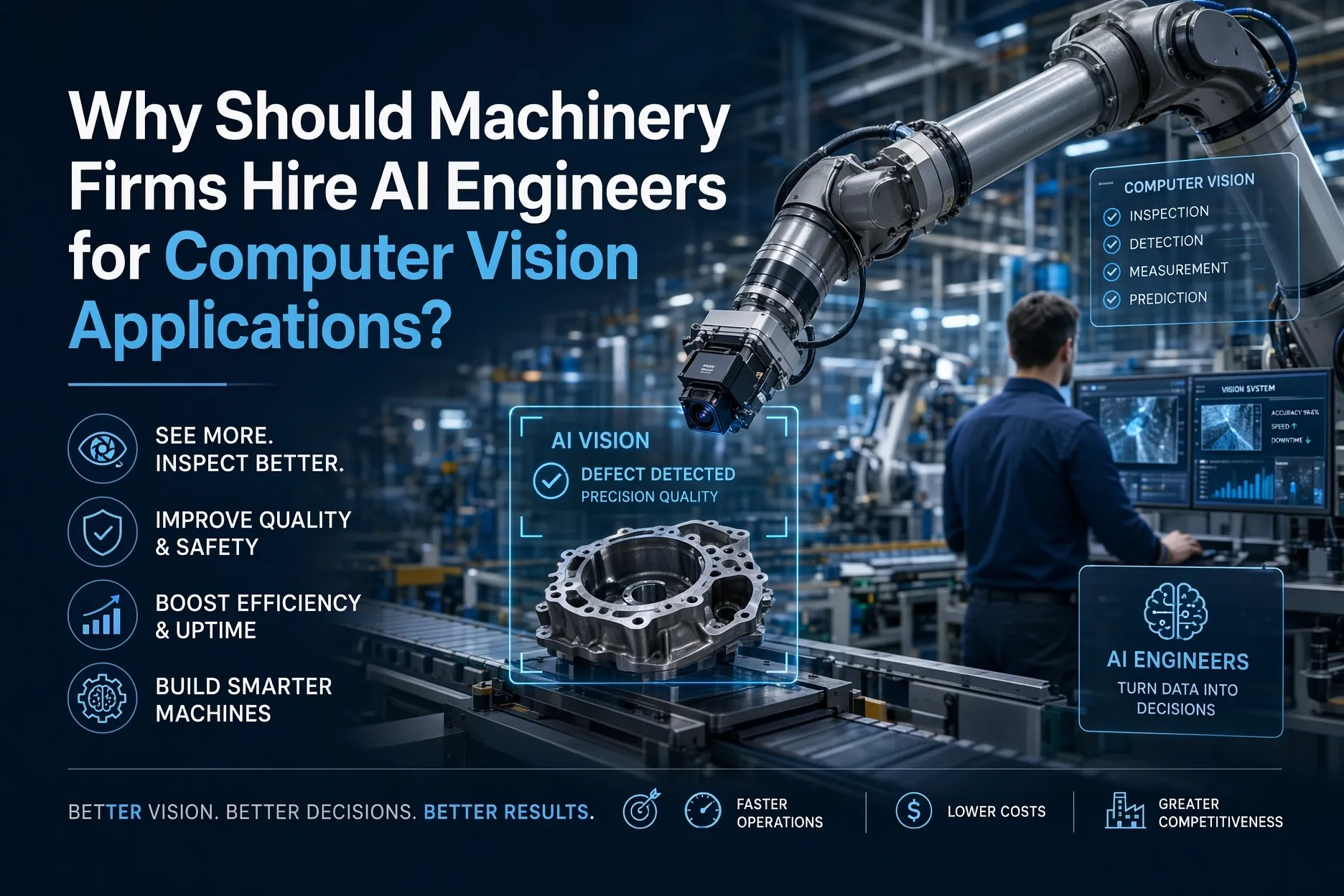
Machinery firms should hire AI engineers for computer vision because packaged vision tools rarely fit the parts, lighting, and tolerances of a specific production line. An AI engineer trains models on your own images, connects them to PLCs and machine controllers, and keeps accuracy steady as products change. The payoff is fewer escaped defects, less manual inspection, and vision features you can build into the machines you sell.
Walk through most machine shops and you will still find people checking welds, castings, and assemblies by eye at the end of a shift. Cameras are now cheap. The hard part is the model behind the camera and the code that ties it to the line. That is a software skill, and it is why so many manufacturers now look to hire AI developers rather than buy another boxed inspection system.
What Does Computer Vision Do for Machinery Firms?
Computer vision lets a machine see a part, judge it, and act on it in milliseconds. For machinery makers, the most common uses are:
- Surface defect detection: spotting porosity in castings, cracks in welds, burrs on machined edges, and paint flaws on housings.
- Assembly verification: confirming that every bolt, gasket, and connector is present and facing the right way before a unit ships.
- Non-contact measurement: checking bore diameters, hole positions, and gaps without slowing the line for a gauge.
- Vision-guided robots: bin picking of mixed parts and seam tracking for robotic welding.
- Visual wear monitoring: watching tool wear, belt fraying, or oil leaks so maintenance happens before a breakdown.
- Traceability: reading serial plates, laser marks, and data matrix codes on every component.
- Vision inside the product: obstacle detection on construction equipment, crop and weed recognition on farm machinery, and operator-presence checks on presses.
That last point matters. Many machinery firms are no longer only users of vision. They are sellers of machines that need vision built in, and that changes who should own the code.
Why Hire AI Engineers Instead of Buying a Packaged Vision System?
Packaged smart cameras work well for simple, stable checks such as barcode reading or presence detection. The gaps show up when the job gets specific to your plant.
Your defects are not in any public dataset
A hairline crack in a gray-iron pump housing looks nothing like the sample images a vendor trained on. AI engineers build models from your own images, often starting with very few defect examples by using anomaly detection, which learns what a good part looks like and flags anything that differs.
The model has to talk to your machines
A vision result is useless if the reject gate never fires. AI engineers who know industrial systems wire the model output into PLCs, robot controllers, and MES software, and they keep inference fast enough to match the cycle time of the line.
Accuracy drifts on a real shop floor
Lighting changes with the seasons, suppliers change materials, and new product variants arrive. A model that scored 98% at launch can slip within months. Someone needs to watch the numbers, collect new samples, and retrain. That is ongoing engineering work, not a one-time install.
You keep the IP when vision goes into your product
If vision is a feature of the machines you sell, a licensed black box limits what you can change and adds a cost to every unit. An engineering team, in-house or dedicated, builds code your firm owns.
Computer Vision Trends Machinery Firms Should Watch in 2026
The money is moving from cameras to software. The October 2026 machine vision market report from Global Market Insights puts the market at USD 14.4 billion in 2026, growing to USD 27.3 billion by 2035. Software is the faster-growing piece, at a projected 10.17% a year, and the analysts expect the ability to deploy, train, and maintain vision applications to matter more than hardware gains. The same report lists retraining and recalibration in high-mix production as a key barrier. Both points describe engineering work.
Four trends stand out for machinery firms:
- Edge inference on the machine. Models now run on compact AI controllers next to the camera, so results arrive in milliseconds without a cloud round trip.
- Synthetic training data. Generative models create realistic images of rare defects, which cuts the months spent waiting for enough bad parts to appear.
- Vision-guided robotics. GMI projects robotics vision applications to grow at 10.76% a year, the fastest of any application, as bin picking and seam tracking spread to smaller batches.
- Vision-language models. Operators can ask plain questions such as "why was this part rejected?" and get an answer tied to the image, which shortens training for new staff.
What Skills Should You Look for When You Hire AI Engineers?
A strong computer vision engineer for industrial work combines model skills with factory sense. Check for these:
- Model building: hands-on work with PyTorch, OpenCV, object detection, segmentation, and anomaly detection.
- Small-data methods: transfer learning and augmentation for lines where defects are rare.
- Edge deployment: experience shrinking models with ONNX or TensorRT and running them on embedded GPUs.
- Industrial integration: familiarity with OPC UA, Modbus, PLC handshakes, and MES data flows.
- Optics and lighting basics: knowing when a problem needs a better light angle, not a bigger model.
- MLOps: versioned datasets, monitoring, and a clear retraining routine.
In interviews, ask candidates how they balance false rejects against escaped defects. A good answer talks about the cost of each on your line, not just accuracy scores. Ask for one project that ran on a real production floor for at least six months.
In-House Team, Dedicated AI Developers, or Generative AI Developers?
The right hiring model depends on how much vision work you have and how fast you need results.
| Option | Best for | Time to start | Main trade-off |
| In-house AI engineers | Firms with vision in several product lines and a long roadmap | 3 to 6 months to recruit | High fixed cost and a thin talent pool in industrial towns |
| Dedicated AI developers | A pilot or a single product line that needs full-time focus | 1 to 3 weeks | Needs clear goals and a named owner on your side |
| Generative AI developers | Synthetic defect data, operator assistants, inspection reports | 1 to 3 weeks | Adds value on top of core vision skills, not in place of them |
Many machinery firms start by choosing to hire dedicated AI developers for a pilot, then keep one or two engineers in-house once the use case proves itself. If you are comparing engagement models, rates, and screening steps, this guide on how to hire AI developers for industrial projects is a useful reference. It is also worth adding a generative AI developer when rare defects slow down data collection.
How to Start a Computer Vision Project in 5 Steps
- Pick one costly checkpoint. Choose the inspection point with the highest scrap, rework, or warranty cost. One line, one defect family.
- Collect real images first. Capture two to four weeks of images under actual shift lighting, including the parts your inspectors reject.
- Set business metrics up front. Agree on the escape rate, false reject rate, and maximum inference time per part before any model is built.
- Pilot at the edge. Run the model beside human inspectors for a few weeks and compare results before it controls the reject gate.
- Plan ownership and retraining. Decide who reviews flagged images, how often the model is retrained, and who handles new product variants.
Frequently Asked Questions
Why should machinery companies hire AI engineers for computer vision?
Because off-the-shelf vision systems are trained on generic images, while machinery defects are specific to each plant. AI engineers build models on your own data, connect them to PLCs and controllers, and retrain them as materials and products change.
2. How many images does a defect detection model need?
It depends on the method. Anomaly detection can start with a few hundred images of good parts. Classifying several defect types usually needs a few hundred labeled examples of each, which synthetic data can help supply.
3. Should I hire dedicated AI developers or build an in-house team?
Hire dedicated AI developers when you need a pilot running within weeks or have one product line to cover. Build in-house when vision is part of several products and you expect years of ongoing work.
4. When should a machinery firm hire generative AI developers?
When real defect samples are too rare to train on, or when you want operator assistants and auto-written inspection reports. Generative AI developers work best alongside computer vision engineers, not as a replacement.
5. How long does a computer vision pilot take in manufacturing?
Most single-line pilots take 8 to 16 weeks, covering image collection, model training, edge deployment, and a side-by-side trial with human inspectors.
Final Thoughts
Computer vision in machinery is no longer a camera purchase. It is a software project that has to fit your parts, your controllers, and your production pace, and keep working as all three change. That is why the firms getting real results choose to hire AI engineers who understand both models and machines.
Start small, measure what a missed defect costs you, and pick the hiring model that matches your roadmap. For teams that want to begin with a dedicated engineer or a small pod, you can find options to hire AI engineers with computer vision and generative AI experience, which can be a practical way to test a pilot before you commit to a full in-house team.





Sign in to leave a comment.