
AI has quickly moved from an experimental technology to a serious business priority. Companies are exploring copilots, AI agents, intelligent automation, predictive analytics, and dozens of other use cases. But as these projects move beyond pilots, many organizations are running into a problem that has very little to do with the AI models themselves: their data simply is not ready.
Most established businesses have accumulated years of information across ERP systems, CRM platforms, cloud applications, data warehouses, departmental databases, spreadsheets, and legacy applications. That worked reasonably well when analytics mostly meant generating reports or building dashboards. AI demands much more. It needs reliable access to current, connected, well-governed information, often across several business systems at once.
This is why the enterprise AI conversation is gradually becoming a data modernization conversation.
AI Is Exposing Problems That Have Existed for Years
Data fragmentation is hardly a new problem. IT teams have been dealing with it for decades, but businesses have usually found ways to work around it. Finance teams reconcile information manually, analysts combine datasets before creating reports, and employees often know which system contains the most reliable version of a particular piece of information.
AI does not have that organizational knowledge unless the underlying systems and data provide it.
Consider a relatively simple request from a business leader: “Which customers are at the greatest risk of leaving, and what should we do about it?” Answering that properly could require customer information from a CRM, support history from a service platform, billing data from an ERP system, product usage information, contract details, and possibly previous customer communications.
When those datasets are disconnected, duplicated, outdated, or defined differently across departments, AI can produce an answer that sounds convincing without necessarily providing the complete business picture. That is where trust quickly becomes an issue.
The challenge, therefore, is not simply giving AI access to more data. Organizations need to make sure the data being accessed is accurate, relevant, properly governed, and understandable in the context of the business.
The Traditional Data Stack Is Starting to Show Its Age
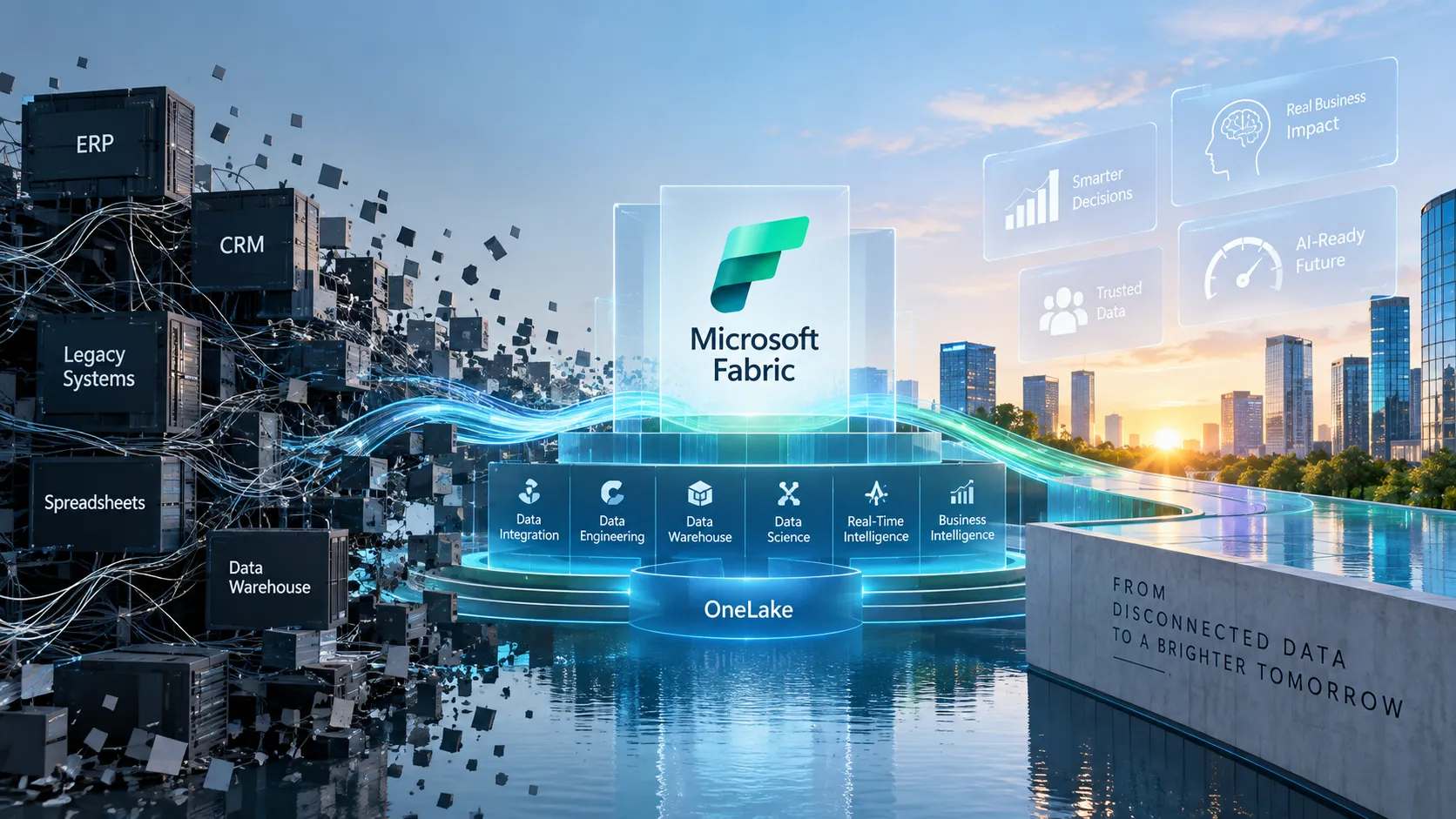
Many enterprise data environments were never designed as one coherent architecture. They grew gradually as new business requirements emerged. A company might use one platform for ingestion, another for transformation, a data warehouse for reporting, a data lake for large datasets, separate business intelligence tools, and additional technologies for machine learning and governance.
Individually, those systems may continue to work perfectly well. The complexity appears when information needs to move between them.
Every additional integration creates something else to maintain. Multiple copies of the same data can appear across different platforms, costs become harder to track, governance becomes more complicated, and teams can spend significant time moving and preparing information before anyone can actually use it.
AI makes those weaknesses much more visible because the expectation has changed. Business users increasingly want information and insights in near real time rather than waiting for another reporting cycle.
That is forcing organizations to think beyond where their data is stored and consider whether the overall architecture is suitable for the way data will be consumed over the next several years.
Why Microsoft Fabric Is Getting Enterprise Attention
This changing environment is one reason Microsoft Fabric has attracted interest from organizations looking to modernize their analytics and data estates.
Rather than treating data integration, engineering, warehousing, data science, real-time intelligence, and business intelligence as completely separate environments, Microsoft Fabric brings these capabilities together within a unified SaaS-based platform. OneLake, its unified logical data lake, is intended to provide a common data foundation across Fabric workloads.
For organizations already heavily invested in Microsoft technologies, that can be particularly interesting. Many businesses already use Azure, Microsoft 365, Power BI, Dynamics 365, or other parts of the Microsoft ecosystem, so the discussion around Fabric is often less about introducing another isolated technology and more about simplifying how existing information is managed and consumed.
However, adopting Fabric should not automatically mean moving everything into a new environment. The more important question is what business and technical problems the organization is actually trying to solve.
Modernization Is More Than Moving Data
One of the easiest mistakes to make with any new data platform is to treat modernization as a migration project. If an organization simply moves existing datasets and processes into a newer environment without reviewing how they are structured, governed, and used, many of the old problems will follow.
A better starting point is the business use case.
An organization may want to improve demand forecasting, give executives faster visibility into operations, create a more complete customer view, introduce AI-assisted support, or allow employees to interact with enterprise knowledge using natural language. Each of those objectives places different requirements on the underlying data.
Once the business priorities are clear, teams can determine which datasets matter, where they currently reside, how reliable they are, what integrations are required, and which governance controls need to be applied.
This approach also helps prevent modernization programs from becoming unnecessarily large. Not every legacy workload needs to be migrated immediately, and not every dataset needs to become part of an AI initiative.
What Should Organizations Assess Before Moving?
Before making a significant data platform decision, businesses should understand the current state of their environment. That assessment should go beyond creating an inventory of databases and applications.
| Area | What organizations should understand |
|---|---|
| Data quality | Whether critical information is accurate, complete, consistent, and current |
| Integration | How easily information can move between important business systems |
| Duplication | Where multiple copies or competing versions of the same data exist |
| Governance | Who owns important datasets and how access is controlled |
| Security | Whether sensitive and regulated information is appropriately protected |
| Reporting | Where analysts still depend heavily on manual preparation or reconciliation |
| Architecture | Whether existing platforms can support future analytics and AI workloads |
| Cost | Where overlapping technologies, storage, or processing are creating unnecessary expense |
This assessment often reveals that the biggest opportunities are not necessarily where organizations expected them to be. A relatively small integration or governance issue can sometimes have a much greater impact on analytics and AI readiness than a large infrastructure migration.
AI Makes Data Governance More Important, Not Less
There is an understandable push to make enterprise information easier to access. Employees want faster answers, analysts want fewer barriers between datasets, and AI applications need broader organizational context to become genuinely useful.
At the same time, easier access cannot mean unrestricted access.
Businesses still need to understand who owns data, how it is classified, where sensitive information resides, who should be allowed to use it, and how information moves between systems. Data lineage also becomes increasingly important when AI-generated answers or automated decisions need to be traced back to their underlying sources.
These questions become particularly important in industries dealing with financial, healthcare, customer, employee, or other sensitive information. Governance cannot simply be added once an AI project reaches production. It needs to be considered as part of the underlying data architecture.
Start With a Business Problem, Not a Platform
There is often pressure to modernize everything at once, especially when a new technology gains momentum. In practice, a phased approach usually makes more sense.
Organizations can begin with a current-state assessment, identify one or two high-value business problems, and determine which data those use cases require. A focused pilot can then test the proposed architecture, integrations, security controls, performance, and cost before the approach is expanded.
This is also where experienced technology partners can add value. Companies such as Synoptek work with organizations across data, cloud, AI, and broader technology modernization initiatives, helping businesses assess existing environments and determine how platforms such as Microsoft Fabric fit into their longer-term architecture.
The important point is that the platform should follow the business requirement rather than the other way around. Microsoft Fabric may be a strong fit for certain environments, while others may require a hybrid approach that retains parts of the existing data estate.
Data Modernization Is Becoming an AI Strategy
The most interesting part of the current AI cycle is that it is forcing businesses to address technology issues they may have postponed for years.
An organization can experiment with an AI assistant relatively quickly. Building an AI capability that employees and customers can rely on every day is considerably harder. It requires good data, sensible architecture, appropriate security, consistent governance, and integration with the systems where actual business processes take place.
That work may receive less attention than the latest AI model or agent, but it is increasingly what separates an interesting demonstration from a useful enterprise capability.
As AI becomes embedded in more business processes, companies with modern, connected, and well-governed data environments will have far more flexibility to adopt new technologies without rebuilding their foundations every time something changes.
For many enterprises, that means the next important step in their AI strategy may not begin with AI at all. It may begin with finally getting their data environment ready for what comes next.






















Sign in to leave a comment.