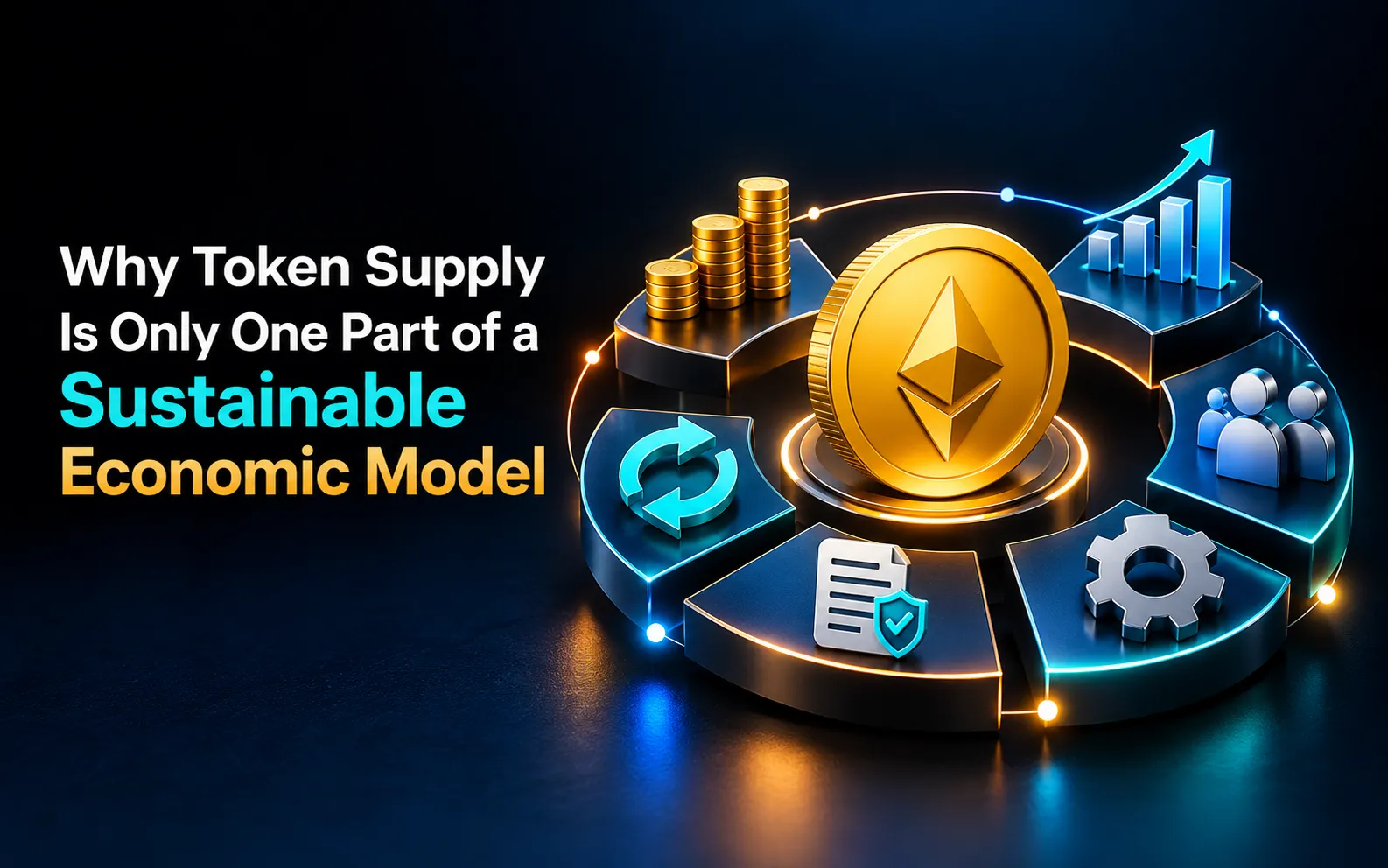

A crypto token can have a fixed supply and a well-planned distribution schedule without supporting a sustainable business. These features influence scarcity and circulation, but they do not explain why users will acquire the token, what drives demand, or how the project will fund future growth.
For Web3 founders, sustainable tokenomics requires a balance between supply, utility, incentives, distribution, and governance. Each element must support the project's business objectives and encourage meaningful participation over time.
Why Token Supply Alone Cannot Guarantee Value
Token supply is one of the first decisions founders make when designing a cryptocurrency. They define the maximum supply, initial circulation, and allocation for investors, team members, community participants, and ecosystem development.
These decisions influence ownership and potential selling pressure. Yet a limited supply does not automatically create demand. A token with a maximum supply of 10 million units may still struggle if users have no practical reason to acquire or hold it.
Bitcoin illustrates this distinction. Its protocol limits total issuance to 21 million BTC, but its market value also depends on adoption, liquidity, network security, and user confidence. Scarcity is one part of its economic model, not the entire explanation for demand.
The same principle applies to business-focused crypto tokens. A supply cap may support a scarcity-based model, but the project still needs a useful product, a clear purpose, and an active user base.
How Token Utility Creates Sustainable Demand
Token utility gives users a reason to acquire or use a digital asset. Depending on the project, a token may support payments, service access, governance, staking, rewards, or digital ownership.
Consider a Web3 platform that uses its token to provide access to premium features. If those features solve a genuine customer need, demand may grow alongside product adoption. If the token offers no clear advantage over existing payment methods, users may have little reason to use it.
Staking rewards also require careful planning. They can encourage participation and help secure a network, but rewards funded mainly through new token issuance may dilute existing holders. If new supply grows faster than demand, the project may face persistent selling pressure.
Founders should connect token functions to measurable user needs. A strong utility model explains who needs the token, why they need it, and whether that demand can continue when promotional rewards decline.
Why Token Distribution Matters
A token's allocation can affect market stability as much as its maximum supply. Concentrated ownership may give a small group substantial influence over governance and create selling pressure when large allocations become available.
Vesting schedules help manage this risk by releasing tokens over a defined period. Cliff periods delay initial releases, while gradual vesting spreads distributions over time. These measures improve predictability, although they cannot prevent holders from selling after receiving their tokens.
Uniswap's UNI launch in September 2020 provides a useful example. Its initial allocation reserved 60% of the genesis supply for community members, with separate allocations for the team, investors, and ecosystem initiatives. Team and investor allocations followed four-year vesting schedules.
The token entered an existing decentralized exchange ecosystem with established trading activity. This highlights an important lesson for founders: distribution works best when it supports an actual product and a credible participation model.
A sustainable allocation plan should balance contributor compensation, community access, investor expectations, and the resources needed for future development.
Balancing Token Emissions and Burns
Tokenomics must account for what happens after the initial supply is distributed. Some projects issue new tokens to reward validators, stakers, developers, or other participants. Others burn tokens to remove units from circulation.
Inflationary models can fund useful activity, such as network security or ecosystem development. Their sustainability depends on whether the benefits justify the additional supply. If issuance grows without corresponding demand or network activity, holders may experience dilution.
Burn mechanisms can reduce circulating supply, but they do not automatically increase demand or guarantee higher token prices. Ethereum, for example, burns a portion of transaction fees under its fee mechanism. Its overall supply still depends on issuance and network conditions.
Founders should choose emission and burn policies based on the project's economic needs. Reward schedules, user activity, transaction fees, and treasury spending should work together rather than function as isolated features.
How Incentives Influence Long-Term Growth
Incentives can help projects attract users, liquidity providers, developers, and community contributors. Yet poorly designed rewards may generate temporary activity instead of lasting adoption.
Imagine a decentralized application that distributes tokens to every new user. Registrations may rise quickly, but participants might leave once rewards stop. The project has gained attention without building consistent product usage.
A stronger model rewards actions that support the ecosystem's goals. A decentralized exchange may incentivize liquidity provision, while a decentralized storage network may compensate providers for delivering verifiable services.
Founders should measure whether these programs produce recurring usage, retention, and valuable contributions. They should also assess the cost of rewards and determine whether resulting revenue or network benefits justify the expenditure.
Governance and Treasury Planning
A sustainable token economy needs a clear process for making decisions and funding development. Governance tokens may give holders a voice in protocol changes, treasury spending, and ecosystem initiatives. Yet voting rights alone do not guarantee fair or effective decisions.
Projects need transparent proposal rules, clear voting procedures, and safeguards against excessive concentration of power. Low voter participation can also weaken governance, even when voting takes place onchain.
Treasury planning matters because projects need resources for development, security reviews, partnerships, and user acquisition. Founders should explain how treasury assets will be allocated and how spending decisions will be reviewed.
A project that depends heavily on its own token to fund operations may also face financial pressure during market downturns. Planning for different market conditions can help teams manage expenses and maintain development priorities.
How Founders Can Evaluate Their Tokenomics Model
Before finalizing token supply, Web3 founders should consider five essential questions:
- Purpose: What problem does the token solve, and why is it necessary?
- Demand: Which users or activities create recurring reasons to acquire or use it?
- Supply: How will allocation, vesting, emissions, and burns affect circulation?
- Incentives: Do rewards encourage lasting participation or short-term speculation?
- Financial sustainability: Can the project fund development and operations under different market conditions?
Scenario testing can reveal weaknesses before launch. Founders should examine what happens if user growth slows, token prices decline, rewards increase, or a large allocation unlocks.
The technical design must also match the economic plan. Smart contracts should implement the intended issuance rules, vesting schedules, and administrative permissions. Security reviews and transparent disclosures help participants understand how the token operates.
Building Tokenomics Around Business Goals
A sustainable token economy begins with the business model, not a supply number. Founders should identify their users, define the product's value, and determine whether a token adds a practical benefit.
Not every Web3 application needs a custom token. If tokenization introduces volatility, technical complexity, or additional regulatory responsibilities without solving a clear problem, another approach may serve the business better.
When a token is necessary, its utility, distribution, incentives, and supply rules should support the product's long-term goals. Technical development and economic planning must work together to create a system users can understand and trust.
Blockchain App Factory supports businesses with crypto token development, tokenomics planning, smart contract development, and deployment based on project requirements.
Conclusion
Token supply influences scarcity and circulation, but it cannot sustain an ecosystem on its own. Long-term economic health depends on real utility, consistent demand, thoughtful distribution, balanced incentives, and responsible governance.
For Web3 founders, the goal is to build a token economy around real product activity and clear business objectives. When supply decisions support that wider model, tokenomics can help a project encourage lasting participation and plan for sustainable growth.


















Sign in to leave a comment.