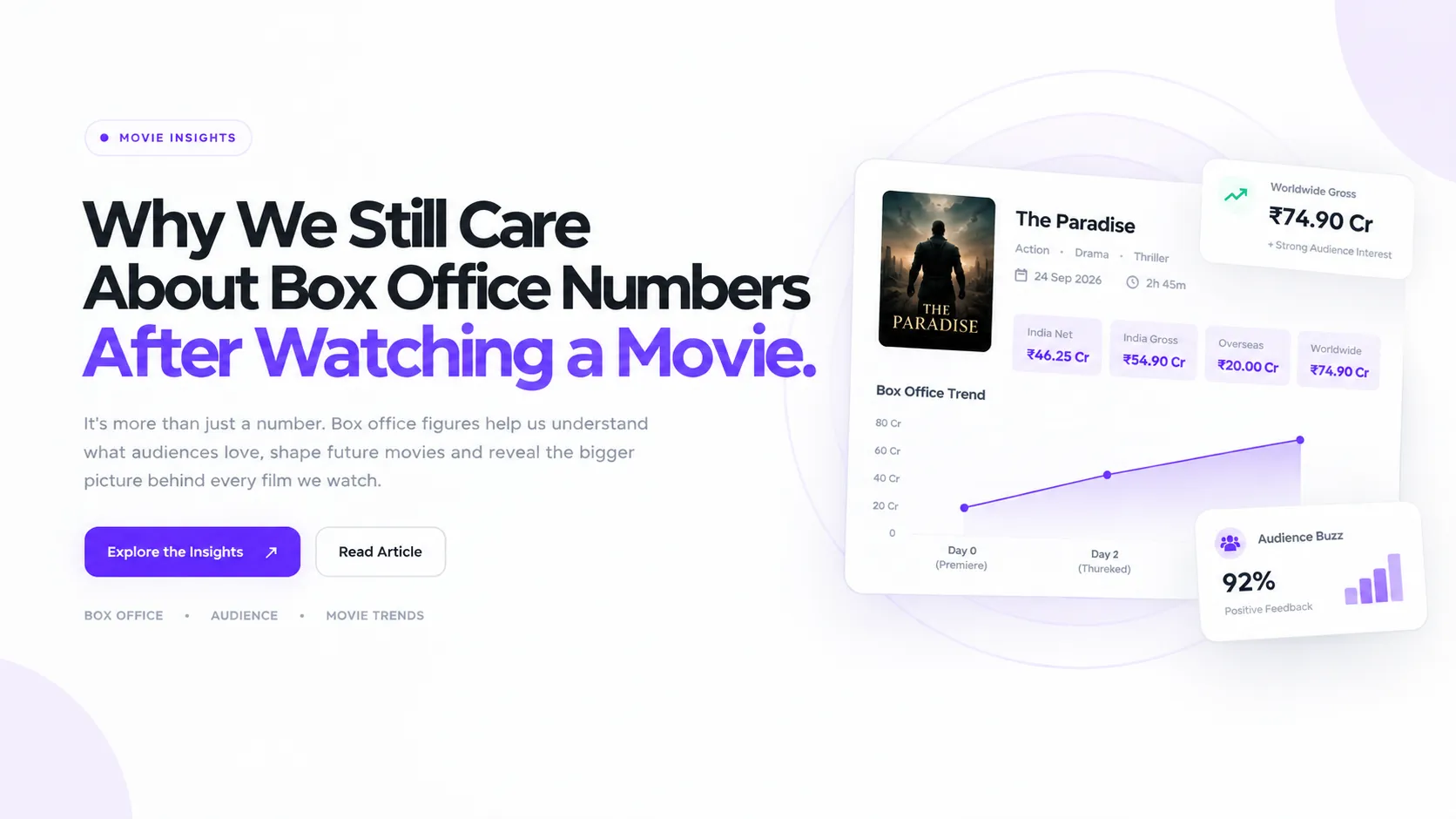

There is a funny little ritual that happens after watching a movie.
You leave the theatre with the story still floating around in your head. Maybe you loved it. Maybe you hated it. Maybe you're somewhere in between and need a day before deciding.
Then, almost without thinking, you reach for your phone.
You search for the movie.
Not the trailer. You have already seen that.
Not the cast. You probably know who is in it.
You want to know one thing:
How much did it make?
I've done this more times than I'd like to admit.
And the strange thing is that I don't work in the film industry. I'm just someone who enjoys movies. Yet box office numbers have somehow become part of the experience.
The more I thought about it, the more I realised that we're not really obsessed with numbers.
We're curious about the story behind them.
A movie has a life after the theatre
When the credits roll, the filmmaker's job is technically finished.
Ours isn't.
We start talking.
Was the ending good?
Did the lead actor carry the movie?
Was the second half too long?
Would you recommend it to a friend?
And somewhere in that conversation, the box office often appears.
"Did it open well?"
"Apparently, yes."
"Let's see what happens this weekend."
Suddenly, we're following the movie as if it were a sports team.
That's because a film has two stories.
There's the story written in the screenplay.
Then there's the story of what happens after audiences start watching it.
Opening day can be exciting, but it can also be misleading
A big opening always looks impressive.
The number gets shared everywhere. Headlines appear. Fans celebrate. Rival fan groups start comparing figures.
But one day isn't enough to understand a movie.
Imagine a film that makes a huge amount on Friday and then drops sharply.
Now imagine another movie that opens modestly but keeps growing throughout the weekend.
The first film had the bigger opening.
The second might have the healthier audience response.
That's why I find day-wise collections more interesting than a single final number.
They show movement.
And movement tells a story.
The weekend changes everything
Saturday and Sunday can completely alter the picture.
People who couldn't make it on Friday finally have time. Families go together. Friends plan group outings. Someone who saw the movie on Friday recommends it to another person.
Suddenly, a film that looked ordinary on its first day starts gathering momentum.
Or the opposite happens.
A strong opening doesn't translate into strong word of mouth, and the numbers begin to slow down.
The interesting part is that we can see the audience's reaction developing almost in real time.
The box office becomes a kind of diary.
Friday tells us about anticipation.
Saturday and Sunday tell us about the broader audience.
Monday often tells us whether that excitement can survive the weekend.
Domestic and worldwide collections tell different stories
Another reason movie numbers can become surprisingly complicated is geography.
A film doesn't necessarily have the same journey everywhere.
It may perform extremely well in India and have a smaller overseas audience.
Another movie may have a particularly strong international following.
Looking only at domestic numbers can hide part of the picture.
Worldwide collections don't tell us whether a film is good, of course. They simply tell us that its audience travelled beyond one market.
That matters because Indian cinema has become increasingly global.
People watch Indian films in countries and communities far beyond where they were originally made.
The journey of a movie is no longer confined to one box-office chart.
Numbers don't decide whether a movie is good
This is probably the most important distinction.
A successful film isn't automatically a great film.
A poorly performing film isn't automatically a bad one.
We've all experienced this.
Sometimes a movie that everyone around us loves leaves us completely cold.
Sometimes we discover a film years later that struggled commercially but becomes one of our personal favourites.
Box office measures business.
It doesn't measure the lump in your throat during the final scene.
It can't measure whether a character reminded you of someone you love.
It doesn't know that you still remember a particular line years later.
Those things belong to another kind of measurement.
The personal kind.
So why do we keep checking?
Maybe because movies are social experiences.
We don't just want to know what we thought.
We want to know what everyone else thought too.
A movie's collection gives us a tiny glimpse into that larger reaction.
Millions of people don't walk into theatres at random.
Their decisions are influenced by trailers, stars, reviews, friends, social media, holidays, word of mouth and sometimes simple curiosity.
The final number is the result of all those little decisions.
That's what makes it interesting.

When I want to follow that journey after watching a film, I sometimes check DNAMovie for day-wise collections, worldwide earnings and other box-office information.
It doesn't change my opinion of the movie.
It simply satisfies the other question in my head:
What happened after people started watching it?
The number is only the beginning
The next time you see a headline announcing that a movie has crossed some impressive collection figure, look beyond the number.
Ask how quickly it got there.
Look at the opening.
Look at the weekend.
Look at the weekdays.
Think about the audience it reached.
Then compare that journey with your own experience of the film.
You might discover something interesting.
A movie can be a commercial success and still disappoint you.
It can be a financial struggle and still become unforgettable.
And sometimes, the film you almost skipped turns out to be the one you keep talking about for weeks.
That's the strange beauty of cinema.
We watch a two-hour story on a screen.
Then we spend days creating another story around it.
The reviews.
The arguments.
The recommendations.
The memes.
The box-office numbers.
And eventually, the question that started everything:
"Did you see that movie?"






















Sign in to leave a comment.