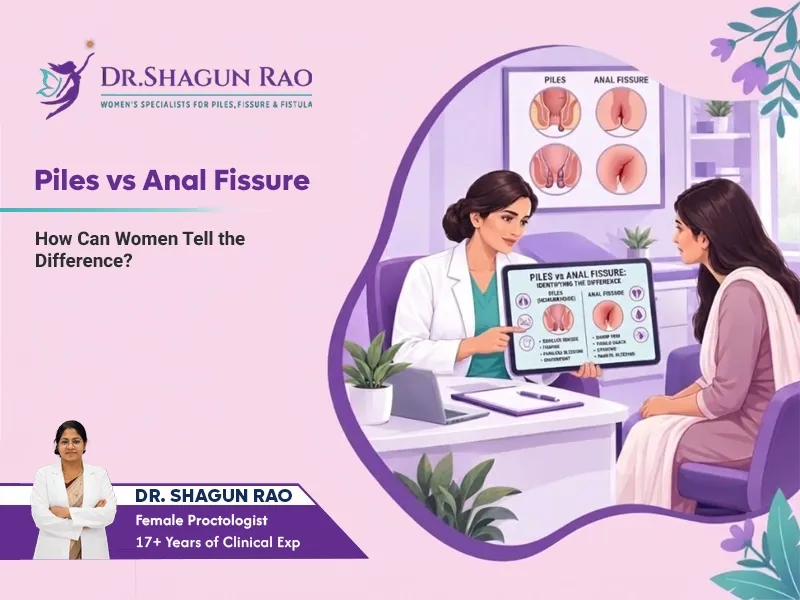

Pain while passing stool is easy to dismiss, especially when it happens after constipation or a particularly hard bowel movement.
But when the pain keeps coming back, becomes severe, or is accompanied by bleeding, swelling, or other symptoms, it is worth paying attention to what may be causing it.
Piles and anal fissures are two common anorectal conditions, but they are not the same thing.
Start by looking at the pattern of pain
Not all anal pain feels the same.
Some women describe an anal fissure as sharp, cutting, burning, or tearing pain during a bowel movement. The discomfort can sometimes continue after passing stool.
Piles can also cause discomfort or pain, especially when a hemorrhoid is inflamed or thrombosed. However, uncomplicated piles do not always cause significant pain.
The timing and character of the pain can provide clues, but symptoms alone cannot reliably establish a diagnosis.
If you want to understand the differences more clearly, this detailed guide explains how women can tell the difference between piles and an anal fissure, including the typical patterns of pain, bleeding, itching, swelling, and constipation.
Constipation can become part of the problem
Hard stools can put additional pressure on the anal tissues.
A person may strain to pass stool, experience pain, and then begin avoiding bowel movements because they expect the next one to hurt.
That can create a cycle:
Hard stool → Straining → Anal irritation → Pain → Delayed bowel movement → Harder stool
Constipation can contribute to both hemorrhoidal symptoms and anal fissures.
Addressing bowel habits is therefore an important part of managing many anorectal symptoms.
Rectal bleeding should not automatically be called piles
Bright red blood can occur with piles and anal fissures.
It may appear on toilet paper, on the surface of stool, or in the toilet after a bowel movement.
However, recurrent rectal bleeding should not simply be assumed to be hemorrhoids.
There can be other causes of rectal bleeding, so persistent or unexplained bleeding deserves appropriate medical evaluation.
What other symptoms should women watch for?
Anal pain becomes more important to evaluate when it occurs with other symptoms such as:
- Repeated rectal bleeding
- A lump around the anus
- Swelling
- Persistent itching
- Discharge
- Difficulty passing stool
- Pain that continues after bowel movements
- Symptoms that repeatedly return
A painful swelling accompanied by increasing redness, significant tenderness, pus, or fever should be assessed promptly.
Piles and fissures can occur together
It is possible to have both piles and an anal fissure.
For example, someone dealing with constipation and repeated straining may develop an anal fissure while also experiencing hemorrhoidal symptoms.
This is one reason why self-diagnosing based on one symptom can be unreliable.
The treatment approach can also differ depending on which condition is present.
Does every case require surgery?
No.
Having piles or an anal fissure does not automatically mean surgery is necessary.
Depending on the diagnosis and severity, management may include dietary changes, adequate fluid intake, increased dietary fiber, constipation management, improved bowel habits, medications, conservative treatment, office-based procedures, minimally invasive procedures, or other clinically appropriate options.
The treatment decision should be based on the actual condition and individual clinical findings.
When should you consult a proctologist?
Consider professional evaluation when anal symptoms are persistent, recurrent, severe, or interfering with daily activities or bowel movements.
A specialist may ask about:
- When the symptoms started
- Whether pain occurs during or after passing stool
- The duration of the pain
- Any rectal bleeding
- Constipation
- Swelling or lumps
- Discharge
- Previous episodes
- Treatments already tried
Depending on the symptoms, a clinical examination may be recommended.
For some women, discussing anorectal symptoms with a female proctologist can feel more comfortable.
Female proctology care in Pune and PCMC
Women may hesitate to discuss symptoms involving the anus and rectum because the subject can feel private or embarrassing.
Dr. Shagun Rao provides proctology care for women and men in Pune and PCMC, including care related to piles, anal fissure, anal fistula, pilonidal sinus, anal pain, and rectal bleeding.
The goal of a consultation is to understand the symptoms, evaluate the underlying condition, explain the available treatment options, and select an approach appropriate to the individual patient.
The main takeaway
Repeated anal pain should not automatically be treated as piles.
Piles and anal fissures can share symptoms, particularly when constipation and hard stools are involved. At the same time, the two conditions can have different symptom patterns and may require different management.
If you are experiencing persistent or recurring pain, bleeding, swelling, itching, or difficulty passing stool, getting the cause evaluated is more useful than repeatedly guessing.
Read Dr. Shagun Rao's complete guide to understanding piles vs anal fissure symptoms in women.





















Sign in to leave a comment.