

You have tried everything.
You downloaded the habit tracker. You set the alarm for 5am. You wrote the goal on a sticky note and put it on your mirror. You told your friend to hold you accountable. You started on Monday, because everyone starts on Monday.
And by Thursday, it was gone.
Not because you are lazy. Not because you lack discipline. Not because success is meant for other people and not for you.
Your habit failed because it was never yours to begin with.
This is the conversation nobody in the self-help world wants to have with you. Because it is far easier to sell you another planner, another morning routine, another "5 steps to success" framework than to ask you the one question that actually matters:
Who are you when you are not performing?
The Identity Problem Nobody Is Talking About
Here is what most habit and productivity experts get wrong.
They treat your behaviour as the problem. They tell you to change what you do, wake up earlier, eat better, exercise more, read for thirty minutes a day. And so you try. And for a few days, maybe even a few weeks, it works. You feel the momentum. You feel like this time is different.
And then life happens. You have a bad day. You miss one morning. And suddenly the whole thing collapses like a house of cards.
Why?
Because you were trying to change your actions without changing the identity underneath them.
Think about it this way. Imagine two people who are both trying to quit smoking. Someone offers them both a cigarette.
The first person says, "No thank you, I am trying to quit."
The second person says, "No thank you, I am not a smoker."
Do you feel the difference? The first person is fighting against a habit. The second person is living from a different identity. One is using willpower. The other is using who they are.
This is the entire game. And almost nobody is playing it at the right level.
What Acting Taught Me About Who You Really Are
I have spent decades in the world of theatre and acting. And the greatest lesson that world gave me, one I have spent years translating into a framework for everyday life and business, is this:
A great actor does not pretend to be a character.
A great actor becomes the character. They synchronise with that person's reality so completely that there is no gap between the performance and the truth. The character's walk becomes their walk. The character's fears become their fears. The character's certainties become their certainties.
And here is what is remarkable: when the actor fully inhabits that identity, the behaviour follows automatically. They do not have to think about how the character would move, speak, or react. It just happens, because they have stepped into a different self.
This is what I call Perceptual Acting and Directing. And it is not just a technique for the stage. It is a map for how human beings actually work.
Because here is the truth that modern neuroscience, quantum physics, and ancient wisdom all agree on: you are not your habits. You are the identity your habits are trying to express.
Change the identity. The habits follow. Every single time.
The Three Layers of Who You Think You Are
To understand why identity change works and why behaviour change alone does not, we need to look at the three layers of self that every human being operates from.
The first layer is the Performed Self.
This is the version of you that shows up for the world. The professional, the parent, the partner, the leader. This is the role you have been playing for so long that you have mistaken it for who you actually are. The Performed Self is always managing, managing impressions, managing outcomes, managing what other people think.
Most personal development works at this level. Change your morning routine. Change your habits. Change your behaviour. But the Performed Self is just a costume. You can keep adjusting it forever and never feel like yourself.
The second layer is the Conditioned Self.
This is the deeper layer, the beliefs, values, memories, and neural pathways that were shaped by your experiences. This is where your internal map lives. Every human being interprets reality not as it is, but through the lens of their own internal map, shaped by their language, their upbringing, their wounds, and their victories.
Your Conditioned Self is where most of your automatic behaviour comes from. It is running in the background, making decisions before you are even consciously aware of them. And until you examine this layer, you will keep recreating the same patterns, in your work, your relationships, your health, no matter how many new habits you try to stack on top.
The third layer is the Supraconscious Self.
This is the layer that most people never reach, not because it is hidden or difficult, but because they are so busy managing the first two layers that they never stop long enough to feel it.
The Supraconscious Self is the part of you that exists beyond role, beyond conditioning, beyond performance. It is the observer. The part of you that watches your thoughts without being your thoughts. The part that knows, even on your most chaotic day, that something deeper and steadier is always present.
And here is the remarkable thing: when you begin to lead your life from this third layer, when your identity is rooted in the Supraconscious Self rather than in the Performed or Conditioned Self, everything changes. Including your habits. Including your results. Including how you show up in your work and your relationships.
Not because you forced it. But because it became the natural expression of who you know yourself to be.
Why Business Genius Is Not a Technique
I work with entrepreneurs, executives, and high performers across many industries. And the pattern I see again and again is this:
They are brilliant. They are driven. They have the skills, the knowledge, the strategy. And yet something keeps stopping them, an invisible ceiling they cannot seem to break through, no matter what they try.
And almost without exception, the ceiling is not a business problem. It is an identity problem.
They are trying to perform at the level of the leader they want to become while still carrying the identity of the person they used to be. And those two things are in constant conflict.
Business genius is not a technique you pick up. It is not a framework you install or a course you complete. It is what becomes available when you truly know who you are, when your perception, your awareness, and your direction are all aligned from the inside out.
This is what PAD, Perception, Awareness, Direction, is designed to help you access. Not by adding more to what you do. But by stripping away the layers of performance and conditioning that are blocking what was always already there.
How to Begin the Recalibration
So what does identity recalibration actually look like in practice? It is not a dramatic overnight transformation. It is a quiet, consistent process of asking better questions and listening more deeply to the answers.
Start with perception. Before you try to change anything, examine how you are seeing yourself right now. Not the version of yourself you present to the world, the version you actually believe in when no one is watching. What are the stories you are telling yourself about who you are and what is possible for you? These stories are not the truth. They are your internal map. And maps can be redrawn.
Move into awareness. Begin to notice the gap between the identity you are living from and the identity of the person you want to become. Not with judgment, with curiosity. The actor does not judge the character they are inhabiting. They observe, they explore, they ask: what does this person believe? How does this person move through the world? What is available to this person that is not available to me yet?
Then choose your direction. Once you can see clearly who you are being and who you want to become, you can begin to close the gap, not through willpower, but through intentional, daily acts of becoming. Small choices that say: this is who I am now. Not who I am trying to be. Who I am.
The habit does not create the identity. The identity creates the habit.
A Different Question First
Most frameworks start by asking: what do you want to achieve?
PAD asks a different question first.
Who do you need to be to achieve it?
Because once you answer that question, truly answer it, not at the level of the Performed Self but at the level of the Supraconscious Self, everything else becomes remarkably clear. The habits you need to build, the patterns you need to release, the way you need to show up every day.
You stop trying to force behaviour change from the outside in. And you start allowing identity change to emerge from the inside out.
This is the work. It is quieter than most productivity systems. It is deeper than most coaching programmes. And it is, in my experience of working with hundreds of people across theatre, business, and life, the only change that actually sticks.
Because when you change who you are at the root level, you do not have to manage your behaviour anymore.
You just have to be yourself.
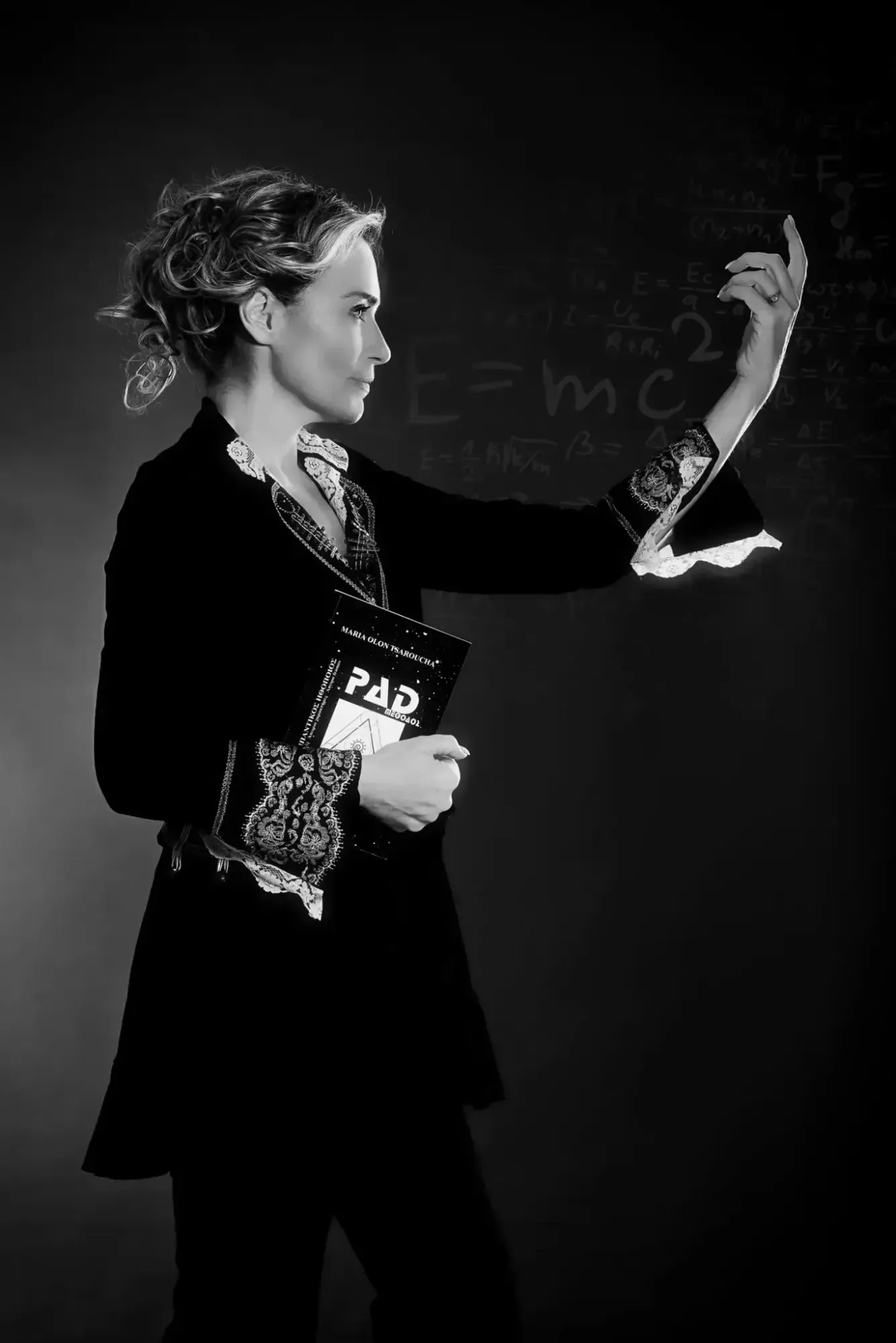
Maria Olon-Tsaroucha is a consciousness researcher, author, and the creator of Perceptual Acting and Directing (PAD), a framework that bridges acting methodology, quantum science, and mindfulness to help individuals and leaders unlock their full potential.
Ready to discover who you are beneath the performance? Download the free PAD Workbook and begin your identity recalibration today.
👉 Get the Free PAD Workbook

























Sign in to leave a comment.