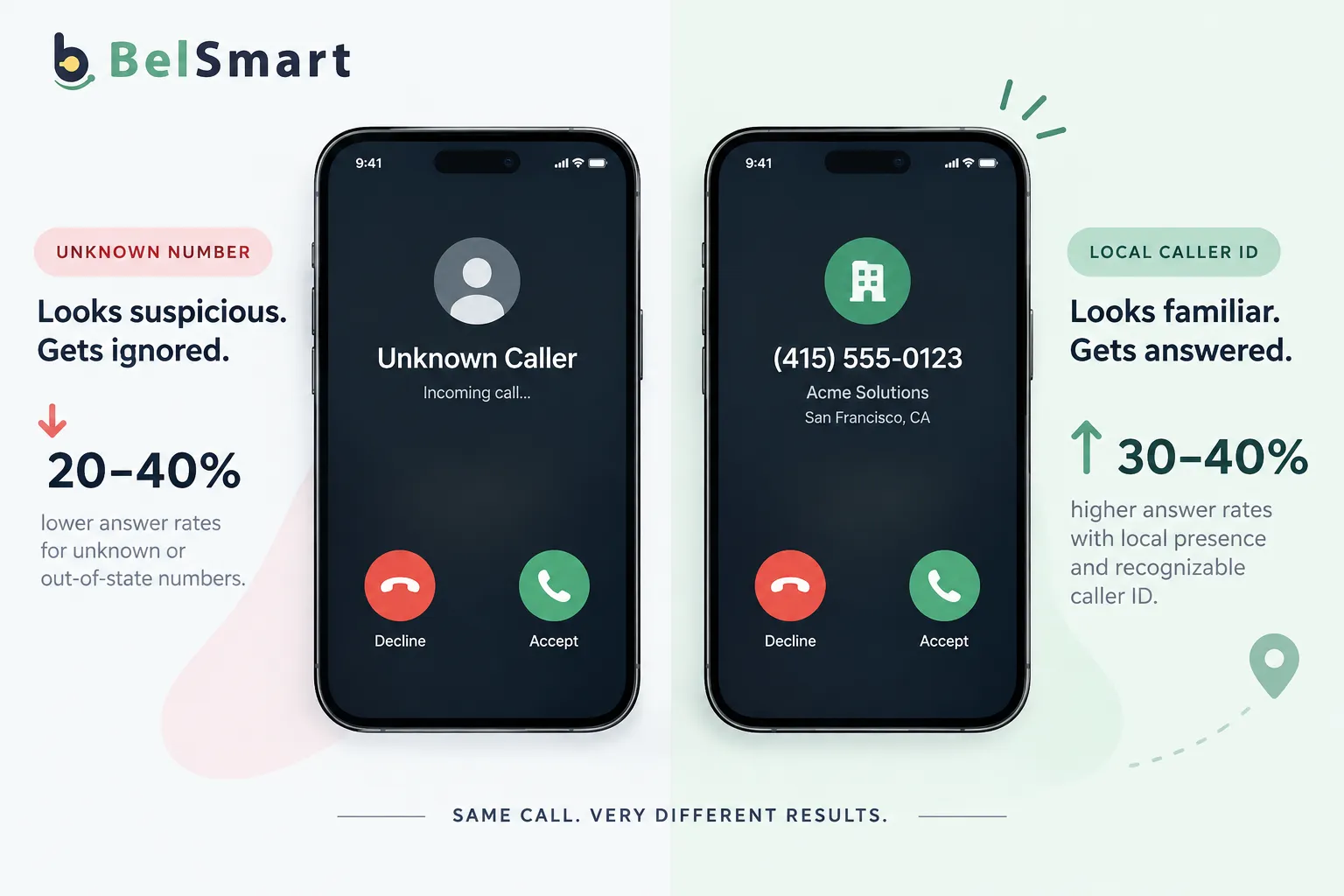


Sales teams tend to blame the pitch first. When answer rates stall, managers rewrite scripts, retrain reps on objection handling, and run role-play sessions — and the numbers barely move. That's because a low outbound call answer rate is usually decided before a single word gets said. If the phone doesn't get picked up, the best script in the world never gets a chance to work.
Outbound call answer rate is the percentage of dialed calls that result in a live person picking up, and it's shaped almost entirely by factors that happen before the conversation: caller ID reputation, number familiarity, and call timing. Script quality only matters once someone has already answered — which is exactly the part most teams are trying to fix first.
This matters more now than it did a few years ago. According to Hiya's State of the Call research, roughly 86% of consumers say they don't answer calls from numbers they don't recognize. Layer that on top of typical cold-outbound connect rates, which industry benchmarks from 2026 place somewhere between 3% and 10% on unverified or generic lists — and it becomes clear the bottleneck sits upstream of the pitch entirely.
Why Do Prospects Ignore Unfamiliar Phone Numbers?
Most prospects ignore unfamiliar numbers because years of robocalls and spam campaigns have trained people to treat any unrecognized caller ID as a probable nuisance call. This is a learned, near-automatic reaction, not a conscious decision to reject your specific company.
The area code plays a bigger role than most sales managers assume. A number sharing the prospect's own area code reads as local — a neighbor, a nearby business, a doctor's office — while an out-of-state or toll-free number reads as "call center" almost instantly. That split-second judgment happens before the phone even finishes its second ring, which is why no amount of script polish can undo it after the fact.
Is Caller ID Reputation the Real Reason Calls Go Unanswered?
Caller ID reputation is one of the most common — and most overlooked — reasons outbound calls go unanswered, because carriers actively score numbers and label high-volume, low-answer-rate lines as "Spam Likely" without the calling company ever being notified.
Caller ID reputation refers to how mobile carriers and call-blocking apps classify a phone number based on calling patterns like volume, frequency, and historical answer rates. A number that dials hundreds of calls a day with a low pickup rate starts to resemble the exact pattern carriers use to detect spam campaigns — regardless of whether the calls are legitimate. Once a number gets flagged, most of its calls get silently sent to voicemail or marked with a warning label before the phone even rings audibly.
This is where caller ID spam remediation comes in: monitoring number reputation continuously and rotating out numbers that carriers start flagging, rather than discovering the problem only after answer rates have already collapsed. Belsmart's caller ID spam remediation tooling is built specifically to catch this before it tanks a campaign, and its broader caller ID management approach treats number reputation as an ongoing thing to maintain, not a one-time setup step.
Does Call Timing Affect Answer Rates?
Yes — call timing has a measurable effect on outbound answer rates, independent of caller ID or script quality, because prospects are simply more reachable during certain windows of their day than others.
Calling too early, during lunch, or right at end-of-day tends to hit people mid-task and unavailable. Multiple industry benchmarks point to mid-morning and mid-afternoon windows performing better than early morning or late evening calls. This is a separate lever from caller ID reputation — a well-reputed local number called at the wrong time will still underperform, and a great script called during a bad window won't get heard regardless of quality.
Timing compounds with a second factor: how fast you call after a lead comes in. A prospect who just filled out a form is far more likely to answer an immediate call than one who's contacted a day later, since the interaction is still fresh in their mind. Belsmart's speed-to-lead breakdown covers this mechanism and its conversion math in more depth — it's a related but distinct lever from the caller ID and reputation factors this article focuses on.
How Can You Tell If Your Script or Your Number Is the Problem?
You can tell the difference by checking answer rate at the dial level before ever evaluating the conversation itself — if calls aren't being picked up at all, no script change will show up in the data, because the problem never reaches the point where a script matters.
Use this sequence before assuming the pitch needs work:
- Check caller ID status first. Look up your outbound numbers on a spam-checker tool or ask a colleague on another carrier to call you back — if your number shows any "Spam Likely," "Scam Likely," or similar label, that's your answer rate problem, full stop.
- Compare answer rates by area code. If local-area-code calls consistently outperform out-of-area calls in your own data, unfamiliarity — not pitch — is driving the gap.
- Review calling times against connect rates. Segment your dial data by hour and day; if certain windows consistently underperform regardless of rep or script, timing is a factor worth fixing before anything else.
- Audit your list/data quality. Old, unverified, or purchased lists connect at meaningfully lower rates than verified direct-dial data, independent of anything a rep does.
- Only then, evaluate the script — on calls that were actually answered. If prospects are picking up and still disengaging quickly, that's a real signal the conversation itself needs work. Skipping straight to this step, before ruling out the first four, is the most common mistake outbound teams make.
What Actually Causes Most Unanswered Outbound Calls?
The table below breaks down the most common root causes behind a low outbound call answer rate, the symptom that usually points to each one, and the typical fix.
| Likely Cause | Common Symptom | Typical Fix |
|---|---|---|
| Caller ID flagged as spam | Answer rate drops sharply and suddenly, even on a previously fine number | Caller ID spam remediation and number rotation |
| Unfamiliar/out-of-area number | Answer rate consistently lower on out-of-state calls vs. local-area calls | Local presence dialing |
| Poor call timing | Answer rate varies heavily by hour/day with no other clear cause | Adjust dial windows to reachable hours |
| Stale or unverified lead data | Many calls hit disconnected or wrong numbers | Data verification and list hygiene |
| Weak script/pitch | Prospects answer but disengage or hang up quickly | Script and objection-handling review |
Reading this table left to right in order is deliberate: the first three causes stop a call before it's ever answered, while the last two only become relevant once someone has already picked up. Teams that jump straight to fixing the script without ruling out the first three are optimizing the part of the funnel that was never actually broken.
Bottom Line
A low outbound call answer rate is very rarely a pitch problem, because most unanswered calls never reach the point where a pitch gets delivered at all. The real fix usually starts with caller ID reputation, number familiarity, and timing — not another round of script edits.
If your team's answer rate has stayed flat despite script changes, it's worth checking whether your numbers are getting flagged before you ever reach that conclusion. Belsmart's caller ID spam remediation and dialer plans are built around exactly this diagnosis — see current pricing here.
FAQ
What is a good outbound call answer rate?
Most industry benchmarks place a solid outbound answer rate somewhere between 15% and 25% on verified data, with plain cold-outbound campaigns on unverified lists often falling to 3–10%. Rates below that range typically point to caller ID or data-quality issues rather than a weak pitch.
Why do people not answer calls from unknown numbers?
Years of robocalls and spam campaigns have trained most people to treat unrecognized caller IDs as likely nuisance calls. Research from Hiya's State of the Call report found roughly 86% of consumers say they avoid answering numbers they don't recognize, regardless of who's actually calling.
How do I know if my number is flagged as spam?
Check your outbound number on a spam-checker tool, or ask someone on a different carrier to call it and see what label appears on their screen. A sudden, unexplained drop in answer rate on a previously reliable number is also a strong signal the number has been flagged.
Does local presence dialing actually improve answer rates?
Yes — displaying a caller ID that matches the prospect's own area code consistently outperforms out-of-area numbers in industry data, since local-looking numbers read as more trustworthy than unfamiliar ones. It works best alongside active caller ID reputation monitoring, since a local-looking number can still get flagged if it isn't maintained.
Is call timing really that important for answer rates?
Yes. Calling during reachable windows — typically mid-morning and mid-afternoon in the prospect's local time — measurably outperforms early morning, lunch, or end-of-day calling, independent of script or caller ID quality.
Should I fix my script before checking my caller ID and data quality?
No — check caller ID status, area-code performance, timing, and data quality first, since those factors determine whether a call gets answered at all. Script quality only becomes relevant on calls that were actually picked up, so evaluating it first risks fixing the wrong part of the funnel.
























Sign in to leave a comment.