

There's a quiet crisis happening in startup marketing right now, and most founders aren't even aware of it until it's too late.
A potential customer opens ChatGPT or Perplexity and types: "What's the best tool for [problem your startup solves]?" Your competitor gets mentioned. Your startup doesn't. The customer moves on, never knowing you exist.
This isn't a one-off. It's happening thousands of times a day — and AI search visibility for startups is quickly becoming one of the most consequential gaps between companies that grow and companies that stagnate.
The New Front Door No One Prepared You For
For a decade, the SEO playbook was clear: rank on Google, get traffic, convert visitors. It was measurable, learnable, and relatively predictable. Then large language models changed everything.
Today, a growing percentage of users — particularly tech-savvy early adopters and B2B buyers — are starting their product research not with Google, but with AI assistants. They ask conversational questions, get synthesized answers, and often make shortlist decisions based entirely on what the AI says. If you're not in that answer, you're not in the consideration set.
The problem is that most startups are optimizing for a search paradigm that's already shifting beneath their feet.
Why AI Models Miss Your Startup
Understanding why you're invisible requires understanding how these models work — at least at a high level.
AI language models are trained on vast corpora of text from the internet. They don't have a live database they query in real time (unless augmented with retrieval tools). What they "know" about your company is whatever was indexed, cited, or discussed before their training cutoff — and how often and credibly it appeared.
This creates a compounding visibility gap for startups, especially newer ones.

You have a thin content footprint: If your website is mostly a landing page and a product demo, there simply isn't enough indexed material for AI models to draw on. They surface companies with extensive documented presence — detailed blog posts, comparison content, forum discussions, documentation, and case studies.
You have no third-party citations: This is the silent killer. LLMs don't just read your own website; they weigh how much the rest of the internet talks about you. Product reviews on G2, articles referencing your company, forum threads on Reddit, comparison posts from analysts — these external signals are disproportionately influential in whether an AI "knows" you're credible.
Your content doesn't answer questions clearly: AI models are fundamentally question-answering systems. Content that's written as a marketing pitch — rather than as an answer to a specific user question — tends to get skipped over in retrieval. If your blog posts don't have clear, structured answers to the exact questions your buyers are asking, they won't surface.
What This Invisibility Is Actually Costing You
The direct cost is obvious: missed leads. But the indirect costs compound in ways founders rarely account for.
When a potential customer asks an AI assistant for recommendations and your company doesn't appear, you lose more than just that one inquiry. You lose it across every user of that AI tool who asks a similar question. You lose brand familiarity at the moment of highest intent. And you lose the opportunity to shape how the AI frames the category you operate in.
There's also a credibility loop at play. The more established companies get cited by AI, the more users trust them, the more they get reviewed and discussed, the more they get cited again. Startups that miss this early window don't just fall behind — they get further behind as the compounding works against them.
The Emerging Practice of AI Search Optimization
A discipline is forming around this challenge. Some call it GEO (Generative Engine Optimization), others call it AEO (Answer Engine Optimization). Whatever the name, the core principles are consistent.
Structured, question-led content is foundational: Your content needs to directly answer the questions your buyers are typing into AI tools. Not broad thought leadership — specific, concrete answers with clear headings, short paragraphs, and definitive statements.
Third-party presence matters more than your own: Getting mentioned in industry round-ups, comparison articles, software review sites, and relevant community discussions carries significant weight. This is essentially the link-building equivalent for AI search.
Entity clarity is critical: AI models build an internal understanding of what your company is — what category it belongs to, what problems it solves, who it's for. If your website, social profiles, and external mentions send inconsistent signals, models struggle to represent you accurately (or at all).
Freshness of information helps: While LLMs have training cutoffs, many now augment with live retrieval. Regularly updated, indexed content gives you a better chance of appearing in those real-time lookups.
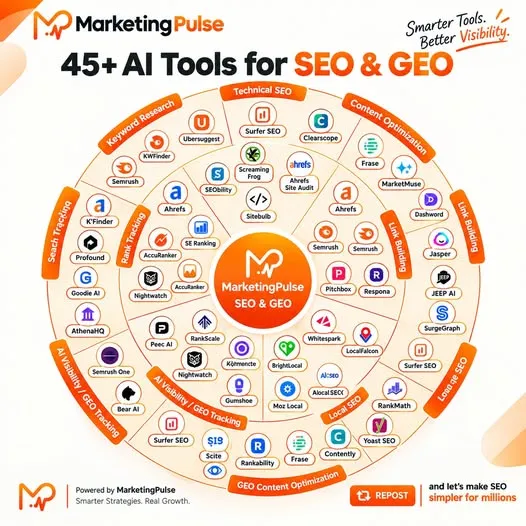
Some teams are starting to use dedicated tools to audit and track how their brand appears in AI responses — checking which queries surface them, how they're described, and where gaps exist. Platforms like Worksbuddy's Ranko are built specifically for this — giving you visibility into your AI footprint across different models and query types, which is useful context when building a strategy from scratch.
Where to Start If You're Behind
The good news: this is fixable, and it's earlier than most founders think.
Start with an honest audit. Ask ChatGPT, Perplexity, and Claude the exact questions your ideal customer would ask. Note who gets mentioned, how they're described, and where your company appears (or doesn't). That's your baseline.
Then prioritise content that directly answers those questions. One well-structured article that answers "What's the best tool for [specific use case]?" with a genuine, balanced perspective will do more for your AI visibility than ten posts about company culture.
Work on your third-party presence. Submit to relevant software directories. Pursue editorial coverage in niche publications your buyers read. Participate in communities where your category is discussed. Each of these creates an external citation trail.
Finally, be consistent about how you describe what you do. Your category, your core use case, your differentiator — these need to appear consistently across every channel. AI models assemble an entity profile from scattered signals, and inconsistency creates noise.
The Window Is Open — But Not Forever
AI search is still early enough that startups can catch up, and in some categories, can actually leapfrog incumbents who are slower to adapt. The companies building AI search visibility now are establishing the kind of ground-level presence that will be very hard to displace once the patterns solidify.
This isn't about gaming a system. It's about making sure that when a buyer genuinely needs what you offer, and they ask an AI to help them find it — you're actually there.
The invisible startup isn't always the inferior one. But in an AI-first discovery world, being invisible and being irrelevant look exactly the same.
Find out if your startup is invisible to AI — before your competitors do
Most founders assume they have a baseline AI presence. Most are wrong. The first step is knowing exactly where you stand — which queries surface you, how you're described, and what's missing.
Check your AI visibility Free to start — no card required





















Sign in to leave a comment.