

Last updated: October 5, 2026
Will AI replace SAP consultants? Not as one job category. Artificial intelligence (AI) will not erase the profession, but it will automate a growing share of the work inside that category, compress some teams, and reward consultants who can own decisions that an agent can only propose. That is a less comforting answer than “no”—and a more useful one.
The real question is not whether an artificial intelligence tool can draft a specification, explain a configuration option, or suggest a test script. It already can. The question is who understands the business consequence, catches the exception, wins stakeholder agreement, and accepts responsibility when the recommendation reaches production.
The career risk is not AI versus consultant. It is consultant-with-AI versus consultant-who-only-executes.
| What is changing? | The 2026 signal |
|---|---|
| Repetitive execution | Moving fastest toward automation |
| Analysis and recommendations | Becoming AI-assisted and review-heavy |
| Business judgment | Rising in value because context stays messy |
| Governance and accountability | Becoming a core consulting skill |
| Entry-level learning | Accelerating, but with fewer low-risk tasks |
Will AI Replace SAP Consultants in 2026?
No, AI is unlikely to replace SAP consultants as a profession in 2026. It is already replacing parts of the role, especially repeatable analysis, documentation, support triage, and first-draft configuration guidance.
SAP SE’s own direction is explicit. Its September 2026 view of AI-driven service delivery describes intelligent agents automating routine work, accelerating incident resolution, and surfacing recommendations. The same article says successful delivery still depends on operational expertise, human judgment, governance, accountability, and alignment on business outcomes.
That distinction matters. A job title is a bundle of tasks, relationships, permissions, and liabilities. AI can absorb a task without absorbing the whole job. It can also reduce the number of people required for a workflow without removing the need for a senior person who owns the outcome.
So the binary question produces a misleading answer. Functional consultants, developers, architects, and project leads will not all experience the same pressure. The closer a role sits to repeatable production, the more exposed its task list is. The closer it sits to ambiguous decisions and consequences, the more AI changes the tools rather than removing the owner.
Which SAP Consulting Tasks Will AI Automate First?
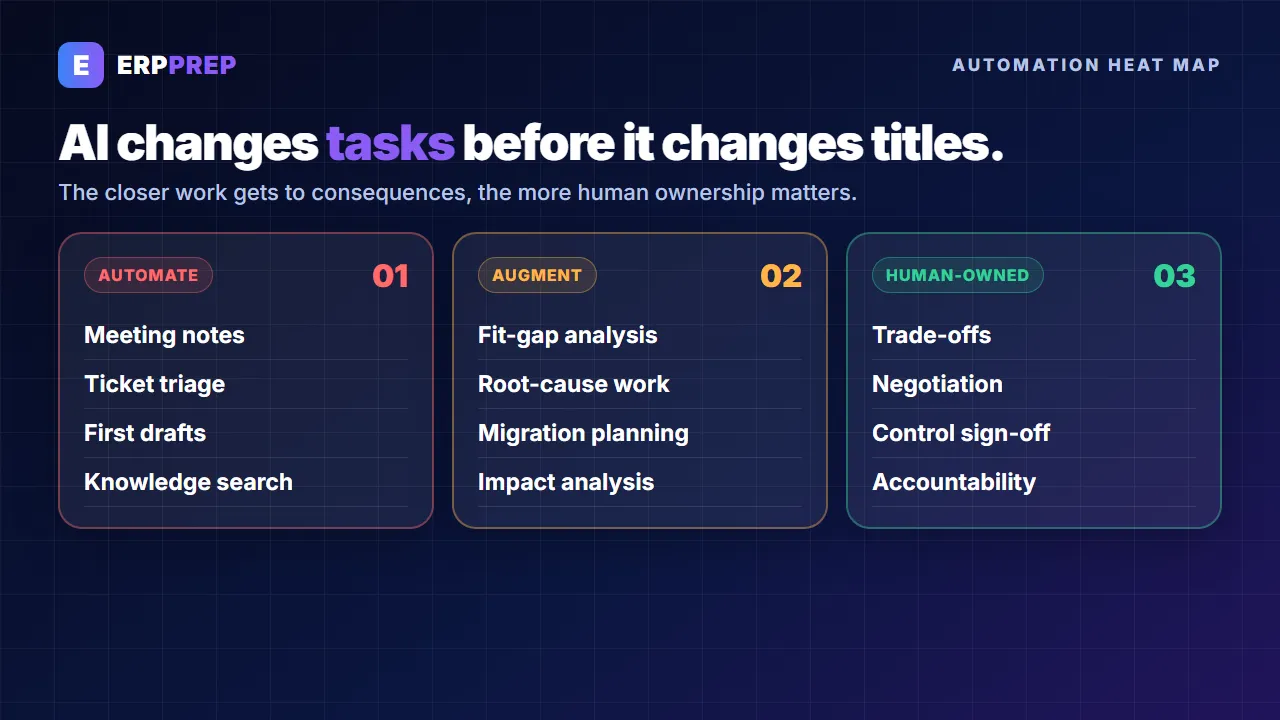
AI will automate tasks with clear inputs, repeatable patterns, and outputs that can be checked cheaply. It will augment work with partial context and stop short where authority, negotiation, or risk ownership begins.
Here is a practical automation heat map:
| Likely to automate | Likely to augment | Human-owned longer |
|---|---|---|
| Meeting summaries | Fit-gap analysis | Process ownership |
| First-draft test scripts | Root-cause investigation | Executive trade-offs |
| Code explanations | Configuration proposals | Regulatory sign-off |
| Ticket classification | Data-migration planning | Stakeholder negotiation |
| Documentation updates | Architecture alternatives | Go-live accountability |
| Basic knowledge search | Change-impact assessment | Exception judgment |
This is not a claim that the left column becomes unsupervised. Enterprise Resource Planning (ERP) systems contain local customizations, inconsistent master data, incomplete documentation, and controls that matter financially. An agent can produce an answer that looks polished while quietly assuming a standard process the client abandoned eight years ago.
The valuable consultant therefore moves one level up. Instead of being paid mainly to produce the test script, the consultant defines the risk coverage, checks whether the generated script exercises the real exceptions, and decides whether the evidence is strong enough for release.
Why Are Junior SAP Roles More Exposed?
Junior roles are exposed because AI is absorbing many low-risk tasks that traditionally taught beginners how the system works. The role remains, but the learning ramp gets steeper and expectations arrive earlier.
A 2026 SAP early-talent survey of 100 US chief human resources officers found that 79% give early-career workers enterprise AI tools within their first month, while 87% expect new hires to be comfortable with AI on day one or learn immediately. Lara Albert, Chief Marketing Officer at SAP SuccessFactors, summarized the shift: “AI isn’t making early talent irrelevant. Instead, it’s accelerating how quickly they become productive.”
That acceleration has a hidden cost. Junior consultants used to learn through documentation, data checks, ticket reproduction, and supervised configuration. If agents do more of that work, a beginner gets fewer repetitions before being asked to interpret an exception or speak to a stakeholder.
The answer is not to avoid AI so that learning feels authentic. It is to make the reasoning visible. A strong junior should be able to explain what the agent assumed, which evidence supports the answer, what could make it wrong, and how the recommendation changes downstream postings or processes. “I verified it” must mean more than “the output looked plausible.”
Which SAP Skills Become More Valuable Because of AI?
The strongest 2026 skill stack combines SAP Business Technology Platform (SAP BTP), AI fluency, data judgment, architecture, and deep functional knowledge. Employers need people who can connect those capabilities, not specialists who merely know the vocabulary.
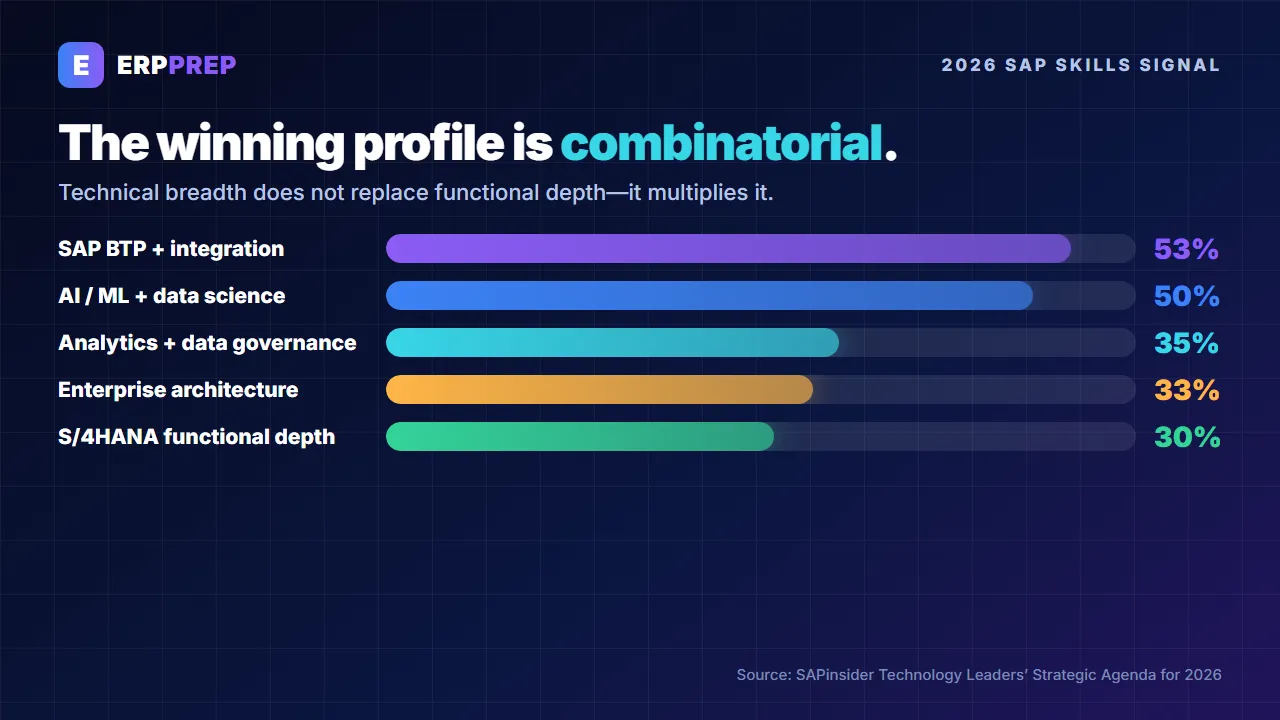
The SAPinsider 2026 skills data gives the clearest signal. Technology leaders ranked SAP BTP development and integration at 53%, AI and machine learning skills at 50%, analytics/data engineering/governance at 35%, enterprise architecture and integration strategy at 33%, and SAP S/4HANA functional expertise at 30% among the most important capabilities to acquire or strengthen.
Those numbers do not say functional expertise is becoming unimportant. They say functional knowledge alone is no longer a complete moat. The high-value consultant can answer four questions together:
- What should the business outcome be? This requires domain and process depth.
- What data can the agent trust? This requires lineage, semantics, quality, and access knowledge.
- Where may the agent act? This requires integration, identity, and architecture skills.
- Who owns the exception? This requires governance and operating-model design.
For developers, the implication is similar. The debate is no longer whether Advanced Business Application Programming (ABAP) survives. It is whether a developer remains limited to requested objects or can design clean-core extensions, APIs, agent tools, and controls. The related WriteUpCafe analysis of the ABAP Cloud career shift explores that technical fork in more depth.
What Does Agentic AI Change About SAP Project Economics?
Agentic AI threatens effort-based delivery models before it threatens the need for transformation expertise. When fewer hours produce the same artifact, clients stop valuing the hours and start valuing the decision, control, and outcome.
In an analysis of roughly 180 SAP ERP Central Component to SAP S/4HANA migration activities, one consultancy modeled a potential 60% cost reduction through AI-compressed effort. The agentic transformation analysis is not a universal benchmark, but it exposes the direction of pressure. Stuart Browne, Founder and CEO of Resulting IT, put it plainly: “The only way we deliver this in the future is by changing the way we’ve delivered it in the past.”
For consulting firms, that means a project cannot rely forever on large pyramids of junior labor producing documents, reconciliations, and test assets. For independent consultants, it means billing for the artifact becomes harder when an agent can create a credible first draft in minutes.
The defensible offer becomes different: reduce a measurable risk, accelerate a business milestone, protect control integrity, or resolve a cross-functional decision. That is outcome-based value. AI may help deliver it, but the client still needs someone who understands what “good” means in the client’s context.
The New SAP Consultant Value Ladder
The new career ladder moves from producing work to governing outcomes. Each step remains useful, but the lower steps become easier to automate and less valuable when sold alone.
Level 1 — Execute. Configure, code, document, test, and close tickets. These skills are necessary, but the output is increasingly agent-assisted.
Level 2 — Explain. Translate system behavior into language a business user, auditor, developer, or executive can act on. AI can help draft the explanation; credibility still depends on context.
Level 3 — Decide. Recommend one path under cost, time, control, and adoption constraints. Decisions require explicit trade-offs rather than a list of possible options.
Level 4 — Govern. Define permissions, evidence, monitoring, exception paths, and accountability for both people and agents. Governance turns AI from an experiment into an operating capability.
A useful self-test is simple: if an agent produced your usual deliverable tomorrow, what would the client still need you for? If the answer is only “to check it,” your role is vulnerable. If the answer includes framing the problem, challenging assumptions, negotiating the decision, and owning the consequence, your role is evolving upward.

How Can an SAP Consultant Future-Proof a Career in 90 Days?
Use 90 days to prove that you can combine one SAP domain, one AI-assisted workflow, and one governance pattern. The goal is not to become an AI researcher; it is to become safer and faster at solving a real enterprise problem.
Days 1–30: Map the work
- List 20 recurring tasks in your current or target role.
- Mark each as automate, augment, or human-owned.
- Choose one painful workflow with clear inputs and a reviewable output.
- Document the business risk if the output is wrong.
Days 31–60: Build one evidence-backed prototype
- Use approved tools to generate a first draft, classification, summary, or recommendation.
- Ground it in controlled SAP documentation or process data.
- Create a review checklist covering accuracy, authorization, privacy, and downstream impact.
- Record where the agent fails; those failure patterns are part of the portfolio.
Days 61–90: Add governance and tell the story
- Define who may run the workflow and which data it may access.
- Add a human approval point for material actions.
- Track cycle time, correction rate, and exceptions.
- Present the result as a business case: problem, control, evidence, outcome, and remaining risk.
The best portfolio item is not a chatbot screenshot. It is a controlled workflow with a clear business owner and a measurable improvement. That signals consulting maturity, not just tool curiosity.

Which SAP AI Learning Paths Are Worth Watching?
Start with the path closest to the work you already understand. Functional consultants need AI process and governance fluency; developers need orchestration and grounding; architects need identity, data, integration, and agent lifecycle controls.
If you are comparing formal credentials, the WriteUpCafe review of whether the SAP GenAI certification matters provides a useful counterweight to hype. A credential can structure learning, but a portfolio proves that you can apply it.
These two ERPPrep Official videos are useful starting points for mapping the current SAP AI certification landscape:
SAP Business AI Solutions Certification — exam details and preparation strategy
Watch the SAP Business AI video on YouTube
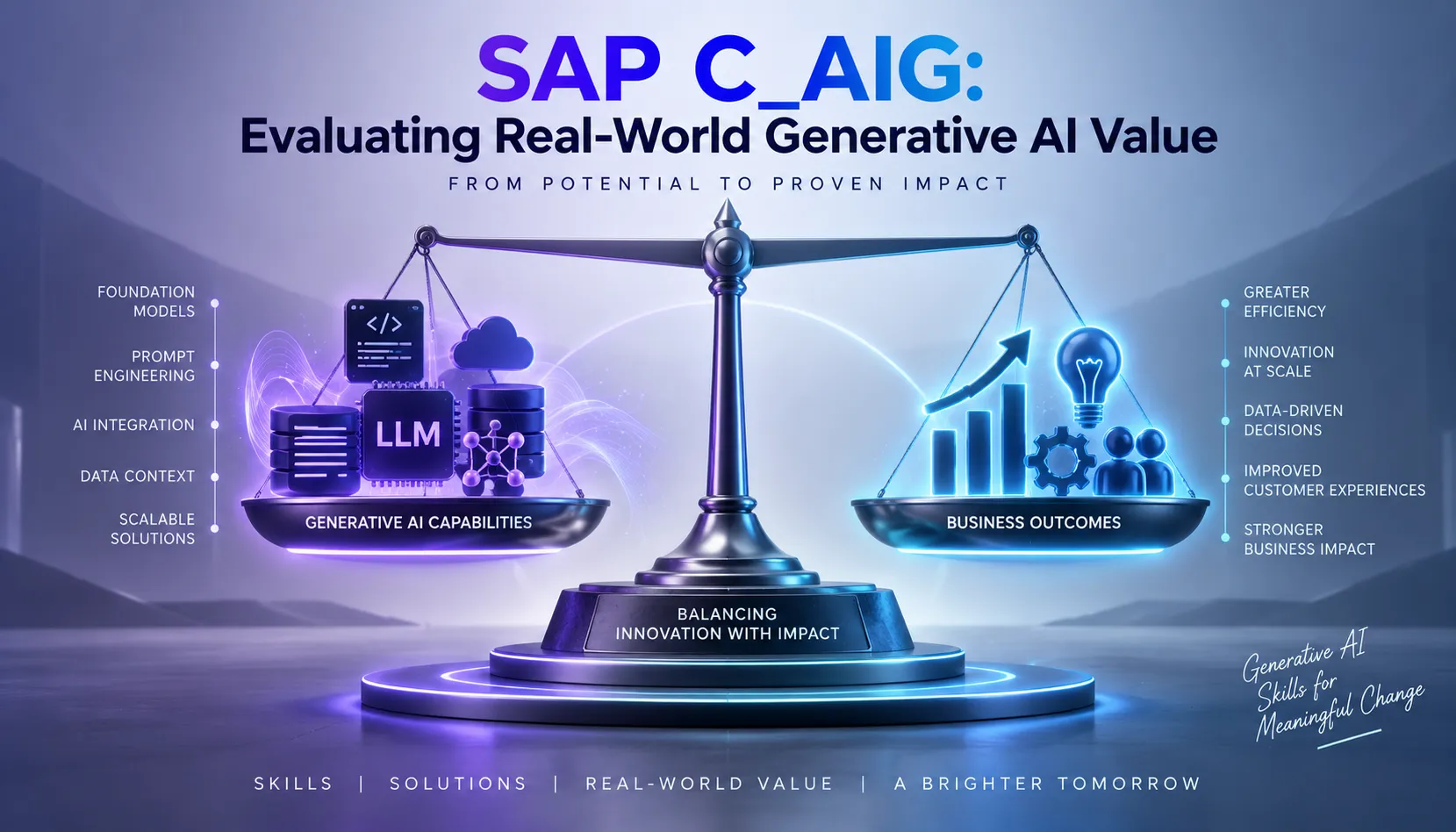
SAP Generative AI Developer Certification — updated skills and preparation
Watch the C_AIG video on YouTube
Treat the videos as orientation, then build something small enough to test. Watching explains the map; a governed prototype demonstrates that you can travel it.
Frequently Asked Questions
Q: Will AI replace SAP functional consultants?
AI will automate parts of functional consulting, but it cannot fully own stakeholder alignment, business exceptions, control decisions, and production accountability. Functional consultants who add data, integration, and AI-governance skills should become more valuable.
Q: Will SAP Joule replace consultants?
SAP Joule can accelerate research, navigation, recommendations, and workflow execution. It changes how consultants work, but customers still need people to define outcomes, validate context, manage permissions, and own exceptions.
Q: Is SAP consulting still a good career in 2026?
Yes, provided you prepare for a more AI-assisted role. The safer career path combines deep process expertise with SAP BTP, data literacy, architecture, communication, and governance.
Q: Which SAP jobs are most vulnerable to AI?
Roles dominated by repeatable documentation, basic ticket triage, template configuration, and unchecked first-draft analysis are most exposed. Roles centered on ambiguous decisions, integration, controls, and stakeholder trust are more resilient.
Q: Should SAP consultants learn prompt engineering?
Yes, but prompt engineering is only a starting skill. Grounding, evaluation, permissions, process design, and human approval points matter more when AI reaches enterprise data and actions.
Q: What should a beginner learn first for an AI-ready SAP career?
Choose one functional or technical SAP domain first, then add AI-assisted workflow design and governance. Breadth without a domain anchor produces demos; domain depth plus AI fluency produces business value.
The Better Question for Your Career
The useful question is not “Will AI take my SAP job?” Ask: Which part of my value survives when execution becomes cheap? Then build around the answer.
For a deeper task-by-task assessment, use this AI-ready SAP career guide to identify the skills that strengthen your current role.
Then bring the debate back to your team: Which part of your current SAP work would you trust to an agent today—and which part would you refuse to delegate? That is the comment worth having.


























Sign in to leave a comment.