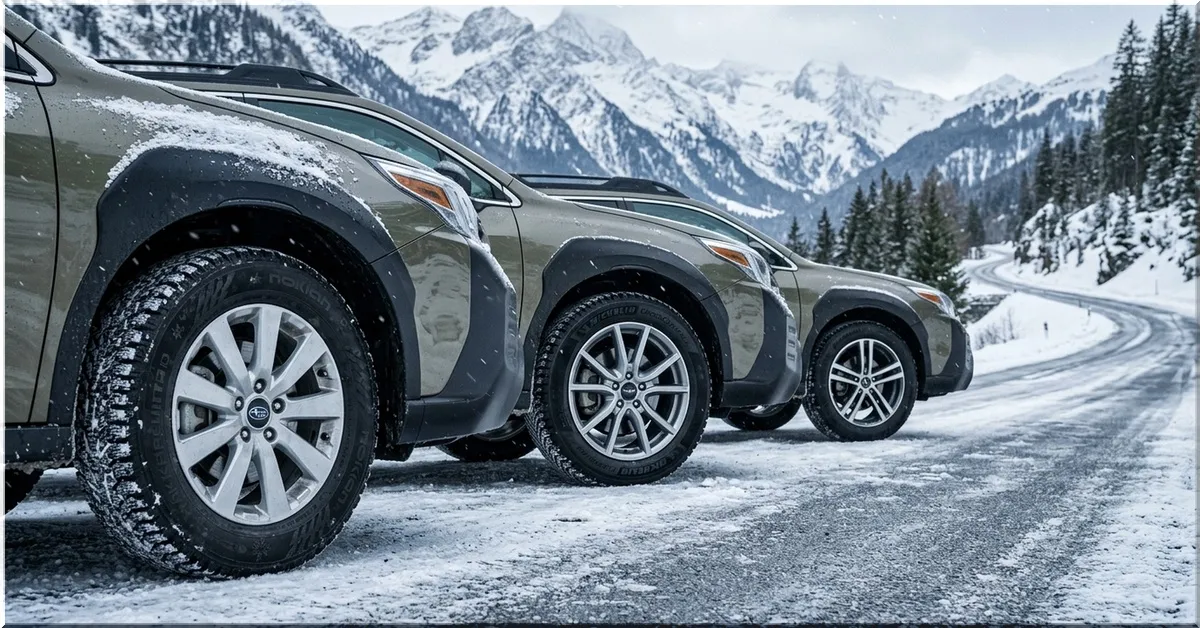

You need tires that match your winter. Not the winter in a brochure. Your winter. The one with specific temperatures, specific snowfall, and specific roads. Pick wrong, and you lose money, traction, or both. The three main tire types look similar on a shelf. They behave nothing alike on a cold road.
This guide shows what separates winter tires, all-season tires, and all-weather tires. It gives you a clear way to choose.
Why Temperature Changes Everything
Rubber has a temperature range where it works best. Outside that range, performance drops.
All-season tires use a harder compound. That hardness helps them last. It also makes them stiffen below 7°C (45°F). A stiff tire does not mold to the road. It slips more easily. Government testing confirms that all-season and summer tires lose elasticity in cold weather. That loss reduces traction.
Winter tires use a softer compound. They stay pliable at -30°C (-22°F). That softness lets the tread grip ice and packed snow. The same softness causes rapid wear in warm weather. That is why you should not run winter tires all year.
All-weather tires sit between those two. Their compound stays flexible in cold and stable in heat. They give up some ice grip compared to winter tires. They also avoid the summer wear problem that winter tires have.

The Three Tire Types Explained
All-Season Tires
Most new vehicles come with all-season tires. They are the default option. They last 70,000 miles or more on many models. They ride quietly. They cost less than specialty tires.
The name misleads. All-season tires are really three-season tires. They work in spring, summer, and fall. They struggle in real winter conditions.
Use all-season tires if you live where winters are mild. If temperatures rarely drop below 7°C (45°F) and snow is rare, they will serve you well. If you see consistent freezing temperatures or regular snowfall, they will let you down.
All-Weather Tires
All-weather tires solve a specific problem. You want one set of tires that handles winter without seasonal swaps.
They carry the three-peak mountain snowflake (3PMSF) symbol. That symbol confirms they passed a standardized snow traction test. They handle slush, cold rain, and light snow without drama.
The trade-off: they wear faster than all-season tires in warm weather. They cost more upfront. They will not match a winter tire on ice or in deep, unplowed snow.
Choose all-weather tires if you face variable winters. Slush, occasional snow, and cold rain are their sweet spot. They suit city and suburban drivers who want safety without the storage and swap costs of a second set.
Winter Tires
Winter tires are the best choice when temperatures stay below 7°C (45°F) for months. They also win when snow or ice covers the roads regularly.
Their tread design features deep, chunky blocks. Those blocks bite into snow and push it away. Thousands of tiny slits called sipes open as the tire rolls. Those sipes create edges that grip ice. The rubber stays soft at -30°C (-22°F). All-season tires turn rock-hard at that temperature.
Winter tires require seasonal swaps. You need storage space. You need a budget for mounting and balancing twice a year. They wear faster in warm weather. You must remove them when spring arrives.
Choose winter tires if you live in a region with harsh, consistent winters. Heavy snow, ice, and long cold spells make them the safest option.
The Symbols That Actually Tell You Something
Two markings cause more confusion than any other part of tire shopping.
M+S stands for mud and snow. It indicates the tread has a certain amount of open space. Any tire maker can put this marking on a tire without passing a traction test. Most all-season tires carry it.
3PMSF stands for three-peak mountain snowflake. A tire earns this symbol only after passing a standardized acceleration test on medium-packed snow. All-weather and winter tires carry it. All-season tires generally do not.
A tire with the 3PMSF symbol delivers reliable snow traction. A tire with only M+S might handle light snow. It has not proven it can.
If you drive in winter conditions, look for the 3PMSF symbol. Do not settle for M+S alone.
All-Season x All-Weather x Winter
| Feature | All-Season | All-Weather | Winter |
|---|---|---|---|
| Best temperature range | Above 7°C (45°F) | Year-round | Below 7°C (45°F) |
| Snow certification | M+S only | 3PMSF | 3PMSF |
| Rubber compound | Hard, stiffens in cold | Flexible across range | Soft, stays pliable at -30°C |
| Tread depth | 8/32" to 10/32" | Deeper, aggressive | Deepest, chunky blocks |
| Seasonal swap needed | No | No | Yes |
| Best for | Mild winters | Variable winters | Severe winters |
How Each Tire Performs in Real Conditions
Dry pavement, wet pavement, snow, and ice each demand something different. No single tire wins every category. The right choice depends on which conditions you face most.
Dry Pavement
All-season and all-weather tires stop shorter than winter tires on dry roads. The gap is smaller than you might expect. In independent testing, the spread was around 6 meters between best and worst. Winter tires still work safely. They just give up a little dry grip.
Wet Pavement
All-weather tires often lead here. Their tread moves water well. Winter tires can feel less precise in heavy rain. All-season tires remain competitive in warm wet weather. The spread in testing was about 11 meters.
Snow
Winter tires dominate. They stop in far shorter distances than all-season tires. All-weather tires sit in the middle. They handle light snow well. They lose ground in deep snow.
Ice
This is where the gap becomes dangerous. In one test, the best winter tire stopped in under 12 meters on ice. The weakest all-season tire needed almost 18 meters. That is a 50% difference from the same speed. Another test with two identical SUVs braking from 12 mph on ice showed a 23-foot gap. The winter tire stopped in 34 feet. The all-season tire needed 57 feet.
Studded vs Studless Winter Tires
Some winter tires accept metal studs. Studs bite into ice and packed snow. They improve traction on frozen surfaces. They also increase noise and can damage bare pavement. Many regions restrict studded tires to certain months.
Studless winter tires use rubber compounds and sipes instead. They work well on ice and snow without the noise and road wear. Check local laws before you buy studded tires.
Stopping Distance: The Number That Should Drive Your Decision
Stopping distance tells the clearest story. It removes opinion and brand loyalty. It measures how many meters or feet you need to avoid a collision.
On ice, winter tires stop in about 12 meters. All-weather tires land around 14 to 15 meters. All-season tires need 17 to 18 meters. That difference can be the space between a near miss and a crash.
On snow, winter tires stop in about 17 meters. All-weather tires need around 19 meters. All-season tires need up to 25 meters.
On dry pavement, the order flips. All-season and all-weather tires stop shorter than winter tires. The gap is small. On wet pavement, all-weather tires often lead.
The lesson: winter tires win when traction is lowest. That is exactly when you need them most.
Cost and Convenience: What You Pay Now and Later
Winter tires cost more upfront. You buy a second set. You pay for mounting and balancing twice a year. You find storage space. Some insurers offer discounts. In Ontario, the law requires a winter tire discount. That discount typically runs 3% to 5% of your annual premium. On an average premium of about $1,800, that equals roughly $90 per year.
All-weather tires cost more than all-seasons. They cost less than two sets of tires. You skip swap costs and storage. You give up some ice performance compared to a dedicated winter tire.
All-season tires cost the least upfront. They last the longest. If you drive in real winter conditions, they may cost you more in the long run. Reduced safety and collision risk carry their own price.
Run the numbers for your situation. Factor in swap costs, storage, insurance discounts, and how long you plan to keep the vehicle. The cheapest option upfront is not always the cheapest over time.
How to Read a Tire Sidewall
The sidewall carries codes that tell you size, load, and speed rating. It also shows the M+S or 3PMSF symbol. Look for the mountain snowflake if you need snow traction.
Check the date code. The last four digits show the week and year of production. A tire made more than six years ago may have hardened rubber. That reduces grip.
When to Replace Tires
Tread depth counts. Use a quarter test. Insert a quarter into the tread with Washington's head down. If you see the top of his head, the tread is at 4/32" or less. Replace before winter. Winter tires need at least 5/32" for snow.
Check for cracks, bulges, or uneven wear. Those signs mean the tire needs replacement. Age also counts. Rubber hardens over time. Replace tires after six to ten years, even if tread remains.
A Decision Framework for Your Climate
Use this framework to pick your tire type.
- Track your winter temperatures. Count how many months stay below 7°C (45°F).
- Track how often snow and ice cover the roads.
- Track your driving routes. Include unplowed roads, hills, and highway commutes.
- Match your data to the options below.
Choose All-Season If:
- Winter temperatures rarely drop below 7°C (45°F)
- Snow is rare and light when it happens
- You want the longest tread life and lowest upfront cost
- You never drive on ice or unplowed roads
Choose All-Weather If:
- You face slush, cold rain, and occasional snow
- You want one set of tires year-round
- You dislike seasonal swaps and storage logistics
- You drive mostly in cities and suburbs with plowed roads
Choose Winter If:
- Temperatures stay below 7°C (45°F) for months
- Snow and ice cover roads regularly
- You drive on unplowed roads or mountain passes
- Maximum safety in cold conditions counts more than convenience
Common Mistakes to Avoid
- Buying only two winter tires. Mixing tire types across axles creates dangerous handling imbalances.
- Running winter tires in summer. Heat wears them fast and reduces performance.
- Trusting the M+S mark alone. It does not prove snow traction.
- Ignoring temperature, not just snowfall. Cold pavement affects grip even without snow.
- Skipping rotations. Uneven wear cuts tire life and grip.
- Waiting until the first storm. Selection and installation take time.
Next Steps Before You Buy
Check the weather patterns where you drive. Track how many months temperatures stay below 7°C (45°F). Look at how often snow and ice cover the roads.
Pick your tire type using the framework above. If you face severe winters, buy winter tires. If you face variable winters, buy all-weather tires. If winters are mild, all-season tires will do.
Whatever you choose, install all four tires at once. A full set of four keeps your vehicle predictable in every condition. Check tire pressure monthly. Rotate on schedule. Replace tires when tread wears down.
Your tires are the only part of your vehicle that touches the road. Choose them for the winter you actually have.

























Sign in to leave a comment.