
The Cordless Hedge Trimmer Market: Strategic Shifts and Commercial Opportunities Through 2032
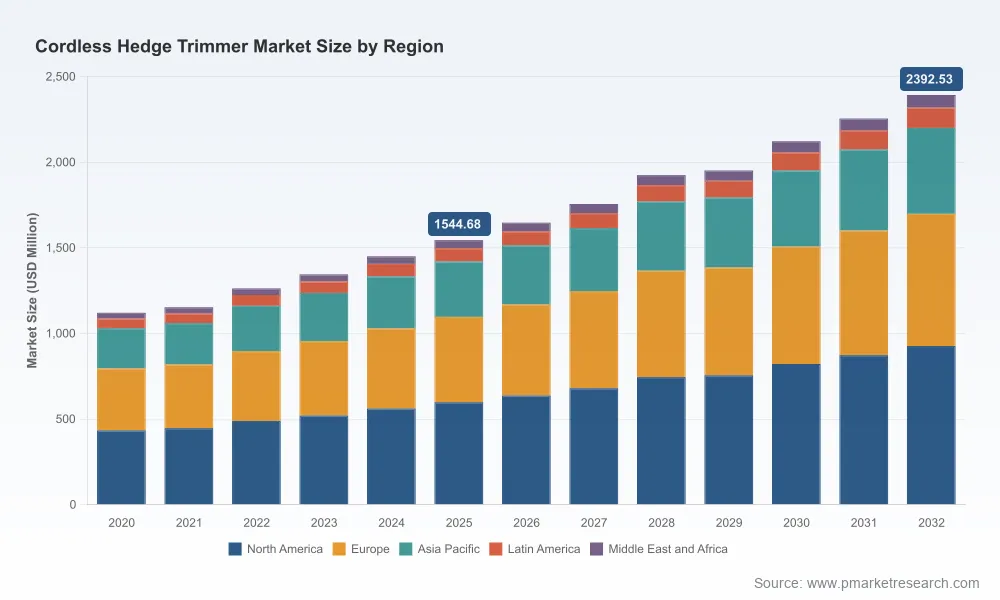
The global market for cordless hedge trimmers has moved from a niche alternative to a mainstream standard, reshaping how landscaping professionals and residential users approach outdoor maintenance. Measured in millions of U.S. dollars, the sector reached an estimated base value of approximately 1,544.68 million in 2025, reflecting a measured but consistent climb from 1,120.45 million in 2020. The trajectory points toward 2,392.53 million by 2032, underpinned by a compound annual growth rate of 6.45 percent across the 2026-2032 forecast horizon. This expansion is not merely a volume story; it signals a structural recalibration of powertrain preferences, user expectations, and distribution models. The market has crossed a threshold where battery-powered cutting tools are no longer defined by compromise but by competitive parity with, and in many cases superiority over, traditional combustion alternatives.
Yet the growth narrative coexists with palpable friction. Supply chain volatility, particularly around lithium-ion battery inputs, is introducing cost unpredictability that ripples through product pricing and margin planning. At the same time, regulatory pressure on emissions and noise is accelerating adoption, but it also compresses the window for manufacturers to align product portfolios with evolving compliance standards across different jurisdictions. A third tension lies in the segmentation of demand: while residential and do-it-yourself users continue to drive broad volume, professional and commercial buyers demand durability, runtime, and ecosystem compatibility that many consumer-grade offerings struggle to deliver consistently. The industry is therefore operating at an inflection point where scale, performance, and total cost of ownership must be balanced simultaneously. For decision makers, the implication is clear: market participation is no longer about entering the category but about choosing where to compete on performance, platform, or price.
Key Drivers Reshaping the Landscape
Battery Technology and Platform Ecosystems
The centerpiece of market momentum is the maturation of cordless powertrains. Brushless motors, higher-voltage architectures, and integrated battery platforms have collectively narrowed the performance gap with petrol equipment while eliminating emissions at the point of use. Manufacturers are increasingly designing hedge trimmers as nodes within broader outdoor power ecosystems rather than standalone tools. This platform logic reduces customer acquisition friction: once a user adopts a battery standard, cross-selling across trimmers, blowers, and pruners becomes more natural. The competitive advantage now hinges on runtime consistency, vibration dampening, and blade engineering that sustains clean cuts without excessive force. Recent product cycles illustrate this shift toward integrated performance. Executing a new model launch in early 2026, one leading specialist introduced dual-sided blade trimmers with magnesium gearboxes, rotating rear handles, and runtime claims reaching up to 80 minutes on a 2.5Ah battery, signaling that endurance and ergonomics are becoming as marketable as raw cutting power.
Policy and Regulatory Tailwinds
Regulatory and policy environments are reinforcing the transition to cordless equipment. Energy conservation mandates, urban noise restrictions, and low-carbon procurement preferences are tilting public and commercial spending toward battery-powered alternatives. The strategic significance extends beyond compliance: in many municipalities and commercial landscaping contracts, emissions-free and low-noise tools are becoming implicit requirements rather than optional green credentials. This dynamic expands the addressable market for quieter, cordless models and raises the stakes for manufacturers that lag in brushless motor adoption or battery platform integration. At the same time, trade policy can reintroduce cost pressure. For example, the United States increased steel and aluminum tariffs from 25 percent to 50 percent ad valorem in mid-2025, raising input costs for metallic components used in outdoor equipment. Such shifts introduce margin complexity even as demand fundamentals strengthen, requiring manufacturers to recalibrate sourcing, pricing, and product mix.
Changing User Behavior and Procurement Routines
Demand-side behavior is evolving on both the residential and professional fronts. Homeowners and DIY users increasingly prioritize ease of handling, low noise, and minimal maintenance over raw power, particularly where suburban density and shared outdoor spaces make noise a practical constraint. In parallel, professional contractors evaluate cordless trimmers through a total cost lens that includes downtime, battery replacement cycles, charging logistics, and compatibility with existing tool inventories. Regional sentiment underscores this shift: in the Nordic market, a substantial majority of respondents indicated that hedge trimmers should be battery-powered, reinforcing demand for quieter, user-friendly cordless designs. This behavior is not uniform globally, but it reflects a broader trajectory where convenience and operational cleanliness are overtaking legacy performance benchmarks rooted in combustion engines.
Reusable Gloves Market
Cost Structure and Supply Chain Dynamics
Cost structures are being rewritten by battery economics and material tariffs. Lithium-ion battery prices are projected to follow an overall upward trend with volatility through 2027, driven by rising raw material costs and surging demand across multiple industries. For hedge trimmer manufacturers, this translates into unpredictable input costs that can compress margins or force price adjustments. Companies that secure battery supply agreements, invest in platform-level battery standardization, or design for lower material intensity gain resilience. Conversely, those reliant on ad hoc component sourcing or single-voltage architectures face greater exposure to swings in battery pricing and metal tariffs. The net effect is a market where operational efficiency in procurement and platform design becomes a strategic differentiator, not just a back-office concern.
Competitive Landscape and Strategic Positioning
Platform Focus, Professionalization, and Value Segmentation
The competitive field is defined by divergent strategic positions rather than a single race to the top. STIHL has built a reputation around high-performance, low-noise, low-vibration cordless models aimed at demanding landscaping work, with a trimmer range that spans consumer and professional use. In early 2026, the company expanded its hedge-trimmer portfolio with new battery-powered long-reach models designed for safe ground-level trimming of tall hedges, reinforcing a positioning centered on reach, safety, and professional-grade reliability. Husqvarna has emphasized brushless motors and anti-vibration systems, marketing battery trimmers that approach the power of gas equivalents while integrating into a shared battery platform for both professional and residential segments. Makita continues to leverage its extensive 18V and 40V cordless ecosystem, framing usability as superior to petrol engines while delivering powerful cutting with reduced vibration, a strategy that benefits from cross-product advocacy among professionals who already operate within its tool set.
Voltage Architecture and Commercial Grading
EGO Power+ has carved a distinct lane through higher-voltage architectures and commercial-grade feature sets. Its 56V ARC Lithium platform anchors a line of hedge trimmers with rotating handles, magnesium gearboxes, and long runtime, targeting users who need repeatable performance across demanding schedules. DeWalt has pursued a different angle by embedding hedge trimmers within its 20V MAX XR and 60V MAX outdoor power equipment lineup, showcasing 60V MAX models alongside other outdoor solutions at major trade events in 2025 and expanding its brushless cordless offerings earlier in the year. This ecosystem-led approach appeals to professionals who value uniform battery platforms across multiple tool categories. Metabo and Bosch maintain presence in the 18V and 36V garden tool segments, emphasizing ergonomic design, reliable cutting, and compatibility with established battery systems, while Einhell addresses the accessible residential segment with affordable 18V kits that include batteries and chargers. Cramer, part of the GGM Group, occupies a high-performance position with an 82V cordless trimmer positioned as an alternative to petrol models, complemented by Bluetooth-connected battery monitoring through its GreenFleet app for professional fleet use. Greenworks rounds out the field with commercial and consumer cordless options, including telescopic pole models that extend reach while maintaining quiet, emission-free operation.
Concentration, Differentiation, and the Trajectory Ahead
Market concentration reflects a balanced but competitive structure, with the top three firms accounting for roughly 42 percent of value and the top five reaching close to 58 percent. This concentration indicates that scale and brand equity matter, but it also leaves meaningful space for specialization. The market is simultaneously integrating around battery platforms and differentiating through voltage tiers, blade technology, and fleet-management features. New entrants and established players alike are using long-reach designs, articulating heads, and app-linked battery diagnostics to create defensible niches. The strategic implication is that winning positions will depend on clarity of target user, consistency of platform experience, and the ability to manage input cost volatility without eroding perceived quality. Companies that treat cordless hedge trimmers as part of a broader service and ecosystem conversation are better positioned to retain customers across product cycles.
Future Trends and Commercial Implications
The Rise of Multi-Tool Platform Loyalty
Over the next three to five years, platform loyalty is likely to intensify as users and contractors consolidate around a limited set of battery standards. The commercial opportunity lies in designing trimmers that reinforce ecosystem stickiness through compatible batteries, predictable runtime, and accessories that extend use cases such as pole mounting and articulating heads. Manufacturers that can demonstrate dependable performance across seasons and battery cycles will capture recurring accessory and battery revenue in addition to tool sales. The risk is that fragmentation in voltage standards and charging protocols could slow adoption among buyers who hesitate to commit to a single platform, making interoperability claims and clear migration paths increasingly valuable.
Commercial-Grade Features Moving Down-Market
Features once reserved for professional models, including brushless motors, magnesium gearboxes, rotating handles, and battery monitoring, are expected to filter into mid-tier and value segments as manufacturing efficiencies improve and competitive pressure mounts. This democratization of performance expands the addressable market but also compresses price premiums for baseline features. The strategic response is to differentiate through durability testing, warranty structures, and fleet-oriented services rather than feature count alone. Companies that can validate long-term reliability and offer predictable total cost of ownership will stand apart as feature parity becomes more common. A related uncertainty is the trajectory of battery raw material costs and tariffs, which could delay the timing of cost reductions and alter the economics of down-market feature migration.
Regulatory and Environmental Expectations as Procurement Criteria
Low-noise and zero-local-emission operation will increasingly enter procurement specifications for municipal contracts, property maintenance services, and residential communities with noise constraints. The opportunity is to align product positioning, documentation, and service support with these procurement requirements, turning compliance into a competitive asset. Firms that proactively address noise, maintenance intervals, and end-of-life battery handling will find favor in settings where environmental and social expectations influence purchasing decisions. The uncertainty lies in the uneven pace of regulation across regions, which means that global product strategies must accommodate local differences in noise limits, emissions expectations, and trade policy without fragmenting the core platform.
Commercial Kitchen Ventilation Systems Market
Actionable Guidance for Decision Makers
For Manufacturers and Brand Leaders
Clarify the target user before scaling the portfolio. Professional and residential buyers evaluate cordless hedge trimmers through different lenses, and a single product architecture rarely optimizes for both. Prioritize platform consistency and battery ecosystem compatibility, because these factors shape cross-category adoption and customer retention. Build resilience against battery input volatility and metal tariffs by diversifying sourcing, standardizing high-volume components, and designing for material efficiency. Invest in validating durability and runtime under realistic use conditions, and communicate those results clearly, since perceived reliability now competes with price in purchasing decisions.
For Investors and Strategic Partners
Favor companies that demonstrate platform discipline, recurring accessory and battery potential, and exposure to commercial-grade segments where margin resilience is stronger. Monitor how firms manage the tension between rising battery costs and the downward migration of performance features, since this will determine who sustains profitability as competition intensifies. Pay attention to regions where regulatory and user sentiment favor cordless adoption, but verify that a company’s supply chain and pricing strategy can withstand localized tariff or material shocks.
PW Consulting
For Procurement and Fleet Buyers
Evaluate total cost of ownership rather than sticker price alone. Consider battery platform compatibility across existing tools, realistic runtime under load, maintenance intervals, and the availability of fleet-oriented diagnostics or service support. Where noise or emissions are constraints, prioritize brushless motor designs and verified low-vibration performance, and request evidence of durability under repeated seasonal use. Align purchases with clear procurement criteria around noise and emissions where applicable, and ensure that battery replacement and support logistics are in place before scaling a cordless fleet.
Market momentum is clear, but the composition of winners will be decided by how well organizations align product strategy, platform economics, and user expectations. For executives seeking region-level breakdowns, voltage-tier trajectories, and tailored scenario planning, a comprehensive research report provides the granular data and customized recommendations needed to convert these trends into execution. The strategic window is open now, before platform loyalties harden and cost volatility reshapes margin assumptions.
For detailed analysis of this topic, please visit the official page: Worldwide Cordless Hedge Trimmer Market
Lacy Lee
Senior Marketing Manager
[email protected]
PW Consulting: www.pmarketresearch.com

























Sign in to leave a comment.