
Navigating the Global 4-Pentyn-1-Ol Market: Strategic Trends and Commercial Opportunities
The specialty chemicals sector has entered a phase of disciplined expansion, where value creation increasingly depends on precision, regulatory compliance, and supply chain resilience rather than sheer volume growth. Within this context, the global market for 4-pentyn-1-ol has emerged as a focused but strategically relevant niche. Driven by its role as a critical building block in pharmaceutical intermediates and advanced organic synthesis, the market reflects broader shifts in how high-value chemical ingredients are sourced, manufactured, and integrated into end-product pipelines. Market size data across the 2020–2025 period shows steady progression from approximately $16.24 million to $21.05 million, with projections extending to $30.63 million by 2032. This trajectory corresponds to a compound annual growth rate of roughly 5.51% over the forecast window, signaling consistent, not explosive, demand expansion.
Such growth rates are characteristic of specialized chemical intermediates that sit at the intersection of R&D-driven discovery and scaled manufacturing. The market’s momentum is not uniform across all use cases or geographies, and this uneven distribution reveals important strategic signals. Companies operating in this space are increasingly evaluated not just on price or availability, but on purity consistency, documentation rigor, and supply reliability. As downstream industries face tighter quality expectations and more complex development timelines, the suppliers that can align technical specifications with operational dependability are capturing disproportionate relevance.
Market Reality and the Core Challenges Ahead
A Market Defined by Precision, Not Scale
The commercial landscape for 4-pentyn-1-ol is concentrated, with the top three players accounting for approximately 42.5% of total market share and the top five reaching nearly 58.8%. This level of concentration indicates that the market rewards scale efficiency, established customer relationships, and strong technical support capabilities. At the same time, a long tail of smaller manufacturers and specialty distributors continues to operate, often competing on regional proximity, niche purity grades, or flexible packaging options for research quantities. The result is a bifurcated environment where large, multi-product chemical platforms and focused regional producers coexist, each serving different segments of the demand spectrum.
The market’s architecture is shaped less by commoditization and more by application-specific requirements. High-purity grades command a substantial portion of overall revenue, reflecting the needs of pharmaceutical development and regulated manufacturing environments where impurity profiles, traceability, and certificate-level documentation directly influence procurement decisions. Below 98% purity grades, while smaller in relative value, still serve legitimate demand in laboratory research and less regulated synthesis pathways, where cost efficiency and convenient pack sizes matter more than stringent certification. This segmentation underscores a market where product differentiation is driven by technical readiness rather than marketing claims.
Key Challenges and Inflection Points
Three structural challenges are reshaping the pathway for participants in this market. First, purity and consistency requirements are becoming more demanding as downstream drug development and specialty chemical processes increasingly rely on tightly controlled intermediate inputs. Variability in assay results, residual solvent levels, or packaging integrity can create costly delays in R&D and production scheduling, pushing buyers toward suppliers with proven quality systems and repeatable lot-to-lot performance.
1,2-Pentanediol Market
Second, supply chain resilience has moved from a back-office concern to a strategic priority. The market’s dependence on specialty alkyne alcohol synthesis means that raw material availability, manufacturing capacity, and logistics reliability can influence lead times and pricing behavior. Companies that rely on single-source sourcing or geographically concentrated production face heightened exposure to disruptions, prompting a broader industry conversation about multi-node sourcing, buffer inventory strategies, and qualified alternate suppliers.
Third, the competitive field is maturing in a way that raises the bar for new entrants. A concentrated group of established suppliers already serves research, pharmaceutical, and industrial laboratory demand with defined product specifications, regional warehousing, and documented quality assurances. Aspiring entrants must therefore bring a clear differentiator, such as superior purity validation, more responsive technical support, competitive bulk pricing, or stronger integration with specific downstream application workflows. Without such a position, competing purely on list price becomes a race to the bottom.
Key Drivers Reshaping Demand and Supply Dynamics
Pharmaceutical Innovation and Intermediate Demand
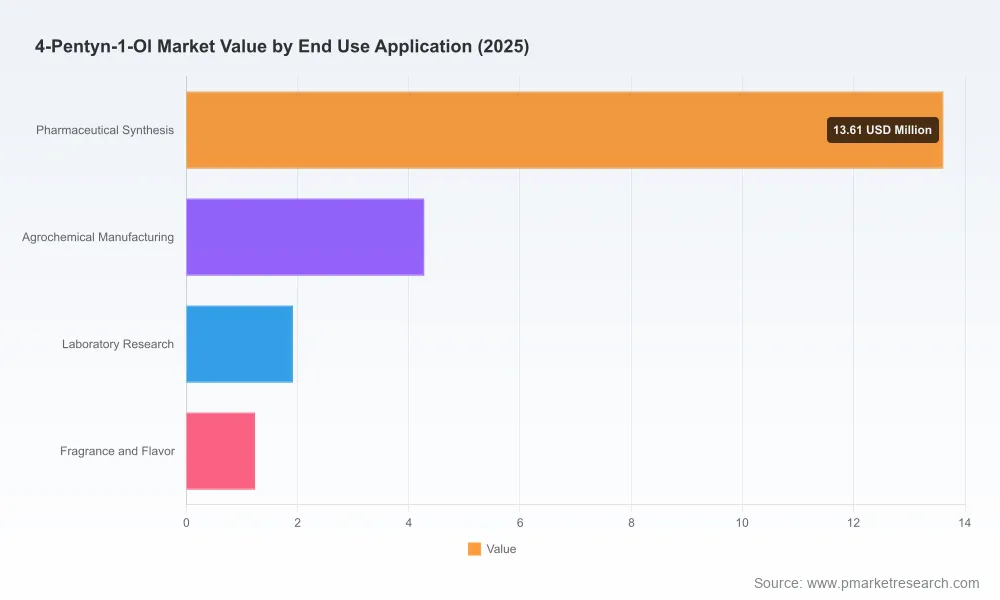
The most consequential demand driver for 4-pentyn-1-ol is its role in pharmaceutical intermediate synthesis. As a specialty alkyne alcohol, it functions as a building block in organic synthesis pathways that feed into drug development and active pharmaceutical ingredient manufacturing. The market’s strongest value concentration aligns with this reality, as pharmaceutical synthesis applications together represent the largest share of end-use demand. More importantly, the commercial relevance of the molecule is amplified by its connection to therapeutic development pipelines, including use in the production of vibegron for overactive bladder treatment.
This therapeutic link matters for two reasons. First, it anchors demand in a regulated, high-value context where consistency and documentation carry tangible commercial weight. Second, it creates a forward-looking demand signal tied to clinical progress, regulatory milestones, and eventual commercialization. When a drug candidate advances through development stages, intermediate supply needs often become more structured, with buyers seeking reliable volume commitments, clear specification alignment, and supplier continuity across project phases.
Regulatory and Quality Expectations Tightening
Regulatory scrutiny across pharmaceutical and fine chemical supply chains is reinforcing demand for well-documented, analytically verified products. Buyers increasingly expect certificates of analysis, lot traceability, and clear statements of purity and impurity profiles. This trend is not unique to 4-pentyn-1-ol, but it becomes especially relevant for intermediates used in regulated synthesis where downstream quality failures can cascade into significant rework or compliance risk. Suppliers that standardize their documentation, maintain robust quality management practices, and provide transparent technical data sheets are better positioned to retain and expand customers in this environment.
At the same time, regulatory dynamics can create bottlenecks for less organized producers. Documentation gaps, inconsistent quality control, or limited technical responsiveness may be acceptable in low-stakes laboratory purchases, but they become disqualifying factors when procurement teams must justify supplier selection to internal quality or compliance functions. The practical effect is a gradual reallocation of higher-value demand toward suppliers that can demonstrate process control and repeatability.
Regional Demand Patterns and Supply Localization
Demand is distributed across multiple regions, with Asia Pacific representing the largest revenue base, followed by North America and Europe, while other regions contribute a smaller but meaningful share. This geographic distribution reflects the broader geography of pharmaceutical development, chemical research, and industrial synthesis activity. It also highlights a practical operational challenge: demand in one region does not automatically translate into supply efficiency in that same region unless local warehousing, technical support, and logistics infrastructure are aligned.
Pentane Market
The localization trend is not simply about shipping from closer facilities. It is about reducing lead-time uncertainty, improving responsiveness for urgent research or pilot-scale orders, and increasing confidence in supply continuity. Suppliers with regional stock availability or the ability to quote and fulfill bulk orders efficiently are gaining a practical advantage, especially when buyers are evaluating total cost of ownership rather than unit price alone.
Cost Structure and Specialty Chemical Economics
Pricing in specialty chemical markets is influenced by a combination of synthesis complexity, purity targets, pack configuration, and order volume. For 4-pentyn-1-ol, the economic value is tied less to bulk commodity dynamics and more to the cost of producing consistent, application-ready material with reliable documentation. As a result, cost structures are shaped by process efficiency, quality control overhead, packaging flexibility, and the ability to serve both small research packs and larger bulk requirements without compromising specification integrity.
This dynamic creates an opportunity for suppliers that can balance scale with flexibility. Companies that can maintain competitive pricing for routine research quantities while also offering volume-based quoting and consistent purity for industrial or pharmaceutical customers are better positioned to capture demand across multiple buying contexts. Conversely, suppliers that handle only one end of the spectrum may miss adjacent demand or cede it to multi-segment competitors.
Competitive Landscape and Strategic Positioning
How Leading Players Differentiate
The competitive field is anchored by established chemical suppliers with strong brand recognition, broad application portfolios, and well-developed distribution networks. These companies do not compete on 4-pentyn-1-ol alone; rather, they compete on their ability to serve research, pharmaceutical, and industrial customers across a wider catalog of specialty chemicals. Within that framework, their positioning for 4-pentyn-1-ol typically emphasizes specification clarity, documentation, stock availability, and the convenience of ordering through mature e-commerce or technical sales channels.
For example, large global suppliers with extensive research-grade chemical portfolios often differentiate by combining multiple purity options, detailed specification sheets, and certificates that support regulated purchasing. Their scale and established quality infrastructure make them a default choice for laboratories and R&D teams that prioritize consistency and procurement ease. Regional manufacturers and distributors, by contrast, may compete on proximity, customized packaging, or the ability to support specific synthesis workflows. In some cases, Indian-based manufacturers position themselves as export-oriented suppliers with analytical documentation, aiming to serve pharmaceutical and chemical buyers seeking cost-competitive yet quality-assured material.
Strategic Positioning in a Concentrated Market
Market concentration does not automatically imply stagnation. In specialty chemical niches, concentration often reflects the commercial reality that a limited number of suppliers can efficiently meet the documentation, purity, and reliability requirements of the highest-value demand. This creates a market where incumbents can defend share through technical credibility and service reliability, while still facing pressure from suppliers that offer better regional availability, more responsive quoting, or more attractive bulk economics.
Differentiation is increasingly multi-dimensional. Some suppliers focus on providing well-established purity grades with clear certificates and pack-size flexibility. Others lean into warehouse proximity and fast fulfillment for research quantities. Still others emphasize manufacturing and export capabilities with documented quality control for customers that require supplier qualification. None of these approaches is universally superior; each aligns with different buyer priorities. What matters strategically is whether a supplier can articulate and deliver a value proposition that matches the purchasing criteria of its target segment.
Emerging Structural Trends in the Competitive Field
The market is likely to see gradual consolidation pressure at the higher end, where larger players benefit from cross-selling, integrated quality systems, and global logistics reach. At the same time, regional specialists and focused exporters may continue to thrive by serving localized demand efficiently or by filling gaps in specific purity ranges and pack configurations. New entrants will find the most traction not by displacing established suppliers across the board, but by targeting underserved buying contexts: fast-response research supply, custom purity documentation, or competitive bulk pricing with dependable lead times.
Another observable trend is the growing importance of supplier qualification as a commercial gate. Procurement teams increasingly evaluate not only the chemical itself, but also the operational maturity behind it. This includes the ability to provide reproducible analytical results, maintain supply during demand spikes, and communicate clearly when specification or availability changes occur. Suppliers that treat these operational details as part of the product offering, rather than as back-office functions, are building durable competitive advantages.
Forward Outlook: Three Trends to Watch
Trend One: Demand Will Remain Application-Led, Not Volume-Led
Over the next three to five years, demand growth is expected to remain closely tied to pharmaceutical intermediate utilization and specialty synthesis needs rather than broad-based industrial volume expansion. The market’s structure favors applications where specification control, documentation, and reliability directly affect downstream timelines and compliance. As a practical implication, suppliers that align their capabilities with pharmaceutical adjacent workflows will likely see more stable demand capture than those competing in lower-requirement segments without a clear service advantage.
The commercial opportunity here lies in anticipating application-driven procurement behavior. Buyers in development-stage pipelines often need a supplier that can move with them from research quantities to larger orders as projects advance. Suppliers that can accommodate this progression, while maintaining specification integrity and transparent documentation, can convert early-stage research demand into longer-term commercial relationships.
Trend Two: Quality Systems and Documentation Will Become More Commercial, Not Just Compliance
Quality documentation is transitioning from a compliance checkbox to a competitive differentiator. As procurement becomes more rigorous, buyers are more likely to favor suppliers that make analytical data, certificates, and lot traceability straightforward to access and verify. This does not necessarily require the largest organization; it requires disciplined processes and a customer-facing commitment to transparency.
For suppliers, the strategic implication is clear: invest in the repeatability of quality output and the clarity of the supporting documentation. For buyers, this trend increases the importance of supplier evaluation beyond price. The most resilient purchasing decisions will likely come from suppliers whose quality systems reduce uncertainty in the downstream workflow.
Trend Three: Supply Chain Redundancy and Regional Fulfillment Will Gain Strategic Weight
Supply continuity will remain a central theme, particularly for buyers exposed to project timelines or pilot-scale production constraints. This reinforces the value of suppliers with regional stock, multi-node logistics, or the ability to offer named alternative routes when primary supply is constrained. The market is unlikely to reward fragility, even at lower price points, if it introduces avoidable delay risk into research or manufacturing schedules.
The associated opportunity is for suppliers to build credibility through reliability rather than only through catalogue breadth. This may involve strengthening regional inventory positions, improving order-to-delivery consistency, or formalizing bulk-quote processes that make larger commitments easier to plan. Buyers, in turn, will likely prioritize suppliers that reduce operational uncertainty, especially when a molecule such as 4-pentyn-1-ol is embedded in critical synthesis pathways.
PW Consulting
Strategic Implications for Decision-Makers
For Chemical Manufacturers and Suppliers
Manufacturers should treat 4-pentyn-1-ol as a specification-driven product rather than a commodity item. The most defensible position combines consistent purity control, clear documentation, and flexible order handling across research and bulk contexts. Rather than attempting to compete on price alone, suppliers can create durable advantage by reducing buyer risk: predictable lot quality, responsive technical communication, and reliable fulfillment for both small research packs and larger supply requirements.
It is also wise to clarify which segment is being served and to align capabilities accordingly. A supplier oriented toward laboratory research may prioritize pack variety and fast availability. A supplier oriented toward pharmaceutical-adjacent demand may prioritize documentation rigor, quality control consistency, and the ability to support supplier qualification processes. Trying to serve both without clear process discipline can dilute reputational value and operational focus.
For Investors Evaluating the Specialty Chemicals Space
From an investment perspective, the market illustrates the value of steady, application-anchored growth rather than cyclical volume swings. The compound annual growth trajectory reflects a niche that expands as pharmaceutical and specialty synthesis activity advances, but the more important question is which suppliers can convert that growth into margin resilience. Investors should look for evidence of quality system maturity, customer retention in higher-value segments, and credible pathways to scale without compromising specification integrity.
Equally important is the risk profile. Concentration creates both stability and exposure. Established players may enjoy repeat demand and procurement familiarity, but they remain vulnerable to operational disruptions, pricing pressure from regional competitors, or shifts in downstream demand if key development programs change pace. Due diligence should therefore examine not only revenue trajectory, but also supply chain redundancy, documentation practices, and the breadth of the customer base across applications and regions.
For Buyers and Procurement Teams
Procurement teams should evaluate suppliers using criteria that extend beyond unit cost. For application areas where purity and documentation directly affect downstream work, the total cost of ownership may be lower with a supplier that offers stronger quality assurance, clearer analytical support, and more reliable fulfillment. In research contexts, the priority may be pack flexibility and availability; in industrial or pharmaceutical-adjacent contexts, the priority may shift to qualification readiness and consistency across lots.
It is also prudent to avoid over-reliance on a single source where project timelines are sensitive. Establishing qualified alternate suppliers, defining acceptable specification boundaries in advance, and aligning ordering patterns with project milestones can reduce exposure to disruption. A disciplined procurement approach in this market means matching supplier capability to application criticality rather than applying a uniform purchasing standard across all use cases.
Conclusion: Turning Niche Relevance into Strategic Advantage
The global market for 4-pentyn-1-ol is not a mass-market chemical story, and that is precisely what makes it strategically interesting. Its value lies in precision, documentation, and application relevance. Demand is anchored in pharmaceutical intermediate synthesis and specialty organic chemistry, and the suppliers that win in this space are those that reduce uncertainty for buyers through consistent purity, clear quality support, and dependable supply.
Looking ahead, the market’s evolution will likely be shaped by three interconnected forces: application-led demand tied to pharmaceutical development, tighter expectations around quality documentation and supplier qualification, and an increasing premium on supply resilience and regional fulfillment. These forces create a market where competitive advantage is earned through operational discipline and customer-facing technical credibility, not through broad advertising or undifferentiated pricing.
For organizations seeking to navigate this market with precision, a deeper understanding of segment-level demand patterns, purity-grade economics, regional growth dynamics, and supplier-specific positioning can make a meaningful difference in strategic planning. Detailed segmentation data, competitive profiles, and forward-looking scenario analysis can help translate broad market trends into actionable decisions for sourcing, investment, and product strategy. For those who need that level of granularity, a comprehensive market research report offers the structured detail necessary to move from directional insight to execution-ready strategy.
For detailed analysis of this topic, please visit the official page: Worldwide 4-Pentyn-1-Ol Market
Lacy Lee
Senior Marketing Manager
[email protected]
PW Consulting: www.pmarketresearch.com






























Sign in to leave a comment.