
Navigating the Worldwide Car Bulbs Market: Strategic Trends and Commercial Opportunities Through 2032
The global automotive lighting sector stands at an inflection point. Across 2020 to 2025, worldwide car bulbs revenue expanded steadily from approximately 5,680 million to 7,243 million, reflecting both replacement demand and gradual technology upgrades within the vehicle parc. The forward trajectory outlined for 2026 through 2032 points toward a compound annual growth rate of 5.71 percent, with market size projected to climb toward 10,677 million by the end of the decade. This expansion is not merely a story of volume; it is a structural shift in how vehicles are illuminated, regulated, and serviced across regions and segments.
For executives and investors evaluating this space, the headline numbers tell only part of the story. The market’s composition, regional weight, and the way value migrates between halogen, LED, and xenon technologies create both risk and opportunity. Concentration among leading suppliers remains notable, yet regulatory mandates, consumer behavior, and new product introductions are gradually reshaping who captures margin and where. Understanding these dynamics is essential for positioning portfolios, pricing strategies, and supply commitments in the years ahead.
Market Snapshot and Structural Challenges
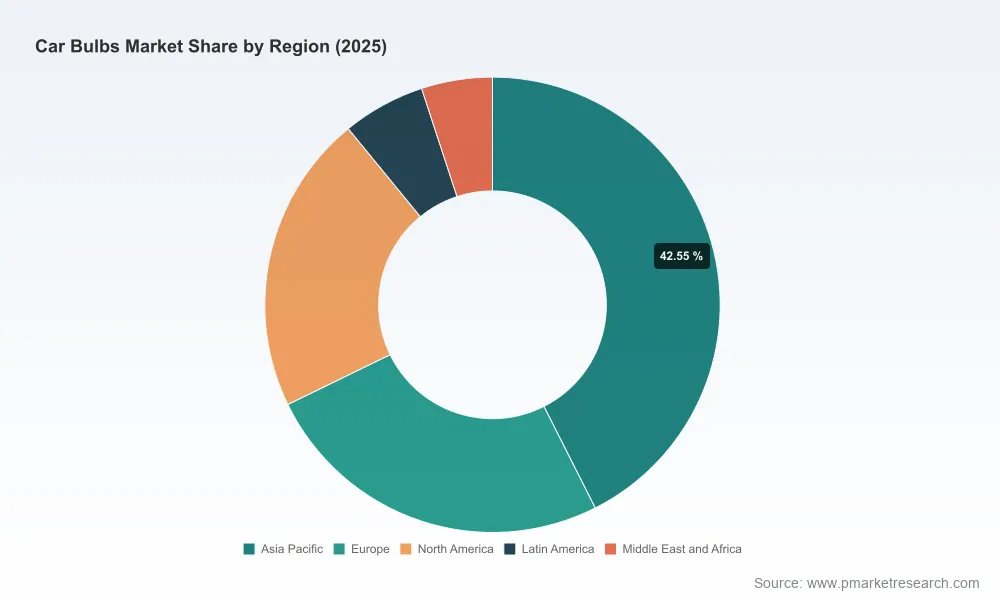
The current market picture reflects a mature but still evolving ecosystem. Base-year revenue sits at 7,243 million, with a moderate but consistent upward slope through 2032. Asia Pacific carries the largest regional share, followed by Europe and North America, while Latin America and the Middle East and Africa contribute smaller but growing portions. In terms of technology, halogen bulbs remain the largest segment, though LED bulbs are gaining share as vehicles adopt more energy-efficient and longer-life illumination solutions. By application, headlights dominate the demand base, with signal and brake lights and interior lighting representing significant but smaller value pools.
Against this backdrop, three challenges define the near-term environment. First, regulatory divergence is accelerating across key markets, pushing manufacturers and aftermarket suppliers to align with stricter photometric performance criteria and, in some cases, phasing out legacy technologies for new vehicle types. This moves the market away from a uniform global product architecture toward region-specific compliance and engineering. Second, the widening gap between OEM specifications and aftermarket substitution creates tension in the replacement segment. Consumers increasingly seek LED upgrades, but fitment, legality, and housing compatibility introduce friction that affects both sales velocity and liability exposure. Third, raw material trajectories remain uneven. While some legacy inputs continue to see sustained demand in certain bulb segments, the overall cost structure is being recalibrated as suppliers shift capacity toward higher-value lighting modules and electronic controls.
The practical implication for industry stakeholders is that aggregate growth can mask segment-level volatility. Companies that manage only to total market expansion risk underweighting the pockets where regulation, product availability, and substitution patterns are converging most quickly.
For manufacturers and aftermarket players alike, the key question is not simply how fast the market grows, but where value is created and defended. The balance between halogen continuity, LED penetration, and xenon niches is shifting, and the competitive advantage increasingly lies in matching product architecture to regulatory timelines and vehicle mix rather than relying on historical substitution cycles alone.
Key Drivers Shaping the Market
Several forces are converging to reframe the long-term direction of car bulbs. The interplay of technology, regulation, demand behavior, and supply economics is producing a market in which product strategy must be localized even as global trends remain recognizable.
Technology innovation is moving from incremental brightness improvements to system-level performance and longevity. LED car bulbs now offer lifespans reaching up to 50,000 hours compared with traditional halogen alternatives, a difference that influences both OEM specification decisions and aftermarket upgrade interest. In practice, this durability advantage is not just a technical specification; it alters total cost of ownership calculations, warranty expectations, and the relative attractiveness of bulb replacement cycles over the life of a vehicle. The availability of street-legal LED street replacement options for halogen headlights across more than 1,000 approved vehicle models further signals how quickly retrofit demand is becoming organized around certified performance rather than ad hoc substitutions.
At the same time, policy and regulatory environments are becoming more prescriptive. In the United States, headlamp photometric requirements continue to shape what can be sold as replacement lighting, with aftermarket LED bulbs in halogen housings generally not compliant unless the full assembly is certified. In Europe, regulations effective from 2024 prohibit new vehicle types from using halogen headlights for high beams in favor of more advanced technologies. These measures do not simply constrain the market; they redirect it. They create sequencing effects in product roadmaps, influence the pace at which halogen demand erodes for new vehicles, and elevate the importance of certified assembly-level solutions for replacement channels.
Demand-side behavior is changing in parallel. Vehicle owners and commercial fleets are increasingly attentive to visibility, safety perception, and modern aesthetics, which supports interest in upgraded lighting even in segments where the base vehicle used halogen architecture. At the same time, the aftermarket is seeing catalog expansion with updated LED bulb lines for common formats and projector-lens solutions designed for OEM and ODM applications. This suggests that demand is not only growing in volume but becoming more segmented, with distinct opportunity sets for certified replacement, performance upgrades, and integration-oriented supply.
Supply chain and cost structure dynamics add another layer of complexity. Even as LED adoption advances, certain legacy inputs maintain sustained demand in select segments, reflecting the reality that halogen and specialized filament-based products still occupy meaningful share in the broader market. The coexistence of legacy and advanced technologies means suppliers must manage dual cost curves, balancing filament-grade inputs with semiconductor-driven component sourcing, thermal management, and electronics integration. This is reshaping sourcing strategies and influencing where margin is earned across the value chain.
Taken together, these drivers favor participants who can align product development with compliance timelines, respond to segment-specific replacement demand, and manage a blend of legacy and advanced technologies without losing focus on the highest-value growth paths.
Competitive Landscape and Leading Strategies
The competitive environment is shaped by a mix of established global suppliers, regional specialists, and companies extending their lighting capabilities into higher-value modules and systems. Market concentration underscores how much of the landscape is anchored by a relatively small group of players, with the top three holding a meaningful share and the top five extending further. Such concentration does not eliminate competition; it intensifies the importance of differentiation in technology, compliance readiness, and channel reach.
Leading companies are positioning around several complementary strengths. Global lighting suppliers with broad OEM and aftermarket coverage are emphasizing high-performance headlight and signal solutions, along with expanded compatibility across vehicle models. This approach supports both volume stability and the ability to capture upgrade demand where certification and fitment can be demonstrated. Other major participants are leaning into comprehensive lighting systems and replacement bulb portfolios that bridge conventional and LED offerings, strengthening their role in OEM integration while maintaining aftermarket relevance.
Japanese manufacturers continue to play an important role in automotive lighting components, producing halogen, HID, and LED bulbs for headlamps and signal lights supplied to major OEMs. Their positioning reflects deep relationships with vehicle assemblers and a strong emphasis on reliability and specification adherence. Similarly, suppliers focused on energy-efficient LED and adaptive systems are investing in product lines that align with regulatory momentum and the shift toward smarter exterior lighting. Specialist premium lighting companies and major aftermarket brands round out the field by targeting specific vehicle applications, replacement ecosystems, and performance-oriented upgrades.
Recent developments illustrate how this landscape is being actively reshaped. Plans to showcase advanced rear lamps with local dimming and other lighting innovations emphasizing energy efficiency and speed to market at a major industry event highlight the continued push toward system-level differentiation rather than standalone bulb commoditization. At the same time, the broader availability of street-legal LED street replacement lamps for halogen headlights across a large number of approved vehicle models demonstrates the practical expansion of certified retrofit solutions. Updated automotive LED bulb catalogs covering common formats and projector-lens solutions for OEM and ODM applications further show how product breadth is increasing to meet segment-specific demand.
The competitive evolution appears headed toward a blend of consolidation pressure and segmentation. Larger players with scale and compliance infrastructure are well placed to capture OEM-driven transitions and broader replacement demand, while more focused suppliers can compete by specializing in particular vehicle applications, regions, or upgrade pathways. New entrants and mid-tier manufacturers are likely to find opportunity where certification, localization, and application-specific engineering create barriers that generic substitution cannot easily cross. The net effect is a market that rewards clarity of positioning: broad coverage with credible compliance, or focused advantage with a defensible technical or channel niche.
Outlook: Three Strategic Trends for 2026–2032
Looking ahead, the market trajectory points toward several developments that will influence where growth accumulates and how competitive advantage is built.
One trend is the gradual but uneven migration from halogen-dominant architectures toward LED-forward and system-integrated lighting, shaped not only by technology preference but by regulatory sequencing. Because compliance obligations differ by region and by new-vehicle type, the transition will not be uniform. Instead, it will create staggered demand patterns in which halogen remains relevant in certain segments even as LED gains in higher-value applications. For businesses, this means planning for a blended horizon rather than a single replacement cycle.
A second trend is the expansion of certified aftermarket pathways as replacement demand becomes more structured. As more LED replacement options become available for approved vehicle models and as catalog depth increases, the aftermarket is likely to see more organized consumption around fitment, legality, and performance claims. The commercial opportunity lies in making compliance and compatibility visible and credible, reducing the friction that still limits broader upgrade adoption in some markets.
A third trend concerns the interplay between bulb-level products and broader lighting modules. As exterior lighting incorporates more advanced functions, local dimming, and energy-efficient design, value begins shifting from the bulb alone toward integrated solutions and modules. This does not eliminate the bulb market, but it changes where margin concentrates and which capabilities matter most. Suppliers that can bridge replacement bulbs with application knowledge, certification readiness, and module-level innovation are better positioned to capture the next layer of value creation.
Automotive Lighting Market
These trends carry risks as well as opportunities. Regulatory interpretation can shift, especially where photometric performance and housing compatibility are concerned, and non-compliant substitution may face enforcement scrutiny. Regional divergence may complicate global product plans and increase engineering overhead. In addition, the persistence of legacy demand in some segments can blur strategic focus if companies fail to distinguish between sunset demand and durable demand. Managing these risks requires disciplined segmentation, clear compliance positioning, and a realistic view of where the market is transitioning fastest.
Actionable Implications for Decision-Makers
For manufacturers, the priority is to align product roadmaps with regulatory calendars and vehicle-mix realities. This means treating halogen continuity, LED expansion, and xenon niches as separate strategic briefs rather than a single market narrative. Investment should be directed toward certified fitment, application-specific engineering, and the product breadth needed to serve both OEM and aftermarket channels without diluting compliance standards. Companies that can demonstrate real compatibility and performance credibility will be better placed to capture the organized upgrade demand emerging in the replacement segment.
For investors, the most valuable lens is segment-level differentiation rather than aggregate growth alone. The market’s 5.71 percent CAGR through 2032 is meaningful, but returns will be influenced by the mix of technology transitions, the pace of regulatory enforcement, and the ability of leading players to convert product availability into compliant, high-margin volume. Due diligence should examine where each company earns its share, how exposed it is to legacy-versus-advanced technology tension, and whether its channel strategy can convert replacement interest into repeatable sales without compliance friction.
Car Batteries Market
For procurement and sourcing leaders, the practical task is to balance continuity with transition risk. Long-term supply commitments should account for the coexistence of halogen, LED, and specialty segments while anticipating regulatory timelines that may accelerate phase-outs in specific vehicle types. Sourcing strategies should favor suppliers with proven certification capabilities, stable compatibility claims, and the ability to support both current production needs and evolving retrofit demand. In this context, visibility into segment-level forecasts, regional compliance direction, and product-availability shifts is not a nice-to-have; it is a decision-quality requirement.
PW Consulting
The market is advancing, but not evenly. Regions, technologies, and applications are moving at different speeds, and the commercial winners will be those who treat that unevenness as a source of insight rather than noise. For leaders who need a precise view of regional breakdowns, technology splits, application-level demand, company positioning, and scenario-sensitive forecasts, the full research report provides the detailed segmentation data and customized guidance required to turn these strategic themes into executable plans.
For detailed analysis of this topic, please visit the official page: Worldwide Car Bulbs Market
Lacy Lee
Senior Marketing Manager
[email protected]
PW Consulting: www.pmarketresearch.com

























Sign in to leave a comment.