
Global Casing Spools Market: Strategic Trends and Commercial Opportunities Through 2032
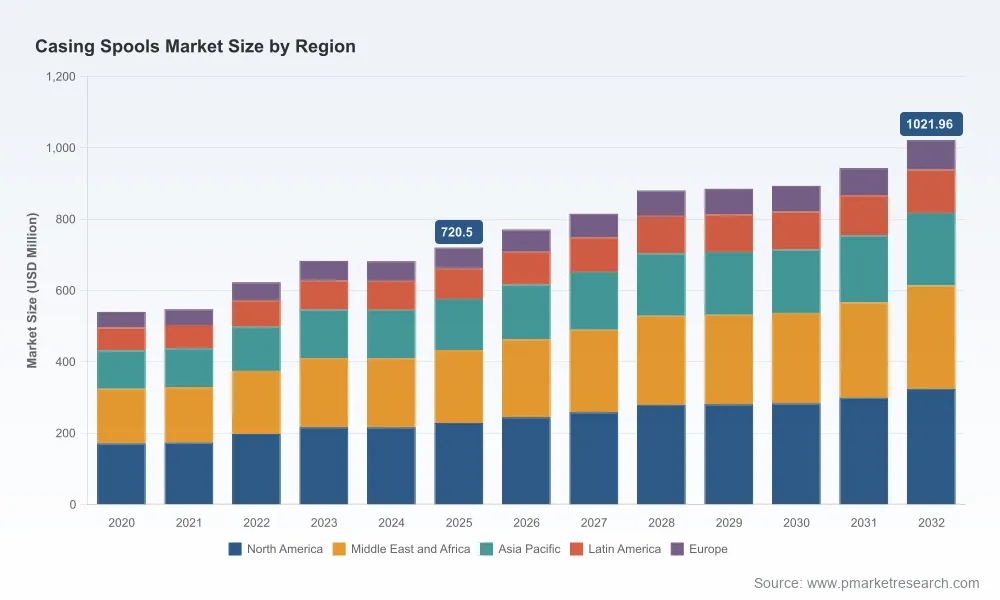
The global marketplace for casing spools has entered a phase of measured expansion, shaped by evolving drilling complexity, regional demand shifts, and tightening operational standards. Valuations for the period spanning 2020 through 2025 illustrate a trajectory that moved from approximately 540 million USD to over 720 million USD, reflecting how infrastructure investments and well completion activity have recalibrated procurement patterns across the oil and gas sector. Looking ahead to the forecast horizon ending in 2032, the total market is projected to approach the one billion USD threshold, sustained by a compound annual growth rate that signals steady, rather than explosive, expansion. This growth profile underscores a market that is maturing alongside the broader upstream industry, where marginal efficiency gains and selective project execution matter more than volume-driven surges.
Despite the constructive outlook, several structural tensions are reshaping how operators, fabricators, and equipment suppliers approach casing spool procurement and deployment. The first challenge centers on engineering complexity. As drilling campaigns extend into ultra-deepwater, high-pressure high-temperature (HPHT) formations, and sour service environments, the performance requirements for wellhead assemblies have become increasingly exacting. Casing spools must now accommodate higher pressure ratings, enhanced sealing integrity, and material specifications that resist creeping degradation under prolonged thermal and mechanical stress. Suppliers that rely on legacy designs face mounting pressure to iterate faster, while operators weigh the cost of advanced configurations against the risk of downtime or well integrity incidents.
A second challenge emerges from input cost volatility and trade policy shifts. The cost of forged and low-alloy steel, the primary raw material base for casing spools, has become more sensitive to tariff adjustments and regional supply constraints. Recent tariff escalations on steel and aluminum derivatives in major consuming markets have the potential to elevate wellhead equipment costs across a broad band, forcing manufacturers to absorb margins or pass expenses downstream. In an environment where project economics are already scrutinized, even modest material cost increases can alter procurement timing, vendor selection, and contract negotiation leverage.
Third, the industry is navigating a more fragmented regulatory and localization landscape. Oil-producing regions are increasingly implementing local content mandates and procurement preferences that encourage domestic manufacturing and service capabilities. While these policies can stimulate regional investment, they also complicate global supply chain planning and create uneven competitive conditions. Suppliers that once operated with centralized production footprints are now evaluating how to balance economies of scale with the need to establish or partner in regional fabrication capacity.
Taken together, these dynamics signal a market that is no longer driven solely by brute volume expansion. The commercial winners will be those who can manage engineering trade-offs, respond to cost pressures without compromising reliability, and adapt their supply footprints to regional requirements. For decision-makers, the practical implication is clear: casing spool procurement and production strategy must be evaluated through a lens of resilience, compliance, and application-specific performance rather than commodity replacement logic.
Key Drivers Reshaping Demand and Supply in the Casing Spools Market
Technological Innovation and Material Engineering
The most immediate catalyst for market evolution is the continued advancement of wellhead component engineering. Casing spools are no longer interchangeable mechanical interfaces; they are increasingly integrated into assemblies that must perform under extreme stress profiles. Forged steel and low-alloy steel formulations, refined to meet API Spec 6A requirements, remain the foundation, but the differentiation now lies in how those materials are deployed. Enhanced sealing technologies, improved thread integrity, and designs that reduce susceptibility to corrosion and fatigue are becoming baseline expectations, especially for HPHT and deepwater applications.
This engineering shift is also encouraging modular thinking. Rather than treating casing spools as isolated hardware, leading suppliers are designing them as part of broader wellhead and surface pressure control architectures. This modular orientation improves installation efficiency, simplifies maintenance, and supports digital monitoring integration. Where traditional procurement focused on unit pricing, operators are increasingly evaluating total lifecycle cost, includinginstallation friction, compatibility with existing hangers, and the reliability of pressure control pathways.
Regulatory Standards and Compliance Pressure
Standards compliance continues to function as both a barrier and a value driver. API Spec 6A defines the materials, dimensions, test procedures, and pressure ratings that guide wellhead equipment, and adherence to these specifications remains non-negotiable for credible market participation. In practice, this means that manufacturing quality systems, traceability, and testing rigor are becoming as important as product geometry. Companies that can demonstrate consistent compliance across product lines gain trust in bidding processes, particularly where well integrity and operational safety are under heightened scrutiny.
At the same time, regulatory environments are becoming more regionally differentiated. Policy changes in key producing regions are encouraging local content requirements, prompting equipment manufacturers to localize production, forge partnerships, or restructure supply arrangements. Compliance is therefore no longer purely technical; it is also geopolitical and commercial. Suppliers that can align with regional content expectations while maintaining consistent product standards are gaining preferential access in certain project pipelines.
Demand-Side Shifts Toward Deepwater, HPHT, and Reliability-Focused Operations
Demand patterns are being reshaped by where operators are drilling and how they are managing risk. Rising investments in deepwater, ultra-deepwater, and HPHT drilling projects are expanding the addressable market for advanced casing spools with enhanced sealing and corrosion resistance. These environments reward designs that reduce failure probability, support longer run-life, and withstand complex downhole conditions. As a result, demand is migrating toward higher-specification spool variants rather than purely volume-based consumption.
Operational reliability is also changing buyer behavior. Operators managing large installed bases are increasingly concerned with compatibility, serviceability, and the ability to standardize components across multiple well sites without sacrificing performance. This creates demand for casing spools that can interface reliably with a range of hangers and pressure ratings, supporting standardization even as technical requirements intensify. In effect, buyers are seeking a middle ground: robust, application-appropriate hardware that does not fragment their supply base unnecessarily.
Supply Chain Restructuring and Cost Dynamics
On the supply side, cost structure changes are becoming a strategic variable rather than a background concern. Tariff actions on steel and aluminum, including extensions to derivative goods, have introduced the possibility of cost increases that can range from moderate to substantial depending on the product mix and sourcing model. These pressures are prompting manufacturers to revisit material sourcing, inventory positioning, and contract structures. Some are diversifying feedstock channels, others are re-evaluating make-versus-buy decisions, and many are building more explicit escalation clauses into long-term agreements.
Regional manufacturing expansion is another supply-side trend that directly affects pricing and responsiveness. The inauguration of new surface pressure control solutions centers, along with joint venture formations in wellhead and pressure-control equipment, reflects an industry-wide push to bring production closer to demand centers. This localization can shorten lead times, improve service coverage, and reduce exposure to cross-border trade volatility. At the same time, it requires capital commitment and operational discipline to ensure that regional scale does not come at the expense of product consistency.
Competitive Landscape and Leading Strategies
The casing spools market is contested by a diverse set of players, from globally integrated oilfield service companies to specialized wellhead equipment manufacturers and regional fabricators. What distinguishes the leaders is not merely product breadth, but the ability to align hardware performance with project execution, service coverage, and commercial flexibility. Several patterns in the competitive field are worth noting.
Large integrated suppliers are positioning around bundled, application-specific solutions. Companies such as SLB, Baker Hughes, and Weatherford are increasingly offering casing spools as part of broader wellhead and surface pressure control packages. This approach reduces integration risk for operators and creates commercial stickiness through service contracts, spare parts ecosystems, and digital monitoring options. SLB, for example, has moved to secure long-term supply arrangements that bundle wellhead assemblies, including casing spools, with artificial lift systems. Such contracts extend revenue visibility and reinforce the value of a single-point accountability model for complex well environments.
Other players are differentiating through materials and environmental specialization. Baker Hughes has emphasized materials innovation for HPHT and offshore conditions, while also restructuring its wellhead and pressure-control equipment business through a joint venture focused on surface pressure control. This combination of product specialization and organizational realignment illustrates how companies are trying to concentrate capability in the highest-value niches. Similarly, TechnipFMC has leaned into subsea production systems and advanced casing spool solutions for offshore and deepwater well development, underscoring how application focus can define competitive identity.
Specialist manufacturers are competing on specification breadth, certification consistency, and cost efficiency. Companies such as NOV and Worldwide Oilfield Machine are offering durable casing spool lines designed for standardization and cost efficiency across onshore and offshore operations. Sentry Wellhead Systems and Kingsa Industries provide multiple pressure rating levels and bore configurations that support different hanger types and installation preferences. Parveen Industries, CCSC Petroleum Equipment, All-Petro, Yulin Machinery, and Qilu Steel Group illustrate the breadth of manufacturing capacity in emerging production hubs, where API 6A compliant offerings and forged steel capabilities are expanding regional supply options. UZTEL S.A. adds another dimension by offering cost-effective solutions particularly relevant to Eastern European and developing markets.
The competitive landscape is evolving along three visible trends. First, there is selective consolidation and partnership activity. Joint ventures and targeted contract wins are being used to deepen reach in specific regions or application segments, rather than to pursue undifferentiated scale. Second, there is geographic differentiation. Suppliers with strong local production footprints are gaining ground where local content expectations and proximity to project sites matter, while globally integrated players compete on technical integration and multi-application coverage. Third, there is a growing emphasis on standardization without sacrificing performance. As operators seek to simplify inventory and maintenance, manufacturers that can offer multiple pressure ratings, hanger compatibility, and consistent testing outcomes are better positioned to win repeat business.
For buyers and investors, the practical takeaway is that the market is not converging on a single business model. Value is being created through combinations of technical reliability, regional responsiveness, contract structure, and lifecycle service. Companies that are perceived as purely low-cost manufacturers may capture transactional volume, but those that can combine certified product quality with dependable delivery and application support are more likely to secure durable positions in a market where well integrity and project schedule adherence are paramount.
Forward Outlook: Key Trends Shaping the Next Three to Five Years
The next several years are likely to be defined by a gradual but meaningful shift in how casing spools are specified, sourced, and integrated into well delivery programs. One prominent trend is the continued migration toward higher-specification solutions in targeted project categories. Deepwater, ultra-deepwater, and HPHT campaigns will keep pulling demand toward spools with stronger sealing performance, improved corrosion resistance, and materials tailored to demanding service conditions. This does not imply that standard configurations will become irrelevant, but it does suggest that growth and margin potential will increasingly concentrate in applications where technical assurance carries premium value.
A second trend is the acceleration of regional manufacturing and localized supply strategies. As certain oil-producing regions reinforce local content expectations, manufacturers will keep investing in regional production capabilities or partnering to achieve them. This will likely reduce lead-time variability for some customers and create new competition in markets that were previously served primarily from centralized hubs. The strategic question will be whether regionalization can deliver both cost efficiency and consistent quality at scale, or whether it fragments the supply base in ways that raise total cost for operators managing multi-region programs.
A third trend is the growing commercial importance of integration and service continuity. Casing spools are increasingly evaluated as part of wellhead systems that must align with pressure control equipment, hanger interfaces, and monitoring capabilities. Suppliers that can offer predictable performance across multiple standard pressure levels and installation configurations will be better positioned to support standardization goals without compromising application suitability. Over time, this may tilt procurement decisions toward vendors that can demonstrate repeatable quality, clear traceability, and responsive aftermarket support.
These trends also carry uncertainty. Material cost volatility, trade policy changes, and shifting project sanctioning rhythms can compress margins or delay demand. If operator spending becomes more disciplined in response to cost pressures, procurement may prioritize short-term savings over long-term reliability, creating a more fragmented buying environment. Likewise, if regional content rules expand faster than local manufacturing capacity matures, supply mismatches could emerge in certain markets. Decision-makers should therefore treat the outlook as conditionally positive: growth is plausible, but it will favor participants who can manage complexity, cost, and compliance simultaneously.
Worldwide Casing Collar Locator Market
Strategic Actions for Decision-Makers
For manufacturers, the priority is to align product roadmaps with where performance requirements are intensifying, while preserving a credible standard offering for high-volume applications. This means investing in material and design capabilities that support HPHT, sour service, and deepwater conditions, but also ensuring that production systems can deliver consistent API 6A compliance across variants. Equally important is supply chain design. Building flexibility into sourcing, inventory positioning, and contract terms can help absorb tariff and raw material volatility without erailing competitiveness. Companies should also evaluate whether regional partnerships or localized production can improve access in markets where local content expectations are strengthening.
PW Consulting
For investors, the opportunity lies in distinguishing between cyclical volume plays and structurally advantaged positions. Businesses that combine certification discipline, application-specific engineering, and service continuity are better placed to defend margins than those competing primarily on price. Attention should be paid to companies that are expanding into higher-value segments, securing multi-year supply relationships, or building regional manufacturing capacity in alignment with demand. At the same time, exposure to raw material escalation and trade policy risk should be assessed carefully, especially for portfolios that lack diversification across regions or product categories.
Worldwide Packaging Reel Market
For procurement and operations leaders, the key is to balance standardization, performance, and total cost. Casing spool selection should account not only for unit pricing but also for hanger compatibility, pressure rating flexibility, testing documentation, and the reliability of the supply base across multiple project phases. Where feasible, standardizing on spool families that cover a range of pressure levels and bore designs can reduce inventory complexity while preserving application coverage. Contracts should also include clear expectations around traceability, delivery consistency, and escalation handling so that cost surprises do not disrupt project schedules.
Given the interplay of technical specifications, regional policy, and cost dynamics, decision-makers benefit from access to more granular market intelligence than high-level sizing can provide. Detailed segmentation data, regional procurement patterns, and company-level strategy comparisons can sharpen sourcing decisions, investment diligence, and production planning. Readers seeking a deeper breakdown of market structure, competitive positioning, and application-specific opportunities can review the full PW Consulting research report for expanded data and customized strategic guidance suited to their operational context.
For detailed analysis of this topic, please visit the official page: Worldwide Casing Spools Market
Lacy Lee
Senior Marketing Manager
[email protected]
PW Consulting: www.pmarketresearch.com


























Sign in to leave a comment.