
Navigating the Worldwide Environment Controllers Market: Strategic Trends and Commercial Opportunities
The worldwide environment controllers market has entered a phase of accelerated expansion, driven by cross-sector demand for precision climate management, energy optimization, and automation. From 2020 through 2025, the market universe expanded considerably, with revenue climbing from approximately 1.12 billion USD to nearly 1.85 billion USD. The forward outlook reinforces this trajectory: during the 2026 to 2032 forecast window, the market is projected to reach roughly 3.71 billion USD, reflecting a compound annual growth rate of 10.45 percent. This growth is not merely a continuation of historical gains; it signals a structural shift toward integrated, data-driven environmental management across agriculture, commercial real estate, data infrastructure, and industrial facilities. Revenue concentration remains moderate, with the top three players capturing under forty percent of total sales and the top five holding just above fifty percent, indicating a fragmented but increasingly competitive landscape where scale, technological edge, and application specialization will determine market leadership.
Despite the clear growth momentum, the sector faces several structural inflection points that will shape competitive outcomes over the next five years. First, the transition from standalone, hardware-centric controllers to networked, software-enabled systems is reshaping procurement cycles and value extraction. Buyers are no longer purchasing isolated devices; they are evaluating platforms that integrate sensing, control logic, predictive analytics, and remote management. This shift raises the bar for interoperability, onboarding complexity, and lifecycle support, creating friction for vendors that lack robust software ecosystems or integration partnerships. Second, regulatory and sustainability mandates are compressing decision timelines but also raising compliance thresholds. Energy efficiency standards, emissions reporting requirements, and indoor air quality directives are forcing facility operators and industrial buyers to upgrade legacy systems faster than traditional replacement cycles would dictate. While this accelerates demand, it also introduces validation costs, certification hurdles, and the risk of stranded assets if solutions are not future-proofed. Third, supply chain exposure to electronic components, semiconductors, and printed circuit board manufacturing introduces volatility in lead times, input costs, and quality consistency. Controllers that depend heavily on specialized sensors and processing units must navigate material sourcing constraints and cost pass-through dynamics, which can erode margin predictability and delay product rollouts. These challenges are not insurmountable, but they require deliberate product architecture choices, supply chain diversification, and capability building in software integration and compliance engineering.
Key Drivers Reshaping Market Dynamics
Technological Innovation and the Shift Toward Intelligent Control
The most consequential driver in the environment controllers market is the convergence of advanced sensing, edge computing, and cloud-connected management platforms. Modern controllers are evolving from threshold-based actuators into adaptive systems that continuously adjust temperature, humidity, airflow, and CO2 levels based on real-time feedback and predictive models. This evolution is particularly visible in controlled environment agriculture and precision facility management, where even minor deviations can impact crop yields, operational uptime, or equipment reliability. Vendors that embed intelligent automation into their offerings are gaining preference because they reduce manual intervention, optimize energy consumption, and provide auditable performance logs. The integration of AI-assisted protocols for fan staging, lighting coordination, and climate parameter balancing is lowering the operational burden for end users while improving consistency across growth cycles and facility zones. As a result, the value proposition is shifting from hardware durability alone to measurable improvements in efficiency, yield, and compliance documentation.
Recent industry activity reflects this technological pivot. In early 2026, industry commentary highlighted the push toward greater precision in greenhouse environmental control systems, emphasizing how tighter climate orchestration translates into better resource efficiency and more predictable outcomes. At the same time, trade exhibitions have showcased commercial cultivation solutions that bundle environmental control hardware with broader cultivation ecosystems, signaling that buyers increasingly view controllers as part of integrated operational stacks rather than discrete components. These developments indicate that competitive advantage will accrue to organizations that can deliver closed-loop control, clear user interfaces, and scalable architecture across varying facility sizes and crop or process requirements.
Worldwide Suspension Bridge Apparatus Market
Policy and Regulatory Pressure as a Demand Accelerator
Regulatory momentum is acting as a powerful catalyst, particularly in commercial buildings, industrial facilities, and data-heavy infrastructure. Stringent energy efficiency mandates and emissions regulations are accelerating the replacement of outdated environmental systems with advanced controllers that can demonstrate measurable performance gains. Compliance-driven upgrades are no longer optional in many jurisdictions; they are becoming a prerequisite for operational continuity, lease attractiveness, and capital allocation. In parallel, regulatory focus on indoor environmental quality and process stability is expanding the scope of controller deployment beyond traditional HVAC and refrigeration applications. Facilities that must maintain tight tolerances for temperature, humidity, or particulate control are investing in systems that can log, report, and adjust conditions proactively.
Tertiary Dodecyl Mercaptan (TDM) Market
This regulatory environment creates a dual effect. It shortens consideration cycles for buyers who face compliance deadlines, but it also raises the evidentiary bar. Procurement teams and facility managers are requesting documented efficiency improvements, interoperability assurances, and lifecycle cost projections rather than relying on legacy relationships or unit-price comparisons. Companies that can articulate clear compliance pathways, provide integration-ready architectures, and support audit trails are better positioned to convert regulatory pressure into durable demand. Conversely, vendors that cannot demonstrate measurable performance or 적응ility to evolving standards risk being excluded from upgrade programs, especially in sectors where downtime or non-compliance carries high financial and reputational costs.
Demand-Side Behavior and the Rise of Outcome-Focused Buyers
On the demand side, buyer behavior is increasingly oriented around outcomes rather than specifications. In agricultural production, operators are prioritizing systems that can stabilize growing conditions across larger footprints, reduce variability, and support repeatable cycles. In commercial and laboratory settings, the emphasis is on reliability, precision, and documentation that supports both operational efficiency and quality assurance. Data centers and IT infrastructure providers are expanding environmental control requirements as densities rise and thermal management becomes more complex, prompting investments in controllers that can coordinate cooling, airflow, and monitoring within constrained physical footprints. These shifts are changing how purchases are evaluated: total cost of ownership, integration risk, and operational flexibility now weigh heavily alongside upfront pricing.
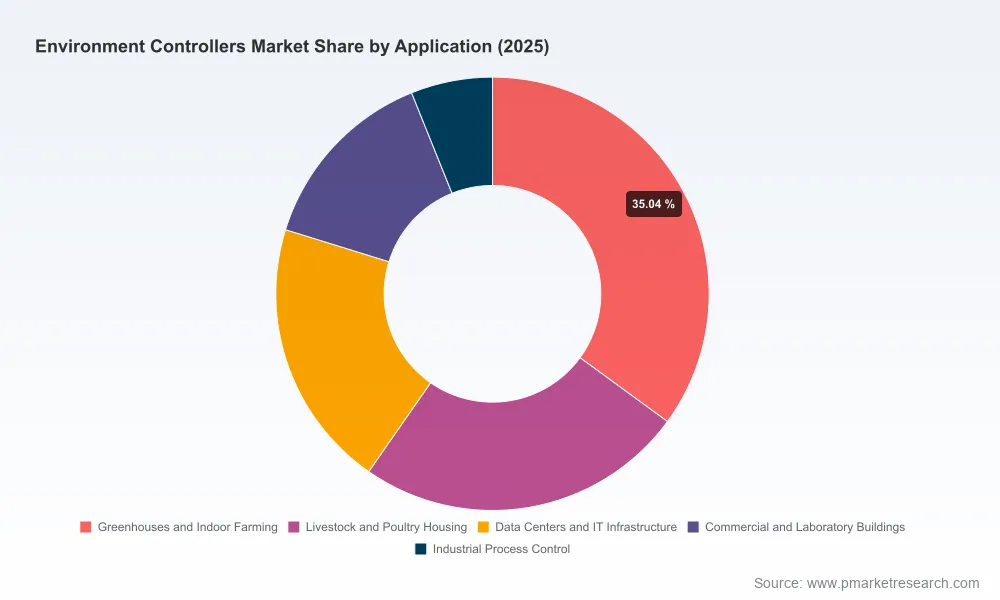
This outcome orientation is also reshaping market segmentation dynamics. Applications that require precise climate orchestration, such as greenhouse and indoor farming, continue to represent a substantial share of demand, reflecting the sector’s reliance on controlled conditions for yield and quality. Livestock and poultry housing remains a meaningful application area, where environmental stability directly affects animal welfare and operational efficiency. Meanwhile, data centers and IT infrastructure are emerging as a fast-growing demand center, driven by the need to manage heat loads and maintain uptime in increasingly concentrated computing environments. Commercial and laboratory buildings, along with industrial process control, add further layers of demand, each with distinct tolerance thresholds and compliance expectations. The practical implication for vendors is that one-size-fits-all offerings are losing ground; differentiated application expertise and configurable platforms are becoming more valuable.
Supply Chain and Cost Structure Realities
Cost structures and supply chain resilience are emerging as critical determinants of margin sustainability and time-to-market. Environmental controllers depend on electronic sensors, semiconductors, and printed circuit board assemblies, all of which involve complex material flows and manufacturing processes. Fluctuations in component availability, lead-time variability, and raw material exposure can influence production scheduling and pricing strategies. This reality is pushing manufacturers to reconsider design-to-cost approaches, buffer strategies, and supplier diversification. It also encourages greater emphasis on modular architectures that can accommodate component substitutions or firmware-level adaptations without requiring complete hardware redesigns.
At the same time, rising industrial automation and infrastructure modernization are expanding the addressable base for environmental control systems across manufacturing and buildings. The broader macro trend toward upgraded automation is reinforcing demand, but it also raises expectations for reliability and service continuity. Buyers are increasingly sensitive to lifecycle support, spare parts availability, and the ability to integrate new controllers into existing building or process management environments. Companies that can balance component cost discipline with robust supply planning and backward compatibility will be better equipped to protect margins while meeting the pace of upgrade demand.
Competitive Landscape and Leadership Strategies
The competitive environment in the environment controllers market is characterized by a mix of large multinational building automation and industrial conglomerates alongside specialized players focused on controlled environment agriculture, laboratory precision, and niche climate applications. Large platforms bring breadth across commercial and industrial segments, with integrated building management capabilities, global service networks, and the ability to bundle environmental control with broader automation portfolios. Their strategic advantage lies in cross-selling, scale procurement, and the capacity to serve enterprise customers that require unified systems across multiple sites. In the building and industrial space, these players frame their offerings around intelligent building solutions, air quality management, climate orchestration, and integrated management platforms, positioning controllers as components of larger efficiency and compliance strategies.
PW Consulting
Specialized manufacturers, by contrast, compete on application depth. Companies focused on greenhouse and controlled environment agriculture emphasize precise climate, irrigation, and nutrient coordination, along with tailored monitoring of temperature, humidity, vapor pressure deficit, and CO2. Their differentiation often comes from growers-centric workflows, configurable control logic, and systems designed for repeatable cultivation outcomes. In laboratory and scientific contexts, providers of incubators, stability chambers, and precision controllers compete on measurement accuracy, process stability, and documentation capabilities that support regulated workflows. Across these niches, the common thread is the pursuit of tighter control and clearer operational feedback, which resonates with buyers who need reliability and repeatability more than broad platform breadth.
Recent developments illustrate how companies are trying to convert their positioning into market momentum. In late 2025, a major cultivation solutions provider highlighted environmental control systems as part of its commercial cultivation portfolio at a leading industry conference, reinforcing the link between climate management and broader cultivation economics. Around the same period, a notable electronics company’s annual filing drew attention to its continued dependence on new product development in climate control controllers for HVAC and home automation markets, underscoring that even diversified electronics players view controller innovation as central to future revenue mix. At the market level, recent analysis underscored sustained demand for environmental control systems driven by industrial automation and energy efficiency mandates, suggesting that the growth narrative is broadening beyond traditional agricultural and building use cases. These signals point to a landscape where both platform scale and application specialization can create defensible positions, provided they are paired with timely product iterations and credible integration pathways.
The market structure is evolving along several axes. Consolidation is likely in segments where buyers prefer fewer vendor relationships, unified support, and standardized interoperability, especially in commercial buildings and industrial facilities. At the same time, fragmentation will persist where application-specific performance, localized service, and rapid iteration matter most, particularly in horticulture, indoor agriculture, and specialized laboratory environments. New entrants can gain traction by targeting gaps in usability, affordability, or cloud-connected management, especially if they can demonstrate measurable efficiency gains or simplify deployment for mid-sized operators. The risk for incumbents is complacency in software enablement, user experience, and integration readiness; the opportunity is to combine domain expertise with adaptable architectures that can scale across applications without diluting performance.
Forward Outlook: Trends Shaping the Next Three to Five Years
Looking ahead, the market will increasingly reward controllers that function as part of connected, data-rich environments rather than isolated control points. One clear trend is the deepening integration of environmental control with facility and process management platforms. As operators seek to coordinate climate, energy, and operational data across systems, controllers that expose clean data streams, support open interfaces, and integrate with analytics tools will become more valuable. This trend creates opportunities for vendors that can simplify cross-system coordination and provide actionable insights, not just real-time adjustments. Another trend is the continued expansion of precision-driven applications. Controlled environment agriculture will keep demanding tighter orchestration for yield consistency, while data centers, laboratories, and specialized industrial settings will extend the need for high-accuracy climate management. This diversification means that application-specific expertise will remain a strong differentiator, particularly when paired with scalable hardware and configurable software.
A third trend is the growing importance of regulatory and sustainability alignment as a procurement criterion. Energy efficiency, emissions accountability, and indoor environmental quality will continue to shape upgrade cycles, making compliance-ready design and demonstrable performance central to winning projects. The commercial opportunity lies in packaging controllers with clear efficiency narratives, lifecycle documentation, and upgrade pathways that reduce the risk of premature obsolescence. At the same time, uncertainty persists. Component supply volatility, shifting regulatory timelines, and varying adoption speeds across regions and applications can create uneven demand patterns. Buyers may also delay decisions if integration complexity or total cost of ownership remains unclear. Organizations that manage these uncertainties through modular designs, diversified sourcing, and strong application evidence will be better positioned to capture growth without overcommitting to narrow assumptions.
Strategic Actions for Decision-Makers
For manufacturers, the priority is to strengthen the linkage between hardware durability and software value. This means investing in interoperable architectures, remote management capabilities, and application-tuned control logic that reduces deployment friction and supports measurable efficiency gains. Product roadmaps should anticipate integration expectations, compliance documentation needs, and the practical realities of component sourcing, while balancing performance with cost discipline. Differentiation will come less from selling devices and more from enabling repeatable outcomes across greenhouse, livestock, data center, laboratory, and commercial building environments.
For investors, the most compelling signals are the intersection of automation momentum, regulatory-driven upgrades, and the shift toward outcome-based purchasing. Capital allocation should favor players with credible application expertise, scalable platforms, and demonstrated ability to navigate supply chain and compliance complexity. It is equally important to assess whether a company’s growth depends on genuine product and integration progress or on broad market tailwinds alone, since the latter can mask execution risk when upgrade cycles tighten or buyer expectations rise.
For procurement and operations leaders, the emphasis should be on total cost of ownership, integration readiness, and long-term support rather than upfront unit economics. Evaluating controllers as part of a broader environmental management strategy—considering data accessibility, service coverage, upgrade paths, and compliance documentation—can reduce the risk of stranded assets and rework. Where possible, structured pilot programs and cross-functional validation can clarify performance under real operating conditions before scaling deployment.
Given the pace of technological change, regulatory evolution, and application expansion, detailed segment-level data and customized strategic guidance can materially improve planning quality. Readers seeking deeper breakdowns across regions, controller types, applications, and competitive profiles can access the full research report for granular analysis and decision-ready recommendations tailored to their operational context.
For detailed analysis of this topic, please visit the official page: Worldwide Environment Controllers Market
Lacy Lee
Senior Marketing Manager
[email protected]
PW Consulting: www.pmarketresearch.com




























Sign in to leave a comment.