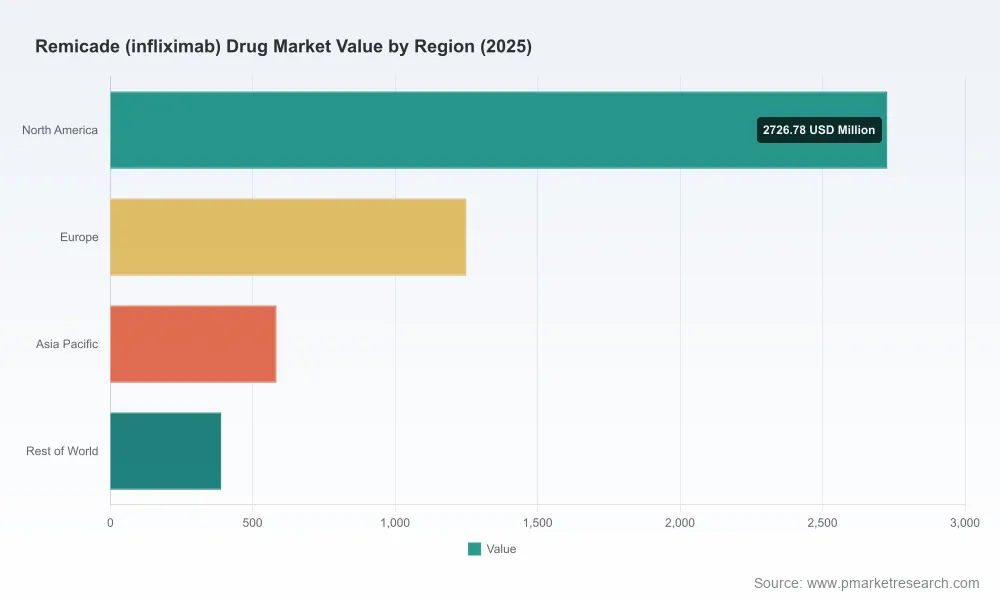

Strategic Shifts in the Worldwide Remicade (Infliximab) Drug Market: Navigating Decline, Biosimilar Expansion, and Commercial Repositioning
Market Landscape and Core Challenges
The global Remicade (infliximab) market is navigating a pronounced contraction that reflects the maturing lifecycle of a once-dominant biologic franchise. Valued at approximately $8.24 billion in 2020, the market has steadily eroded to roughly $4.95 billion by 2025, and forward projections indicate a continued downward trajectory through 2032, with a compound annual decline of around 4.5 percent. This pattern is not an anomaly but rather the structural outcome of patent expiration, biosimilar proliferation, and shifting treatment paradigms across autoimmune and inflammatory indications. While the absolute revenue pool is shrinking, the market remains clinically and commercially relevant, particularly as healthcare systems prioritize cost containment without compromising therapeutic outcomes.
Three interconnected challenges define the current inflection point. First, the erosion of the reference product's pricing power has compressed margins across the value chain. As biosimilar entries scaled, list prices and net realized prices adjusted downward, forcing both originator and follower manufacturers to recalibrate commercial models around volume, formulary access, and differential service offerings rather than premium pricing alone. Second, the treatment landscape for inflammatory conditions is increasingly contested by alternative mechanisms of action, including other TNF inhibitors, IL-17/IL-23 pathway agents, and JAK inhibitors, many of which offer oral administration or more convenient dosing schedules. This competition influences prescribing behavior, patient adherence, and the durability of infliximab's share in specific indications. Third, the operational complexity of biologic manufacturing and distribution continues to weigh heavily on cost structures. Monoclonal antibody production demands precise process control, and the cold-chain requirements for intravenous formulations add logistical cost and risk, particularly as regional supply chains confront capacity constraints, regulatory divergence, and geopolitical variability.
At the same time, the market is not uniformly shrinking across all dimensions. The relative contribution of biosimilars has grown substantially, reflecting deliberate procurement strategies by payers and institutions seeking durable cost savings. This shift has redefined the competitive basis: clinical comparability, supply reliability, and contracting agility now matter as much as price alone. For decision-makers, the core challenge is to interpret the headline decline accurately. The revenue contraction masks a market that is reorganizing around access models, formulation innovation, and efficiency gains, with meaningful implications for manufacturers, investors, and procurement organizations alike.
Key Drivers of Market Change
Several structural forces are reshaping the trajectory of the infliximab market, and their interaction explains both the declining revenue baseline and the pockets of strategic opportunity that remain.
Biologic Innovation and Formulation Differentiation
Formulation innovation is becoming a meaningful differentiator in a category where molecular identity is largely established. Recent regulatory progress for liquid intravenous infliximab formulations illustrates how delivery characteristics can reshape product positioning even within a crowded biosimilar field. A liquid formulation reduces preparation time, supports more predictable administration workflows, and may improve the operational experience for infusion centers and hospitals. In a market where many products are clinically comparable, such practical advantages can influence adoption among institutions that value workflow efficiency, reduced error risk, and simplified handling. This dynamic is particularly relevant as the originator product continues to face share pressure and biosimilar manufacturers compete on more than price alone.
Regulatory Pathways and the Biosimilar Entry Cycle
Patent expirations across major markets opened the door to a multi-player biosimilar ecosystem, and the regulatory framework has since evolved to accommodate broader utilization across approved indications. Multiple infliximab biosimilars have secured approval and are in active use for autoimmune conditions, reinforcing the expectation that biosimilar competition will remain a permanent feature of the landscape. The regulatory acceptability of biosimilar substitution and interchangeability in various jurisdictions has accelerated uptake, but the pace and magnitude of adoption still depend on local policy design, tender structures, and formulary decision-making. In practical terms, regulatory clarity reduces uncertainty for suppliers and buyers, yet it also intensifies the need for differentiated commercialization and reliable supply.
Worldwide Belimumab Market
Reimbursement Pressure and Value-Based Procurement
On the demand side, the most powerful driver is the economics of care delivery. Payers and healthcare institutions are under sustained pressure to manage oncology and immunology spending while maintaining access to effective therapies. Infliximab biosimilars have historically achieved meaningful discounts relative to pre-biosimilar pricing, generating savings that resonate with budget holders. This has encouraged gradual but persistent shifts in utilization toward biosimilar options, particularly in settings where procurement is centralized or where volume-based contracting is common. As a result, the market is increasingly shaped by purchasing behavior, acquisition cost, and total cost of ownership rather than by brand legacy alone. For providers, the decision calculus increasingly includes not just clinical equivalence but also administration logistics, support services, and predictability of supply.
Manufacturing Complexity and Supply Chain Economics
Even as pricing softens, the underlying cost of producing monoclonal antibodies remains substantial. Process complexity, scale economics, and cold-chain requirements create a high operational bar for entrants and a persistent margin constraint for incumbents. The implication is that sustainable competition in this market depends on manufacturing efficiency, yield optimization, and robust distribution capabilities. Companies that can control cost of goods sold while maintaining consistent quality and reliability are better positioned to withstand price competition and to participate in long-term procurement arrangements. Conversely, supply disruptions or quality variability can quickly erode trust and market position, especially in institutional settings where continuity of care is paramount.
Competitive Landscape and Leading Strategies
The infliximab market is characterized by a dense field of manufacturers spanning the originator and a broad biosimilar cohort. Market concentration remains high at the top, reflecting the enduring influence of the reference product and the scale advantages of a few large players, but competition below the leader group is dynamic and increasingly segmented by region, formulation, and commercial model.
IVIG Market
The originator continues to maintain global commercialization activity, including unbranded infliximab variants, which signals a strategy oriented toward preserving reach and serving specific patient and provider segments even as premium pricing fades. Recent sales reporting underscores the reality of biosimilar-led share migration and patient mix shifts, with quarterly revenue reflecting ongoing competitive pressure. In this environment, the originator's strategic task is less about defending a price premium and more about retaining relationships, ensuring continuity, and leveraging any residual brand familiarity or service infrastructure.
Biosimilar manufacturers are pursuing increasingly varied positioning. Some are emphasizing route and formulation advantages, including subcutaneous options and liquid intravenous presentations, to create practical differentiators that resonate with clinical workflows. Others are focusing on broad geographic coverage, leveraging distribution networks and partnerships to secure formulary and tender access across multiple markets. A further group is targeting price-sensitive or emerging markets with cost-competitive supply models and government procurement channels, where affordability and reliability often outweigh other considerations. Partnerships between biosimilar developers and large commercial organizations have also become an important structural feature, allowing specialized manufacturers to access established sales and market access capabilities while partners expand their immunology portfolios.
The market is evolving along two parallel tracks. On one hand, consolidation and partnership activity are likely to intensify as players seek scale, commercial reach, and risk sharing in a declining revenue environment. On the other hand, segmentation is deepening, with differentiation emerging around formulation, administration convenience, supply reliability, and regional procurement dynamics. New entrants face a high bar because price competition is already vigorous and manufacturing requirements are demanding, but targeted entry remains possible where a clear operational or access advantage can be demonstrated. For incumbents, the strategic priority is to defend share through value-added service, dependable supply, and smart contracting, while for followers the priority is to convert clinical comparability into preferred status via procurement relationships and workflow fit.
Forward Outlook: Three Trends to Watch
Looking ahead to the next three to five years, the market's direction will be shaped by the interplay of adoption maturity, formulation innovation, and procurement architecture.
First, biosimilar utilization is expected to continue its gradual climb in many markets, but the pace will be uneven. In regions with centralized procurement or strong payer incentives, share gains may be more pronounced, while in fragmented markets the shift may remain incremental. The commercial opportunity here lies in securing preferred positioning through multiyear supply commitments, value-based contracting, and dependable service levels rather than relying solely on price cuts.
Second, formulation and delivery innovation will become a more visible competitive axis. Liquid intravenous presentations, subcutaneous options, and workflow-oriented features can influence institutional adoption even when molecular comparability is established. Products that reduce preparation burden, improve dosing predictability, or simplify handling may gain traction among infusion networks and hospital systems seeking operational efficiency. This creates an opportunity for manufacturers to defend or expand share by solving practical bottlenecks in administration rather than competing on price alone.
Third, the cost and resilience of the supply chain will increasingly determine commercial viability. As margins compress, manufacturing efficiency, yield consistency, and cold-chain reliability will separate durable players from those that struggle to remain competitive. Any disruption, whether from capacity constraints, regulatory variation, or logistics fragility, can create outsized effects in a market where trust and continuity are critical. Companies that invest in robust production and distribution capabilities, and that can demonstrate reliability to procurement organizations, will be better positioned to sustain long-term participation.
The principal uncertainty is the potential for further erosion from alternative therapies and from shifts in prescribing habits. If newer agents with convenient administration or differentiated mechanisms capture additional share in key indications, infliximab's role could narrow in specific segments even as biosimilar economics remain attractive. Another risk is that aggressive price competition could outpace efficiency gains, pressuring viability for suppliers with weaker cost structures. Decision-makers should therefore treat the market as declining but not disposable, and as increasingly rewarding operational excellence and access strategy over brand legacy.
Strategic Implications for Decision-Makers
For manufacturers, the priority is to sharpen positioning around the factors that procurement groups and clinicians actually value in a biosimilar-heavy environment: supply reliability, formulation convenience, and contracting flexibility. Where feasible, differentiation should focus on workflow improvements and service capabilities that reduce total cost of ownership for institutions. Manufacturers with weaker cost positions should assess portfolio fit carefully, including partnerships or regional specialization, rather than competing head-on across all markets.
For investors, the key is to distinguish between durable operators and those exposed to unsustainable price or cost dynamics. Indicators to watch include manufacturing efficiency, contract visibility, formulation and route advantages, and access to partnership or distribution channels that can stabilize volume. Given the market's contraction, selective exposure and a clear view of regional procurement patterns are likely to matter more than broad category assumptions.
PW Consulting
For procurement and access teams, the opportunity is to move beyond simple price comparison toward a more holistic evaluation that includes administration logistics, supply continuity, and contractual terms. Multi-source strategies, clear quality and reliability expectations, and alignment with infusion workflow can generate savings that are more durable than one-time discounts. In this context, detailed segmentation data and tailored market access intelligence can materially improve contracting outcomes and risk management.
For a fuller picture of regional dynamics, indication-level demand patterns, product-type splits, and company-specific positioning, the complete PW Consulting market report provides expanded datasets and scenario analysis designed to support procurement planning, portfolio strategy, and investment evaluation.
For detailed analysis of this topic, please visit the official page: Worldwide Remicade (infliximab) Drug Market
Lacy Lee
Senior Marketing Manager
[email protected]
PW Consulting: www.pmarketresearch.com

























Sign in to leave a comment.