
Strategic Trends and Commercial Opportunities in the Worldwide Substation Battery Market
The global substation battery market stands at a critical inflection point, where decades of engineering convention meet urgent pressure for grid resilience, regulatory evolution, and technological modernization. Substations form the backbone of electrical transmission and distribution networks, and their reliability hinges on dependable backup power systems. Batteries deployed in these environments are not merely consumables; they are critical infrastructure components that ensure switchgear control, protective relaying, emergency lighting, and communications remain operational during grid disturbances. As utilities worldwide modernize aging networks, integrate variable renewable generation, and confront more frequent extreme weather events, the demand profile for substation batteries is undergoing a structural shift.
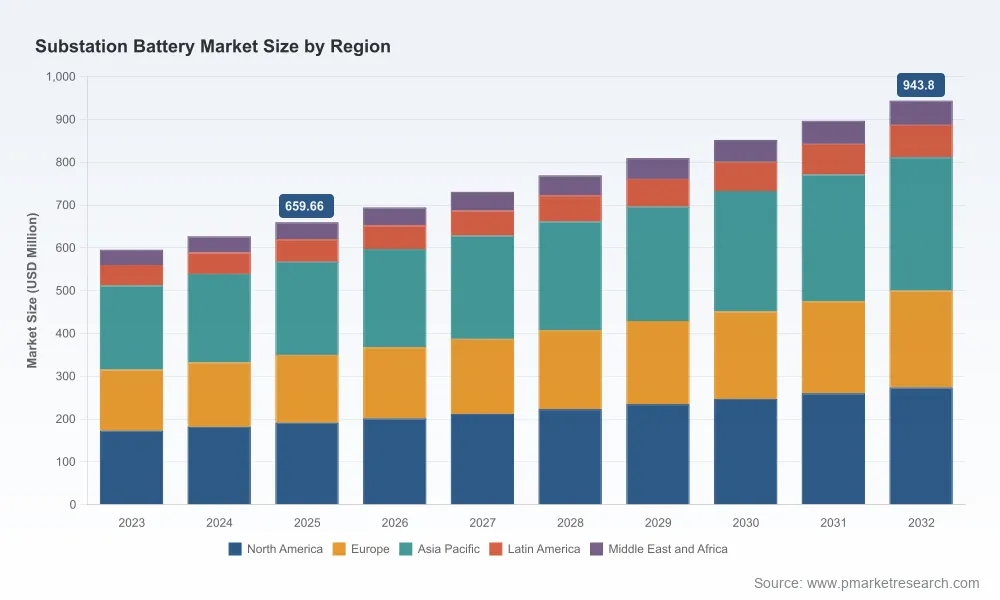
From a market sizing perspective, the sector has demonstrated steady expansion over the past half-decade, with total revenue climbing from approximately $595.5 million in 2023 to an estimated $659.66 million in 2025. The trajectory continues upward through the forecast horizon, reaching a projected $943.8 million by 2032, supported by a compound annual growth rate of 5.24 percent. This growth is neither explosive nor speculative; it reflects the measured pace of utility capital cycles, replacement demand, and incremental modernization programs. Yet beneath these aggregate figures lies a more nuanced reality: regional deployment patterns, technology mix shifts, and evolving compliance requirements are reshaping where value is created, how products are specified, and which manufacturers capture market share. The market is large enough to support multiple competitive strategies, but fragmented enough that execution quality, application expertise, and regulatory navigation increasingly determine commercial outcomes.
Market Conditions and Core Challenges
The substation battery market does not operate in a vacuum. It is influenced by electricity demand growth, transmission and distribution investment cycles, utility procurement rhythms, and the broader energy transition. Current conditions reveal a market that is expanding in absolute terms while facing structural tensions that will dictate competitive dynamics over the next several years. Three challenges stand out as particularly consequential for executives, investors, and procurement teams.
Balancing Legacy Performance with Modernization Pressures
A significant portion of installed substation backup systems continues to rely on mature battery chemistries that have proven reliable under demanding duty cycles. These systems benefit from established supply chains, predictable performance characteristics, and decades of field validation. At the same time, utilities are under increasing pressure to reduce footprint, improve reliability metrics, and align capital expenditures with longer service life and lower maintenance burdens. This creates a tension between incremental replacement of proven systems and selective adoption of newer technologies that may offer different trade-offs in energy density, cycle life, thermal behavior, and monitoring capabilities. The commercial challenge is not simply choosing one chemistry over another; it is matching technology to substation architecture, environmental conditions, utility operational philosophy, and total cost of ownership expectations.
Regulatory and Standards Evolution as a Double-Edged Sword
Regulatory frameworks and industry standards are tightening around battery performance, safety, recycling, and environmental compliance. These developments can accelerate modernization by clarifying specification requirements and creating uniform evaluation criteria, but they also raise the bar for product qualification, documentation, and lifecycle management. For substation batteries, which often operate in mission-critical roles with long service expectations, any shift in sizing guidelines, testing protocols, or end-of-life obligations can alter project economics and specification strategies. Compliance is no longer a peripheral consideration; it directly influences product design, manufacturing processes, supply chain choices, and customer confidence. Companies that can interpret and respond to these requirements efficiently gain an advantage, while those that treat them as administrative overhead risk specification exclusion or delayed project approvals.
Input Cost Volatility and Supply Chain Realities
Battery manufacturing remains sensitive to raw material markets, logistics constraints, and regional production capacity. Price movements in key inputs can influence margins, lead times, and the relative attractiveness of different battery types across geographies. In turn, these cost dynamics affect utility procurement decisions, especially when projects are evaluated on bid price, warranty terms, and lifecycle cost rather than upfront acquisition cost alone. The broader challenge is that substation batteries are often specified as part of larger infrastructure programs where schedule certainty and supply reliability matter as much as unit price. Any disruption in the availability of qualified components, manufacturing capacity, or distribution channels can ripple through project timelines and weaken the commercial position of suppliers who cannot guarantee consistent delivery.
Key Drivers Shaping Market Direction
The substation battery market is being reshaped by a combination of technology, policy, demand behavior, and supply-side economics. These forces do not operate in isolation; they interact in ways that create both headwinds and tailwinds depending on product type, region, and application context.
Technology Innovation and Chemistry Evolution
Advances in battery engineering are expanding the range of viable options for substation backup and auxiliary power. Improvements in lead-acid platforms, including thin-plate pure lead designs and enhanced valve-regulated lead-acid construction, continue to extend service life and improve performance in high-temperature or vibration-prone environments. At the same time, lithium-ion solutions are increasingly considered for substation energy storage and backup roles where space constraints, charge acceptance, or integration with monitoring and controls are priorities. Nickel-cadmium systems remain relevant in certain industrial stationary applications due to their robustness and tolerance for demanding discharge conditions, though their positioning is influenced by environmental regulations and substitution dynamics.
The strategic significance of these technological developments lies not in declaring a single winning chemistry, but in recognizing that substation operators increasingly evaluate options case by case. A transmission substation with stringent DC reliability requirements may prioritize proven durability and long service intervals, while a distribution substation in a space-limited urban site may weigh compact form factors and faster recharge characteristics more heavily. This specificity creates opportunities for manufacturers that can articulate performance in application terms rather than only in generic product specifications.
Policy and Regulatory Environment
Policy frameworks are shaping both demand and product design. Grid modernization incentives, utility resilience programs, and public investment in transmission and distribution infrastructure are expanding the addressable market for substation backup solutions. In some regions, government support for domestic battery manufacturing and supply chain diversification is encouraging local production and creating additional procurement pathways. At the same time, environmental regulations are tightening expectations around industrial battery lifecycle management, including recyclability, material recovery, and restricted substances. These requirements are pushing manufacturers to strengthen documentation, adjust product architectures, and coordinate more closely with recycling and recovery ecosystems.
For market participants, the policy environment acts as both a demand catalyst and a compliance filter. Programs that support grid investment can accelerate project pipelines, while regulatory mandates can raise the minimum bar for market entry and ongoing participation. Companies that proactively align product roadmaps with these expectations are better positioned to win specifications in tenders that increasingly evaluate environmental and lifecycle criteria alongside technical performance.
Emergency Mobile Substation Market
Demand-Side Shifts in Utility Behavior
Utilities are changing how they plan, procure, and operate substation assets. Reliability standards, outage cost awareness, and the growing impact of weather-driven disturbances are elevating the importance of backup power dependability. There is also growing attention to predictive maintenance, remote monitoring, and condition-based replacement strategies. These shifts influence battery specifications because operators want systems that integrate more easily with substation automation, offer clearer performance indicators over time, and reduce the risk of unexpected failures during emergencies.
From a commercial perspective, this means that value is increasingly created through service-friendly design, documentation clarity, and lifecycle support rather than through price competition alone. Battery suppliers that can support utility planning teams with consistent application data, installation guidance, and maintenance expectations are more likely to be included in long-cycle procurement processes. In many cases, the winning proposition is not the lowest initial cost but the most predictable performance across the substation’s operational life.
Supply Chain and Cost Structure Dynamics
Cost structures across the battery value chain are influenced by raw material availability, manufacturing scale, logistics, and regional production footprints. Lead price movements, for example, can affect the economics of valve-regulated lead-acid production and influence bidding strategies for substation projects. At the same time, incentives and industrial policies aimed at strengthening domestic manufacturing can alter sourcing patterns and create new competitive pressure in specific markets. These dynamics matter because substation batteries are often procured in project-based volumes where price stability, lead-time reliability, and supplier accountability can be as important as headline unit cost.
The broader implication is that competitive advantage is increasingly tied to supply chain resilience and manufacturing consistency. Suppliers that can maintain qualified production capacity, communicate realistic delivery expectations, and manage input-cost exposure effectively are better positioned to secure and retain utility contracts. This is especially relevant in programs where substation batteries are part of a broader infrastructure rollout and delays in one component can affect the entire project schedule.
Competitive Landscape and Leading Strategies
The market features a mix of established battery manufacturers with long track records in utility and industrial applications, alongside regional players that compete on localized service, application-specific designs, and cost-competitive manufacturing. The competitive environment is not defined by a single dominant model; rather, it rewards companies that can combine technical credibility, application knowledge, and dependable execution.
PW Consulting
Several manufacturers illustrate the breadth of strategic positioning in this sector. Some competitors focus on lead-acid platforms optimized for substation DC backup, emphasizing ruggedized designs, long discharge performance, and suitability for switchgear control and emergency systems. Others extend their portfolios into lithium-ion racks or specialized nickel-cadmium solutions where modern grid applications or demanding environmental conditions create a case for alternatives to conventional chemistries. Regional manufacturers in markets such as India and Japan demonstrate strong application familiarity with local utility conditions, including high-temperature operation, tropicalized designs, and seismic-resilient requirements. This mix suggests a market where global scale and regional specialization can both succeed, depending on how well a company aligns its offerings with local specification practices and service expectations.
Strategic Positioning and Differentiation
Leading players tend to differentiate along several dimensions that matter in substation applications. One is product heritage and field validation, particularly for utilities that prioritize proven reliability in critical DC systems. Another is engineering support and specification assistance, where manufacturers help procurement teams match battery capacity, discharge characteristics, and environmental tolerance to substation design requirements. A third is lifecycle orientation, including warranty structures, maintenance guidance, and recyclability considerations that align with evolving compliance expectations. Finally, some competitors gain advantage through targeted project execution, such as supplying systems for grid modernization initiatives, railway electrification substations, or utility sites with specific resilience requirements.
These differentiation paths are not mutually exclusive. In practice, the strongest commercial positions often combine product credibility with application-specific value. A battery line that performs reliably in high-temperature environments may win in regions where thermal management is a persistent challenge. A thin-plate pure lead design may appeal where extended service life and reduced maintenance are prioritized. Lithium-ion racks may become increasingly attractive in substations where space constraints, modernization goals, or integrated storage strategies make conventional solutions less suitable. The key for manufacturers is to be explicit about which applications and operating conditions their products are best suited for, rather than relying on broad commodity positioning.
Evolution of Market Structure
The competitive landscape is likely to evolve through a combination of consolidation, specialization, and selective new entry. Consolidation can create scale benefits in manufacturing, distribution, and aftermarket support, which may be particularly valuable in markets where utilities expect integrated supply and service capabilities. At the same time, specialization remains important because substation applications are not uniform; different voltage levels, duty cycles, environmental conditions, and regulatory contexts can favor distinct product strategies. New entrants may find opportunities in lithium-ion integration, advanced monitoring, or regionally focused manufacturing, especially where incentives or project pipelines create near-term demand.
A recent sequence of developments illustrates how competitive activity is translating into real-world deployments. One major manufacturer secured a contract to supply PowerSafe batteries for more than fifty substations as part of a North American grid modernization project, signaling strong demand for established substation backup solutions in large-scale infrastructure programs. In another case, a manufacturer delivered nickel-cadmium battery systems for Indian Railways electrification substations, highlighting the continued relevance of robust chemistry in specialized utility-adjacent applications. Meanwhile, a Japanese manufacturer installed VRLA batteries in utility substations to support seismic-resilient DC power supply, reinforcing the importance of region-specific resilience requirements. These examples show that competition is being won through a combination of product fit, project execution, and alignment with utility priorities rather than through generic brand claims.
Future Trends and Commercial Implications
Looking ahead three to five years, several trends are likely to shape how the substation battery market grows and where commercial opportunities emerge.
Trend Toward Application-Specific Technology Selection
Substation operators will continue to move away from one-size-fits-all procurement toward more nuanced technology selection. Lead-acid platforms will remain widely used where proven reliability, cost-effectiveness, and familiarity matter most, but lithium-ion and specialized nickel-cadmium solutions will gain ground in targeted applications where their performance characteristics offer a clear advantage. This trend creates opportunities for suppliers that can provide clear guidance on suitability, support specification processes with credible application data, and avoid overgeneralizing product claims. The commercial upside lies in helping utilities make defensible choices that balance reliability, footprint, maintenance, and compliance rather than competing solely on initial price.
Increasing Emphasis on Lifecycle Compliance and Recyclability
Regulatory expectations around industrial battery end-of-life management and recyclability are likely to become more central to product evaluation. As standards and directives continue to shape what is required from battery systems over their full lifecycle, manufacturers and utilities will pay greater attention to material recovery, documentation, and traceability. This trend favors companies that can demonstrate structured lifecycle practices and integrate compliance considerations into product design and customer support. For investors and strategic planners, it suggests that regulatory readiness will increasingly influence supplier selection, especially in regions where environmental policy is advancing faster than in others. At the same time, uncertainty remains around how quickly requirements will be enforced, how costs will be distributed across the value chain, and how utilities will incorporate lifecycle criteria into bidding decisions.
Grid Modernization and Resilience as Demand Multipliers
Investment in grid modernization, transmission and distribution upgrades, and resilience improvements is expected to support continued demand for substation backup power. As utilities expand and upgrade infrastructure, they create both replacement demand and new installation opportunities. In parallel, the growing impact of extreme weather and network stress events reinforces the importance of dependable DC backup and auxiliary power. The commercial implication is that market growth will be supported not just by population or electricity demand alone, but by the need to harden critical network nodes. Suppliers that can align product offerings with resilience narratives, project-scale execution, and utility modernization timelines are likely to find stronger opportunities than those competing only in fragmented replacement markets.
Packaged Substation Market
Potential Risks and Uncertainties
Despite the constructive outlook, several risks could influence the pace and shape of market development. Raw material price volatility may pressure margins and affect bidding dynamics, particularly for lead-dependent products. Regulatory clarity may vary by region, creating uneven compliance burdens and uneven market opportunities. Technology adoption may proceed more slowly than anticipated in some utility segments due to conservatism, procurement rules, or concerns about integration and long-term support. In addition, project cycles in the utility sector can be long and subject to budget timing shifts, which can create uneven demand patterns even when the underlying need is strong. Companies should therefore plan for variability in project pipelines, regional policy trajectories, and technology acceptance speed.
Strategic Actions for Decision-Makers
For executives, investors, and procurement teams, the substation battery market offers meaningful opportunities, but they are accessible to organizations that can act with specificity and discipline. The following recommendations reflect the current market dynamics and the likely direction of travel.
For Manufacturers and Suppliers
Focus on application-led differentiation rather than broad commodity positioning. Clearly define where your products perform best, what substation conditions they are designed for, and how they support utility operational goals such as reliability, maintenance reduction, and lifecycle compliance. Strengthen specification support and application engineering capabilities so that procurement teams can justify your solutions during tender evaluations. At the same time, invest in supply chain consistency and manufacturing readiness, because schedule certainty and delivery reliability increasingly influence utility decisions alongside unit economics. Where relevant, align product roadmaps with evolving recycling and compliance expectations so that customers see a credible path through the full product lifecycle.
For Investors and Strategic Planners
Evaluate opportunities with an understanding that growth in this market is steady rather than sudden, and that value is often captured through execution quality, regional presence, and application expertise. Favor business models that combine product sales with dependable service, documentation, and lifecycle support, especially in markets where utilities prioritize long-term operational outcomes. Pay attention to policy environments that can accelerate grid investment or impose new compliance requirements, as these factors can shift demand patterns and supplier requirements over time. Be mindful of input-cost exposure and regional manufacturing dynamics, since these can affect margins and competitive positioning in ways that are not always visible from headline market size figures alone.
For Procurement and Utility Decision-Makers
Approach substation battery selection as a total-cost and risk-management decision rather than a simple equipment purchase. Match technology choices to substation architecture, environmental conditions, maintenance capabilities, and reliability requirements, and ensure that specifications reflect both immediate performance and long-term lifecycle considerations. Evaluate suppliers not only on price but also on application support, delivery reliability, warranty clarity, and compliance readiness. In modernization programs, consider how battery systems will integrate with monitoring, maintenance planning, and replacement cycles, since these factors often determine whether a solution delivers its expected value over time.
The market’s trajectory will be shaped by how effectively participants translate technical capability into application value, regulatory readiness, and dependable execution. For organizations that need deeper segmentation, region-specific demand detail, company-level competitive benchmarking, or tailored procurement and investment scenarios, a more comprehensive research resource can provide the granularity required to move from strategic direction to operational decision-making.
For detailed analysis of this topic, please visit the official page: Worldwide Substation Battery Market
Lacy Lee
Senior Marketing Manager
[email protected]
PW Consulting: www.pmarketresearch.com


























Sign in to leave a comment.