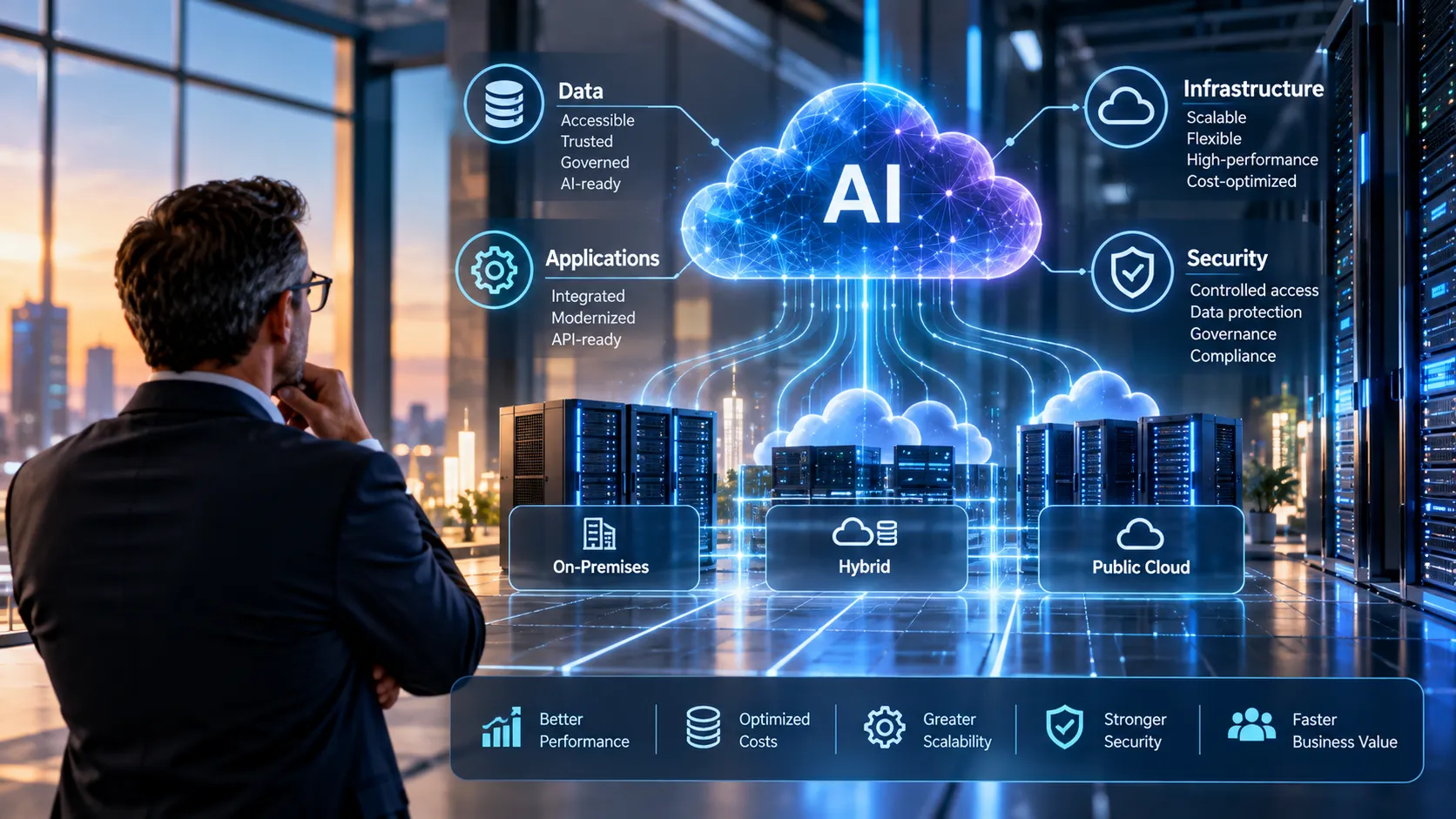

Artificial intelligence has moved quickly from experimentation to executive priority. Enterprises are rolling out copilots, testing AI agents, building internal applications around large language models, and looking for ways to embed AI into customer service, operations, finance, security, and employee workflows.
Yet there is a less exciting part of the AI conversation that can determine whether these initiatives actually scale: the underlying IT environment.
An organization can have a strong AI strategy, executive sponsorship, promising use cases, and access to sophisticated models and still struggle to move beyond pilots. The problem is often not the AI itself. It is fragmented data, aging applications, inconsistent cloud architecture, infrastructure constraints, weak integration, security gaps, or an operating model that was never designed for AI workloads.
For CIOs and CTOs, AI readiness is therefore becoming an infrastructure question as much as an innovation question.
AI Puts Different Pressure on Enterprise IT
Traditional enterprise applications generally operate within fairly predictable infrastructure patterns. AI workloads can behave differently. They may require significant compute capacity, move large volumes of data, interact with several business systems at once, consume external models and APIs, and generate costs that change rapidly with usage.
The challenge becomes more complicated as organizations move beyond standalone generative AI tools.
A simple employee copilot may retrieve information and generate an answer. An AI agent could retrieve information, access several applications, make decisions, initiate workflows, call additional models, and continue operating until a task is complete. Multiply that behavior across departments and the infrastructure requirements begin to look very different.
This is why AI readiness should not be reduced to a question of whether an organization has enough cloud capacity or access to GPUs. The broader environment needs to support the performance, integration, security, governance, reliability, and economics of AI at enterprise scale.
| Area | Traditional IT Question | AI-Ready IT Question |
|---|---|---|
| Infrastructure | Can the application handle expected demand? | Can infrastructure scale with unpredictable AI compute and inference demand? |
| Data | Is the data available? | Is the data accessible, trusted, governed, current, and usable by AI? |
| Applications | Does the application perform its business function? | Can it securely expose data and workflows to AI systems? |
| Security | Who can access the system? | What can users, models, applications, and autonomous agents access and act on? |
| Cost | What does the infrastructure cost? | What does each AI workload cost, and is that cost justified by business value? |
These differences explain why some AI initiatives perform well in a controlled pilot but become difficult or expensive when hundreds or thousands of employees begin using them.
Start With Data, Not Compute
Infrastructure discussions around AI frequently begin with GPUs, cloud platforms, or model selection. Those decisions matter, but many enterprise AI problems begin somewhere less glamorous: data.
Most mid-market and enterprise organizations have accumulated data across ERP platforms, CRM systems, SaaS applications, data warehouses, cloud storage, file systems, collaboration platforms, legacy databases, and departmental tools. Some of that information is well governed. Much of it may not be.
An AI system working across this environment needs more than access. It needs reliable context.
If customer information is duplicated across systems, product definitions differ between departments, access permissions are inconsistent, or knowledge repositories contain outdated material, an AI application can produce technically sophisticated answers based on unreliable information.
That is why AI readiness often exposes data problems that organizations have tolerated for years.
Before scaling enterprise AI, IT leaders need to understand where critical data resides, who owns it, how it is classified, how current it is, which systems can access it, and whether the organization can trace where an AI-generated answer or decision came from.
AI does not eliminate the need for data governance. It increases it.
Legacy Applications Can Quietly Become an AI Bottleneck
Another challenge is application architecture. Many organizations still depend on systems that were built long before APIs, cloud-native integration, real-time data exchange, or autonomous AI agents were common considerations.
Those applications may continue to perform their core business functions reliably, so replacing them simply because they are old rarely makes financial sense. Problems arise when the business wants AI to interact with them.
An AI assistant that only summarizes documents is relatively easy to isolate. An AI agent that needs to check inventory, retrieve customer information, update a service record, create an order, or trigger an approval process requires secure access to operational systems.
If those systems cannot expose data and business functions cleanly, AI initiatives can become dependent on fragile integrations and manual workarounds.
The answer is not necessarily a large-scale application replacement program. API layers, integration platforms, data services, workflow automation, and targeted modernization can make existing systems much easier to incorporate into an AI architecture.
The important point for CIOs is that application modernization and AI strategy are becoming increasingly difficult to separate.
Public Cloud Is Not Automatically the Answer
Cloud platforms provide many of the capabilities enterprises need for AI, including scalable compute, managed AI services, data platforms, model access, security tooling, and development environments. That makes public cloud a natural starting point for many organizations.
It does not mean every AI workload belongs there.
Some workloads involve highly sensitive data. Others may have predictable, sustained compute requirements where alternative infrastructure economics become attractive. Certain applications may require extremely low latency or close integration with systems that remain on-premises. Regulatory, contractual, or data residency requirements may also influence architecture.
For many enterprises, the eventual answer is likely to be a mix of environments.
| Environment | Where It May Fit | Key Consideration |
|---|---|---|
| Public Cloud | Rapid experimentation, elastic workloads, managed AI services | Consumption cost, governance, and data movement |
| Private Cloud | Controlled environments and predictable enterprise workloads | Capacity planning and operational overhead |
| On-Premises | Sensitive data, specialized systems, and latency-sensitive workloads | Hardware investment, skills, and scalability |
| Hybrid | Enterprises with mixed applications, data, and regulatory needs | Integration and operational complexity |
The infrastructure decision should therefore follow the workload rather than a blanket cloud-first or on-premises-first policy.
AI Cost Needs to Become an Architecture Concern
One reason enterprise AI can surprise technology leaders is that the economics behave differently from traditional infrastructure.
An application server may have reasonably predictable monthly costs. AI consumption can vary according to the number of users, model selected, tokens consumed, queries generated, data processed, agents invoked, and how frequently one AI system calls another.
Agentic AI makes this even more interesting. A user might make one request, but an agent could perform multiple reasoning steps, query several systems, invoke different models, and execute a series of actions before completing the task.
The user sees one interaction. The organization may pay for many underlying operations.
This makes FinOps increasingly relevant to AI architecture. Enterprises need visibility into which teams and applications are consuming AI resources, how costs are changing, which models are being used, and whether more expensive models are actually producing enough additional value to justify their use.
AI infrastructure optimization will eventually involve more than negotiating cloud discounts. Model selection, workload placement, caching, data architecture, GPU utilization, application design, and agent behavior can all influence cost.
For CIOs and CFOs, the useful metric will not simply be AI spend. It will be the value produced for that spend.
Security Changes When AI Can Take Action
Security also becomes more complicated as organizations move from AI assistants toward AI agents.
An assistant that summarizes information generally needs read access. An agent that completes business processes may need permission to create records, modify configurations, trigger workflows, approve actions, or interact with other applications.
That means enterprises need to think about AI identities in much the same way they think about privileged users, applications, APIs, and service accounts.
Each agent should have a clearly defined purpose and owner. Access should be limited to what the agent actually needs. High-risk actions should require stronger controls or human approval. Credentials should be managed securely, and actions should be recorded in enough detail for security and audit teams to reconstruct what happened.
These controls become even more important when multiple agents begin interacting with one another.
AI readiness is therefore not only about making infrastructure capable of running AI. It is about making the environment capable of trusting AI safely.
Observability Has to Extend Beyond Infrastructure
Traditional infrastructure monitoring answers questions such as whether a server is available, a network is congested, or an application is responding slowly. AI introduces another set of questions.
Which model produced a response? Which enterprise data was retrieved? How long did the workflow take? How much did it cost? Did an agent execute an action? Was that action successful? Did the model produce an incorrect response? Did the agent access something it should not have?
As AI becomes embedded into business processes, these questions become operational rather than experimental.
Organizations will need visibility across infrastructure, applications, data pipelines, models, APIs, agents, security controls, and business workflows. Without that visibility, troubleshooting an AI-powered process can become significantly harder than troubleshooting a traditional application.
This is another reason existing investments in observability, ITSM, security operations, and automation should be considered part of the AI architecture rather than separate technology programs.
A Practical AI Infrastructure Readiness Framework
Organizations do not need to modernize everything before deploying AI. They do need to understand where weaknesses in the current environment could limit the AI initiatives that matter most.
A practical readiness assessment can focus on six areas:
| Readiness Area | Question for IT Leaders |
|---|---|
| Infrastructure | Can we scale AI workloads without creating performance or cost problems? |
| Data | Can AI access trusted, governed, and appropriately permissioned enterprise data? |
| Applications | Can critical systems securely participate in AI-enabled workflows? |
| Security | Can we control what users, models, applications, and AI agents can access and do? |
| Operations | Can we monitor, troubleshoot, govern, and support AI systems in production? |
| Economics | Can we connect AI consumption and infrastructure costs to measurable business value? |
The purpose of an assessment like this is not to produce another maturity score. It is to identify the specific infrastructure constraints that could prevent high-value AI use cases from reaching production.
This Is Where Managed IT Is Changing
AI infrastructure also changes the conversation around managed services. Keeping servers available and closing support tickets will remain necessary, but enterprises increasingly need technology environments that can evolve continuously as AI adoption expands.
That requires capabilities across cloud, infrastructure, cybersecurity, data, applications, integration, observability, cost optimization, and IT operations. Few mid-market organizations want to build deep internal expertise in every one of those areas.
This is where managed services providers can play a broader role. A provider such as Synoptek can help connect infrastructure modernization with cloud operations, security, application transformation, data readiness, and ongoing optimization rather than treating AI infrastructure as an isolated implementation project.
For enterprise buyers, however, the important question should not simply be whether a managed services provider "does AI." It should be whether that provider understands the operational environment AI depends on and can help modernize it without disrupting the systems already running the business.
Don't Build an AI Infrastructure Strategy in Isolation
The biggest mistake may be designing an impressive AI architecture without connecting it to the organization's broader technology roadmap.
AI initiatives touch applications that may already be scheduled for modernization, data platforms undergoing consolidation, cybersecurity programs introducing Zero Trust, cloud environments being optimized for cost, and IT operations adopting greater automation. Treating each initiative separately can create another generation of fragmented technology.
A better approach is to use AI as an opportunity to revisit some of those decisions together.
Which applications need modernization anyway? Which data needs better governance regardless of AI? Where is infrastructure already too expensive or difficult to operate? Which integrations repeatedly slow down new projects? Where are identity controls weakest? Which operational processes consume disproportionate amounts of IT time?
Addressing those issues improves AI readiness, but it also improves the underlying IT environment.
That may ultimately be the more valuable outcome.
For CIOs and CTOs, the race is not simply to deploy AI faster than competitors. It is to build a technology environment where successful AI experiments can become secure, reliable, economically sustainable business capabilities.
The AI strategy may already be written. The harder question is whether the rest of the enterprise technology environment is ready to support it.




























Sign in to leave a comment.