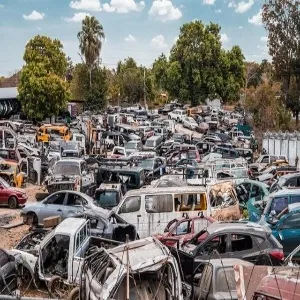

Your mechanic gives you the estimate.
You stare at the number.
Then you stare at your car.
And suddenly, that old vehicle in the driveway doesn't look like transportation anymore. It looks like a very expensive question mark.
The question is no longer simply "Can I repair it?"
It's "Does repairing it make financial sense?"
That's where things get interesting.
A car can be fixable and still be a terrible investment. If the repair bill keeps climbing while the vehicle's value keeps falling, you may eventually be paying more to keep the car alive than the car is worth to you.
So when is it actually smarter to scrap a car?
A Car Doesn't Have to Be Completely Dead to Be a Scrap Car
Many people picture a scrap car as something that hasn't moved in ten years.
That's not necessarily the case.
A car can still start, run and drive and be a strong candidate for scrapping if keeping it on the road has become too expensive.
Think about a vehicle with 250,000 kilometres.
It still runs.
But it needs a transmission, new tires, suspension work, brakes and rust repairs.
Technically, it can be fixed.
Financially, that's another story.
The real question is not whether the vehicle can be repaired.
The question is whether the money required to repair it will give you enough useful transportation in return.
Start With One Simple Number: What Is the Car Worth Today?
Before approving a major repair, find out what the vehicle is realistically worth.
Not what you paid for it.
Not what you hope someone will pay.
Not what the same model sold for five years ago.
What is it worth today, in its current condition?
This matters because an older vehicle can lose value quickly while repair costs remain high.
A $3,500 vehicle doesn't suddenly become a $7,500 vehicle because you spent $4,000 repairing it.
You may simply have spent $4,000 to make a $3,500 vehicle usable again.
That can still be worthwhile if you plan to drive it for years.
But if you're repairing it just to sell it, the math becomes much harder to justify.
When a Repair Bill Is Bigger Than the Car's Financial Future
Let's say your car is worth about $4,000.
The transmission fails.
The repair estimate is $3,800.
That's already a warning sign.
Now imagine the vehicle also needs $1,200 in tires and brakes.
There is significant rust.
The suspension is getting noisy.
The battery is several years old.
Suddenly, you're not making a $3,800 decision.
You're potentially looking at $6,000 or more to get a $4,000 vehicle back into decent condition.
That is when scrapping deserves serious consideration.
The 50% Rule Is Only a Starting Point
You may have heard people say that if repairs cost more than half the vehicle's value, you should scrap it.
There is no universal rule like that.
A $3,000 repair on a $6,000 car could make sense if the vehicle is otherwise excellent.
A $2,000 repair on an $8,000 car could be a poor decision if several other major problems are waiting.
The repair bill is only part of the calculation.
You need to look at the whole vehicle.
Look at What Could Break Next
This is where many owners get caught.
They repair the immediate problem and celebrate.
Three months later, another problem appears.
Then another.
Then another.
Suddenly, the car has become a subscription service you never signed up for.
Before approving a major repair, ask your mechanic:
"What else is likely to need attention soon?"
Don't just ask what is broken today.
Ask what is approaching the end of its useful life.
That answer can completely change the financial decision.
Repeated Repairs Are a Major Warning Sign
One expensive repair doesn't necessarily mean you should scrap your car.
Repeated repairs are different.
Imagine you spend:
$900 on brakes.
Then $700 on suspension.
Then $1,200 on electrical problems.
Then $2,000 on the transmission.
That's $4,800.
And the car still isn't necessarily trouble-free.
This is when you need to stop looking at individual repair bills.
Look at your total annual repair spending.
If the vehicle keeps consuming thousands of dollars every year, its low purchase price may no longer make it cheap to own.
Don't Let Past Repairs Trick You Into Spending More
This is one of the biggest financial traps.
You've already spent $5,000 on the car.
Now it needs another $2,500.
You think:
"I can't scrap it now. I've already put too much money into it."
But that $5,000 is already gone.
It shouldn't determine what you do next.
Instead, imagine someone offered you the same car today.
Same mileage.
Same problems.
Same condition.
Would you buy it for the amount you're about to spend on repairs?
If the answer is no, that's worth paying attention to.
When an Engine Failure Makes Scrapping More Attractive
Engine problems can quickly change the economics of an older car.
A minor oil leak is one thing.
A seized engine is something else entirely.
Engine replacement or rebuilding can involve substantial parts and labour costs.
On a newer vehicle in excellent condition, that investment might make sense.
On an older vehicle with high mileage and several other problems, it may not.
Why replace a $5,000 engine if the transmission, suspension and body are already approaching the end of their useful lives?
You may simply be moving the financial problem from one component to another.
A Failing Transmission Can Be the Final Straw
Transmission problems deserve the same scrutiny.
Slipping gears, delayed engagement, harsh shifting and failure to move properly can indicate expensive repairs.
But don't evaluate the transmission by itself.
Look at the rest of the car.
If the transmission is failing and the vehicle also has serious rust, worn tires, weak brakes and suspension problems, a major transmission repair could be difficult to justify.
Sometimes the transmission isn't the reason you scrap the car.
It's the problem that finally makes you look at everything else.
Rust Can Make an Old Car Economically Impossible to Save
Rust doesn't usually arrive with a dramatic announcement.
It starts with a small patch.
Then another.
Then bubbling paint.
Then corrosion underneath.
Canadian winters and road salt certainly don't make the situation any friendlier.
Surface rust may be manageable.
Extensive corrosion is a different matter, particularly when important structural areas or components are affected.
If the vehicle requires thousands of dollars in rust-related repairs and has little market value, putting more money into it may not make financial sense.
Sometimes the metal is telling you something.
Listen to the metal.
Accident Damage Can Change the Numbers Completely
A badly damaged vehicle may still be repairable.
But repairable doesn't mean economical.
A serious collision can affect the frame, suspension, steering, airbags, electrical systems and body structure.
Even if the vehicle can be restored, the final repair bill may approach or exceed what the car will be worth afterward.
At that point, the vehicle may have more financial value as a source of parts and recyclable material than as a repaired road vehicle.
What About a Car That Still Runs but Keeps Leaving You Stranded?
This is another expensive situation.
Suppose your car breaks down four times a year.
Each repair costs $600.
That's already $2,400.
But then add towing.
Add rideshares.
Add rental vehicles.
Add missed work.
Add the time spent arranging repairs.
Your actual cost could be considerably higher.
A car that costs $2,400 a year in repairs isn't necessarily costing you only $2,400.
Unreliability has a price.
The Cost of Doing Nothing Can Add Up Too
What if the car isn't being driven?
Maybe it has been sitting in your driveway for six months.
You keep saying you'll repair it.
Meanwhile, the battery dies.
The tires deteriorate.
Brake components can corrode.
Rust continues.
And you're still dealing with insurance, parking, storage or other ownership costs depending on your situation.
The longer an unwanted vehicle sits, the less attractive the problem can become.
"Maybe I'll fix it someday" isn't really a financial plan.
It's procrastination with wheels.
A Non-Running Car Can Still Have Value
A vehicle doesn't have to run to have value.
That surprises some owners.
Even a non-running vehicle may contain usable parts and recyclable materials.
Engines, transmissions, wheels, body components and various other parts can have value depending on their condition and demand.
The vehicle can also contain significant amounts of recyclable metal.
So a dead car isn't necessarily worthless.
Its value has simply changed.
You're no longer selling transportation.
You're selling the remaining value inside the vehicle.
Don't Automatically Repair the Car Before Selling It
This is another common mistake.
Owners sometimes assume they need to repair everything before they can sell.
Not always.
Suppose your vehicle is worth $6,000 when fully repaired.
The repairs will cost $4,500.
You might think:
"$6,000 minus $4,500 means I make $1,500."
But what happens if the repair grows to $5,500?
What if another problem appears?
What if you spend months trying to sell it?
What if the final market price is only $5,500?
The theoretical profit can disappear very quickly.
Sometimes selling or scrapping the vehicle in its current condition is the cleaner financial decision.
Private Sale vs. Scrapping: Don't Forget Your Time
Selling privately can potentially bring more money.
But it requires work.
You have to photograph the car.
Write the listing.
Answer messages.
Arrange inspections.
Deal with negotiations.
Coordinate payment.
Arrange transportation if the vehicle doesn't run.
For a desirable used car, that's often worth doing.
For a dead vehicle with a blown transmission and significant rust, the extra money may not justify the hassle.
Your time has value too.
Parts Can Be Worth More Than the Whole Car, But There Is a Catch
Selling parts sounds attractive.
You might look at the vehicle and think:
"I could sell the wheels, seats, lights and electronics separately."
Possibly.
But now you have to remove those parts.
Store them.
List them.
Find buyers.
Negotiate.
Arrange pickups.
And eventually deal with whatever is left.
The theoretical value of the parts isn't necessarily the amount you will actually collect.
That's why professional vehicle recycling can be more practical for owners who don't have the time, space or mechanical knowledge for dismantling.
When Scrapping Becomes the Financially Sensible Option
So, when should you seriously consider scrapping the car?
Usually when several problems start appearing together.
For example:
The repair bill is close to the vehicle's value
If you're spending thousands to repair a vehicle worth only a little more than the repair itself, stop and run the numbers.
Several repairs are needed
One repair may be manageable.
Four major repairs at the same time are a different financial problem.
The car has high mileage and declining reliability
Mileage isn't everything.
But high mileage combined with repeated breakdowns and expensive repairs can make continued ownership increasingly difficult to justify.
Severe rust is involved
Especially when corrosion affects important structural or mechanical areas.
The engine or transmission has failed
A major drivetrain repair on an otherwise worn-out vehicle can be difficult to justify.
The car has major accident damage
If repair costs are approaching the vehicle's post-repair value, scrapping may make more sense.
You are spending thousands every year keeping it alive
At some point, the repair cycle becomes the problem.
The car has been sitting unused
If you aren't going to repair or drive it, continuing to keep it can become an unnecessary expense.
Use the 12-Month Test
Here's a simple way to make the decision.
Don't ask:
"Can I afford this repair?"
Ask:
"What will this car probably cost me over the next 12 months?"
Add the major repair.
Then add known maintenance.
Add likely upcoming work.
Consider tires, brakes and other aging components.
Then compare that total with the vehicle's realistic value.
For example:
Major repair: $2,800
Known maintenance: $1,000
Likely upcoming repairs: $1,500
Potential 12-month cost: $5,300
If the vehicle is worth $3,500, that's a serious warning.
If it is worth $15,000 and otherwise in excellent condition, the same $5,300 may be easier to justify.
The numbers matter.
What If Replacing the Car Costs More?
This is where things get tricky.
You shouldn't scrap a $3,000 vehicle simply because it needs a $2,500 repair and then immediately finance a $30,000 replacement without doing the math.
Replacing a vehicle comes with its own costs.
There may be financing interest, taxes, insurance differences, registration and maintenance.
So compare repairing versus replacing, not repairing versus getting a free car.
However, don't use the high cost of replacement as an excuse to keep throwing money at an unreliable vehicle.
If you are spending $5,000 every year on repairs, eventually that "cheap old car" isn't cheap anymore.
A Simple Financial Question Can Settle the Argument
Ask yourself:
"If I had the repair money in cash today, would I spend it fixing this particular car?"
Then be brutally honest.
If the car is dependable apart from one problem, perhaps yes.
If the vehicle has major rust, high mileage, multiple mechanical issues and another repair waiting around the corner, perhaps not.
That answer can be more useful than the emotions attached to the vehicle.
You Don't Need to Wait Until the Car Becomes Completely Worthless
This is perhaps the biggest takeaway.
The best time to scrap a car isn't necessarily when it has completely died.
It may be when you can clearly see that the next repair is unlikely to produce enough value to justify its cost.
Waiting another year doesn't necessarily improve the situation.
The car may depreciate further.
More components may fail.
Rust may worsen.
And you may spend more money simply keeping the vehicle around.
If the financial writing is already on the wall, you don't need to wait for the car to underline it.
The Bottom Line: Scrap When the Numbers Stop Working
A car doesn't become a scrap car because of one particular mileage number.
It becomes a scrap car when keeping it on the road stops making financial sense.
That usually happens when major repairs pile up, the vehicle's market value falls, reliability disappears, or the cost of restoring it becomes too high compared with what you'll realistically get back.
Before spending thousands, calculate the full picture.
Look at the current value.
Look at the repair.
Look at upcoming maintenance.
Look at reliability.
Look at the cost of replacement.
And look at how much you've already spent without letting those past expenses control your next decision.
If the numbers still make sense, repair it.
If they don't, selling or scrapping the vehicle may be the smarter financial move.
And if you've reached the point where the car is no longer worth repairing, Scrap Car Buyer Mississauga at scrapcarbuyermississauga.ca can provide scrap car removal for unwanted and non-running vehicles in Mississauga and surrounding GTA communities, helping you turn an expensive problem sitting in the driveway into whatever value the vehicle still has.
Because the goal isn't to keep an old car alive forever.
The goal is to get the most sensible financial outcome from the car you have today.























Sign in to leave a comment.