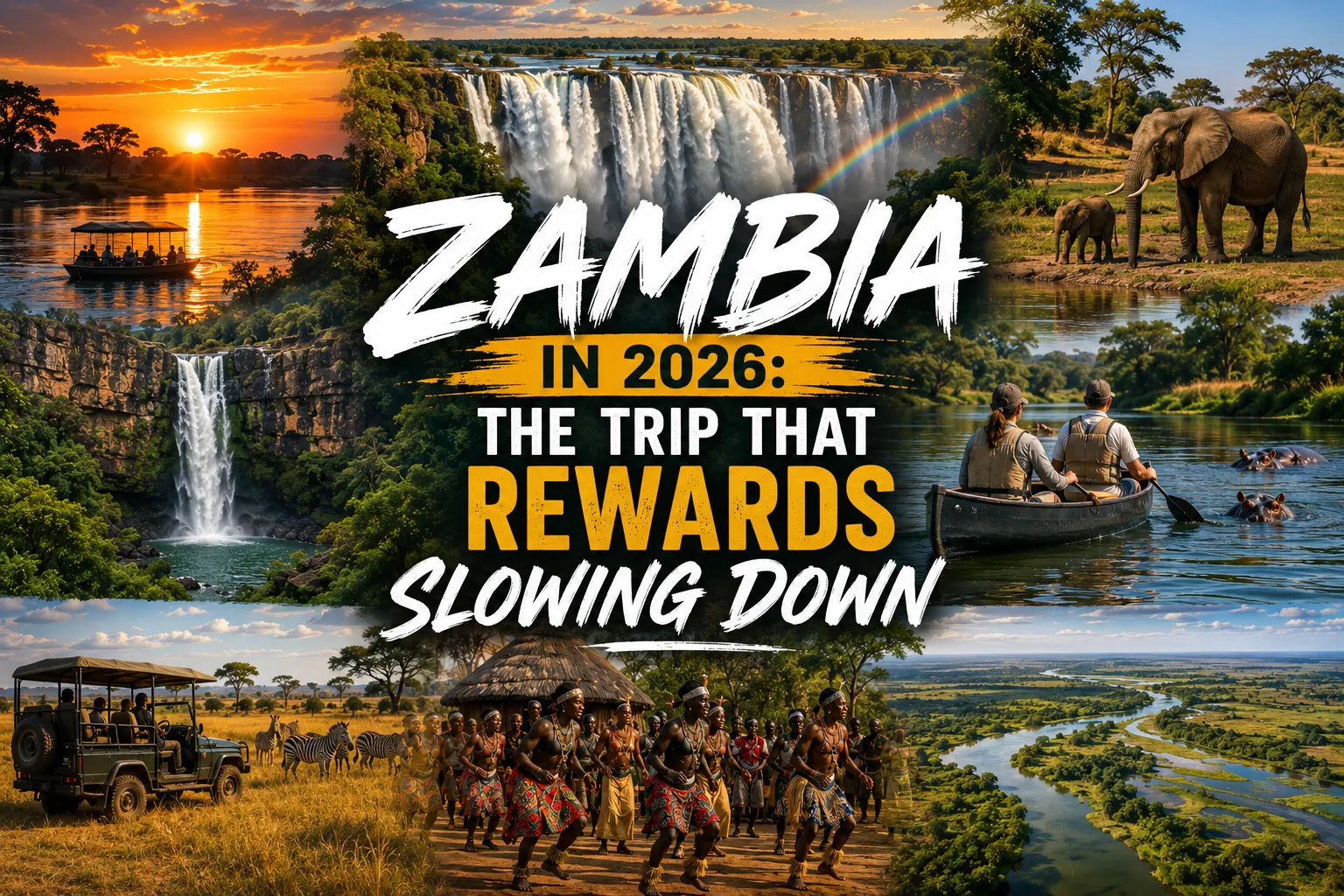

Every Zambia trip seems to start the same way — someone mentions Victoria Falls, a few photos come to mind, and the rest of the itinerary gets built around it. Nothing wrong with that. But spend more than a few days in the country and you start to realise Victoria Falls is really just the loudest part of a much quieter story. Zambia doesn't hand over its character all at once. It gives it up gradually, region by region, to people willing to move through it at something other than a rushed pace.
Here's what that slower version of the trip actually looks like.
The falls set the tone, but they're not the whole opening act
Most journeys start in Livingstone. There is a good reason for that. Victoria Falls is located at the edge of town, where the Zambezi River falls into a gorge deep enough to spray hundreds of metres into the air during the wetter months. Come later in the year once the dry season begins the same waterfall shows you something less mist, more of the rock face and gorge actually visible. What a lot of first-time visitors don't expect is how much there is to do in Livingstone beyond the viewpoints. River cruises, white-water rafting and a handful of adventure operators built around the Zambezi mean the town can keep you busy, for a few extra days, not just an afternoon.
South Luangwa slows everything down on purpose
The shift into South Luangwa is where the trip really changes character. This is one of the country's most established wildlife areas, built around the Luangwa River and the lagoons that spread out from it. Animals and bird life gather here in numbers, particularly once the dry months set in and water becomes harder to find elsewhere.
What makes South Luangwa genuinely different, though, is the walking safari. A vehicle pulls your attention toward the biggest thing in view. On foot, with an experienced guide reading the ground ahead of you, the smaller details start to matter — a track half-covered in dust, a broken branch, the particular call of a bird you haven't heard yet. With more than 400 recorded bird species in the park, it's also become something of a quiet favourite among birdwatchers.
Lower Zambezi puts the river in charge
Lower Zambezi flips the format again, and it's one of the more memorable shifts in a Zambia itinerary. The Zambezi runs alongside the park here, and much of the wildlife viewing happens from a canoe or a boat rather than a vehicle. Elephants wander down to drink at the water's edge. Hippos are a constant, unmistakable presence. Crocodiles hold still along the banks. And the whole experience moves at the pace of the current rather than the pace of a game-drive schedule.
For travellers who'd rather be on the water than bouncing along a dirt track, this is where the trip earns its keep.
Kafue asks for patience — and gives it back
Kafue National Park is enormous, and that size changes what a visit here feels like. It doesn't have the tightly packed, well-trodden feel of some of Africa's more famous parks. Large sections remain genuinely wild, and getting to them takes real time. The Busanga Plains, in the north, are worth the effort — a seasonal floodplain that transforms with the water levels and opens into wide grassland that draws wildlife in from every direction.
Kafue punishes a rushed schedule more than any other park on this list. Try to squeeze it into a single overnight stop and you'll come away with a fraction of what it offers. Give it real days instead, and it starts to make sense why people who've been saying it's their favourite part of the country.
The waterfalls nobody puts on the itinerary
Victoria Falls understandably gets the attention, but it isn't the only waterfall worth knowing about. Kalambo Falls, Kundalila Falls, Lumangwe Falls and Ngonye Falls are all promoted by Zambia's own tourism authorities, and most travellers never make it to any of them. Some require a genuine detour — extra hours on the road, limited infrastructure once you arrive — but that inconvenience tends to be exactly why they feel different once you're standing in front of one.
Culture is the layer easy to skip and worth not skipping
Wildlife and scenery pull most people to Zambia, but the country's cultural calendar deserves a place in the conversation too.
Ceremonies like Kuomboka, Nc'wala, Mutomboko and Likumbi Lya Mize remain genuinely important events in different regions, not staged performances built for tourists. Local food, crafts, music and community life add a layer to a trip that would otherwise be entirely about parks — and they give real context to the landscapes you've just spent days driving or walking through.
Picking the right season for your route
There's no single "best month" for a country this varied. The dry season tends to suit safari best, since wildlife concentrates predictably around remaining water sources. The green season brings its own rewards — lush landscapes, dramatic weather, and some of the strongest bird watching conditions of the year. Victoria Falls runs on its own separate clock entirely, tied to the Zambezi's water levels rather than the safari calendar.
The honest answer is that the right time depends on which parts of Zambia are actually on your route — not a single date that works for everyone.
Sorting the visa before anything else gets booked
Before you start check your entry requirements come down to nationality, it is worth checking early rather than assuming it'll sort itself out later.
Zambia's Department of Immigration sorts travellers into groups. Some nationalities can travel without a visa. Some can get a visa when they arrive or through an office abroad. Others must get approval before they go using the e‑Visa system. A normal tourist application requires a copy of the passport, a photograph, proof of where you will stay and a ticket home. Your passport must have at least six months left before it expires and must have three empty pages.
If your trip crosses between Zambia and Zimbabwe around Victoria Falls, it's worth checking whether the KAZA UniVisa fits — it currently costs USD 50 and covers eligible travel between the two countries.
Why the slower version of Zambia is the better one
A short stop at Victoria Falls will always be worth doing. It just won't tell you much about the rest of the country.
South Luangwa brings walking safaris and wildlife density. Lower Zambezi hands the trip over to the river. Kafue offers the space that busier parks can't. And the waterfalls and cultural events most visitors skip end up being the parts people remember longest. In 2026, that's really the appeal of Zambia — not trying to see everything on one trip, but choosing a handful of places and letting each one actually unfold.






















Sign in to leave a comment.