
Internet providers in Florida do precisely what their name describes: They provide Internet services to customers in both residential and commercial settings. Internet service providers emerged in the late 1980s and early 1990s when Internet access became widespread. Initially, telephone companies operated as ISPs, due to the prevalence of dial-up Internet.
Later, these companies expanded into DSL (Digital Subscriber Line) broadband providers. Then, in the late 1990s and early 2000s, they introduce cable broadband, and many cable television companies began offering Internet services and television and voice services.
Today, there are hundreds of different Internet service providers, and they may be commercial, non-profit, or even utility companies. Depending on your location in the country, you may have several different ISPs to choose from to get Internet service.
What exactly do ISPs do?
In a nutshell, an ISP gives you access to the internet, usually for a fee. Without an ISP, you would not be able to shop online, access Facebook or read this website. Connecting to the internet requires special telecommunications, networking, and routing equipment. ISPs provide users with access to networks that contain the necessary equipment for users to connect to the internet.
ISPs are responsible for providing Internet access, routing Internet traffic, resolving domain names and maintaining the network infrastructure that enables Internet access. Although the main task of an ISP is to provide access to the Internet, many ISPs do much more.
How do Internet Service Providers work?
At the top of the Internet, access pyramid is Tier 1 ISPs. A Tier 1 ISP is an ISP that has access to all networks on the Internet only through the use of peering agreements, for which it does not have to pay. To better understand the purpose of Tier 1 ISPs, think of Tier 1 ISPs as the main highways of the Internet. These ISPs connect all corners of the World Wide Web. Some well-known examples of Tier 1 ISPs are Vodacom, Bharti, Deutsche Telekom, British Telecommunications, and Verizon.
Tier 1 ISPs sell their networks to Tier 2 ISPs. Tier 2 ISPs then sell Internet access to organizations and residential customers. Sometimes, however, Tier 1 ISPs may sell Internet access directly to organizations and individuals. In addition, a second intermediary ISP, called a Tier 3 ISP, may purchase network bandwidth from a Tier 2 ISP before selling that bandwidth to end-users.
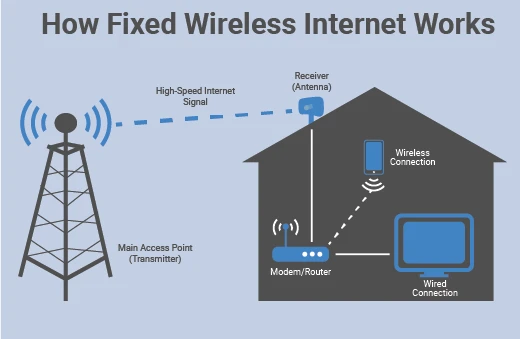
When traffic is routed from the home network to the Internet, it goes through several hops before reaching its destination. For example, traffic may travel from a modem to a Tier 3 ISP's network, to a Tier 2 ISP's network, to a Tier 1 ISP's network, and then back through different ISPs before reaching its destination. The underlying technology used by ISPs to establish connectivity may be based on analog (dial-up) telephone lines, DSL, cable, satellite, Wi-Fi, fibre, or other connectivity methods. Many cable and telephone providers are also ISPs, as their underlying infrastructure can accommodate Internet traffic.
Types Internet offered by Internet Service Providers
DSL
DSL stands for "Digital Subscriber Line" and refers to a system where your Internet connection is delivered over your existing telephone line. It is the cheapest form of broadband on the market and can reach speeds of up to 25 Mbps. If you live in a neighborhood where phone lines are relatively newer, then your DSL Internet speeds can even reach up to 100 Mbps.
While the DSL system is quite efficient, the only downside is that the distance from your service provider's operations center has an impact on your Internet speed. The further away you are, the slower your Internet speed will be. However, for pricing, you can consider your options and try to find an ISP that is closer.
CABLES
Cable Internet is delivered to your home through your cable connection. Because of the infrastructure's ability to transfer more data at faster speeds, cable Internet connections tend to be very fast, often over 100 Mbps. However, you will be sharing that connection with everyone else in your neighborhood. This means that you will be experiencing slower speeds, especially during peak hours. If you regularly use the Internet during off-peak hours, then cable Internet may be a good option. Otherwise, it's just asking for poor streaming and failed downloads.
FIBER OPTIC
Fiber optic Internet is where the connection transfers data using fiber optic cables. Due to the material properties of these cables. They transmit data at very fast speeds, allowing for quality, uninterrupted high-speed Internet. The prices of fiber optic ISPs are comparable to DSL and you end up with more speed and better quality. The only downside is that fiber optic Internet is not available everywhere. But, ISPs are constantly adding to their network and soon you may just have a fiber-optic Internet connection available in your neighborhood.
SATELLITE
The last type of Internet is the least used. As the name suggests, this type of connection delivers the Internet to your location via satellite. Speeds tend to be below the 20 Mbps mark, which explains why it is not used by many. While it may be the slowest Internet option on this list, the connection tends to be very stable. Satellite Internet is a good option if you live in a rural area that does not have cable, DSL, or fiber optic infrastructure in place. Otherwise, it's best to stick with the other options.
0



















Sign in to leave a comment.