



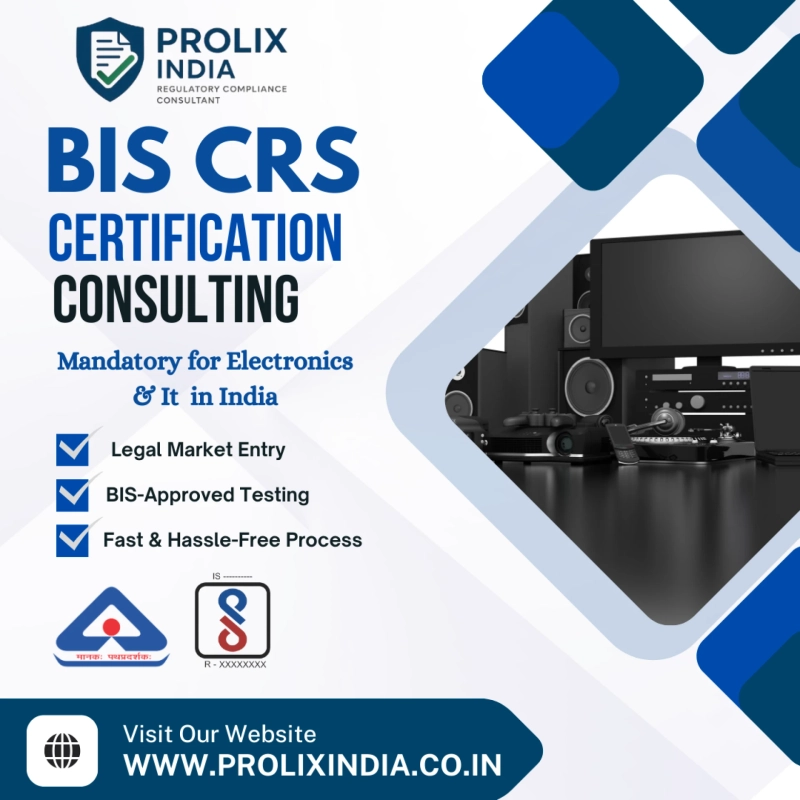
India has one of the fastest-growing electronics markets in the world. With increasing consumer demand comes the responsibility to ensure that electronic products are safe, reliable, and compliant with national standards. To regulate quality and safety, the Government of India introduced the Compulsory Registration Scheme (CRS) under the Bureau of Indian Standards. This scheme makes BIS CRS Registration mandatory for several electronic and IT products before they can be manufactured, imported, or sold in India.
Introduction to the Compulsory Registration Scheme
The Compulsory Registration Scheme was launched to bring uniformity and accountability to the electronics sector. Under this framework, manufacturers must ensure that their products conform to applicable Indian Standards and are tested by BIS-recognized laboratories. Once compliance is confirmed, BIS grants registration, allowing the product to carry the standard compliance mark.
This system is designed to reduce the circulation of unsafe electronics, protect consumers, and promote high-quality manufacturing practices.
What Does BIS CRS Registration Mean for Manufacturers?
BIS CRS Registration is a legal requirement for manufacturers whose products fall under the notified list issued by the Ministry of Electronics and Information Technology (MeitY). The registration is granted to the manufacturer, not the trader or distributor, and is specific to the product model.
Both Indian and foreign manufacturers are covered under this scheme. For overseas applicants, appointing an Authorized Indian Representative (AIR) is mandatory to liaise with BIS authorities.
CRS Registration vs. Traditional BIS Licensing
CRS Registration differs from conventional BIS licensing in several ways:
- It follows a self-declaration model rather than factory audits
- Product testing is mandatory before application
- Registration is product- and model-specific
- Market surveillance is conducted post-registration
This approach ensures faster approvals while maintaining regulatory oversight through periodic checks and enforcement actions.
BIS Registration for Electronic Products in India
The BIS Registration for Electronic Products applies to a wide range of devices used in households, offices, and industries. These include:
- Mobile phones and smart devices
- Laptops, notebooks, and tablets
- LED lighting products
- Power adapters and chargers
- Audio-video equipment
- Household electronic appliances
Any electronic product covered under CRS must obtain BIS registration before being introduced in the Indian market. Non-compliance can result in penalties, product recalls, and import restrictions.
Importance of BIS Certification for Electronic Products
Obtaining BIS Certification for Electronic Products offers multiple strategic advantages:
- Regulatory Approval – Ensures compliance with Indian laws and regulations
- Consumer Confidence – Builds trust by assuring product safety and quality
- Market Expansion – Enables smooth entry into the Indian electronics market
- Risk Reduction – Minimizes chances of legal action or business disruption
- Brand Reputation – Demonstrates commitment to quality standards
For importers, BIS certification is often a prerequisite for customs clearance, making it an essential compliance requirement.
Step-by-Step CRS Certification Process
The CRS Certification process generally includes the following stages:
- Product Standard Identification
Identify the applicable Indian Standard for the electronic product. - Laboratory Testing
The product is tested in a BIS-recognized laboratory to verify compliance. - Application Preparation
Collect test reports, technical details, manufacturing information, and authorization documents. - Online Registration
Submit the application on the BIS CRS portal along with prescribed fees. - Evaluation and Approval
BIS reviews the application and grants registration upon successful verification. - Use of Standard Mark
After approval, the product can legally display the BIS CRS mark.
Common Challenges Faced During CRS Registration
Despite clear guidelines, businesses often face obstacles such as:
- Incorrect identification of applicable standards
- Delays in laboratory testing
- Documentation errors
- Non-alignment with Indian safety norms
- Communication gaps for foreign manufacturers
Addressing these challenges requires technical understanding and familiarity with BIS procedures.
Role of Professional BIS Consultants
Given the technical nature of compliance, many businesses prefer working with professional consultants. Experienced advisors help in product classification, test coordination, documentation accuracy, and timely application submission. This reduces rejection risks and ensures faster approvals.
Conclusion: BIS CRS Registration Made Simple with Prolix India
Achieving BIS CRS Registration and Certification is essential for any business dealing with electronic products in India. While the process demands precision and regulatory awareness, expert support can significantly simplify the journey.
Prolix India provides comprehensive assistance for BIS CRS Registration, BIS Certification for Electronic Products, and regulatory compliance services. With a strong understanding of BIS requirements and hands-on experience across diverse electronic categories, Prolix India helps manufacturers and importers achieve hassle-free compliance.
By partnering with Prolix India, businesses can focus on growth and innovation while ensuring their electronic products meet all mandatory Indian standards with confidence and efficiency.