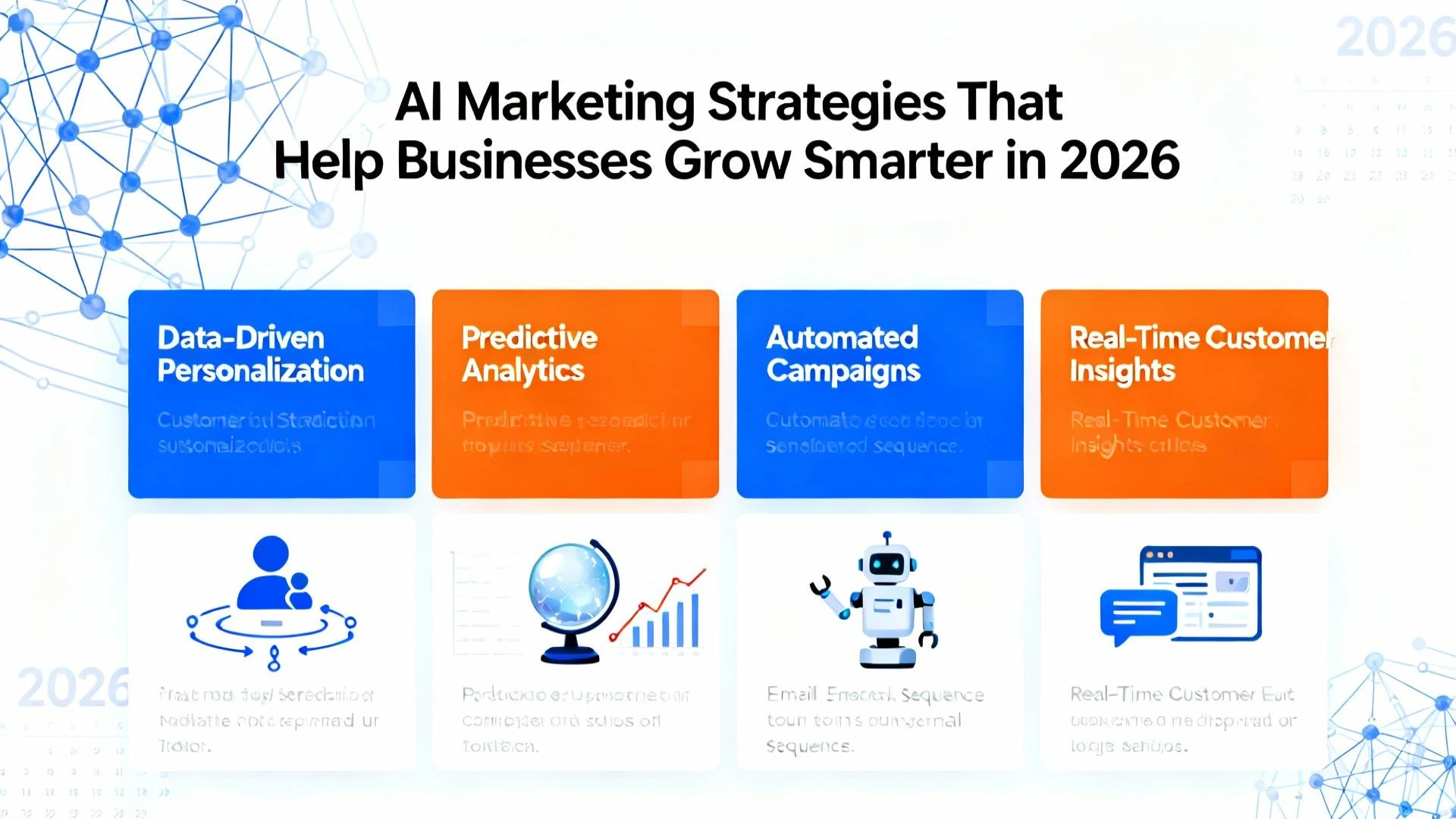

By 2026, artificial intelligence in marketing will have graduated from a shiny experimental tool to the central nervous system of business growth. The days of wondering "if" we should use AI are long gone; the question now is how effectively we can integrate it to outmaneuver the competition.
For modern businesses, "growing smarter" isn't just about efficiency or cutting costs—it's about precision. It is about using data to anticipate customer needs before they are even expressed and delivering value at a scale that was previously impossible. As we navigate this mature AI landscape, the gap between businesses that treat AI as a novelty and those that embed it into their strategic core is widening.
This article explores the definitive AI marketing strategies for 2026, offering a blueprint for businesses ready to move beyond the hype and drive tangible, revenue-generating results.
1. The Rise of "Agentic" AI and Autonomous Campaigns
The most significant shift in 2026 is the move from generative AI (creating text/images) to agentic AI (taking action). AI agents are no longer passive chatbots; they are active participants in the economy. They can research products, negotiate prices, and book services on behalf of users.
Optimizing for Machine Customers
For businesses, this means your marketing strategy must appeal to both humans and machines. Your product data must be structured so clearly that an AI agent acting for a customer can instantly verify your pricing, availability, and specs.
Actionable Tip: Ensure your structured data (schema markup) is impeccable. If an AI agent cannot "read" your product's value proposition in milliseconds, it will bypass you for a competitor it can understand.
2. Hyper-Personalization at Scale
In the past, personalization meant adding a customer's first name to an email subject line. In 2026, it means dynamically altering the entire user experience in real-time. AI algorithms now process vast amounts of behavioral data to create a "segment of one."
Dynamic Web Experiences
Imagine a visitor landing on your homepage. Instead of a static banner, AI analyzes their past interactions, current location, and referral source to generate a custom landing page instantly. If the user is a CFO, the copy highlights ROI and efficiency. If the user is a creative director, the page emphasizes design and aesthetics.
- Behavioral Triggers: AI tracks micro-behaviors (mouse movement, dwell time) to trigger offers at the exact moment of hesitation.
Predictive Recommendations: E-commerce sites now populate carts with items a user is statistically likely to need next, reducing friction and increasing average order value (AOV).
3. Mastering the New Search Landscape
Search behavior has fundamentally changed. Users are increasingly turning to AI-powered answer engines (like ChatGPT Search, Perplexity, or Google's AI Overviews) rather than scrolling through ten blue links.
Adapting to AI Search Optimization (AISO)
To remain visible, businesses must pivot from traditional keyword stuffing to "Answer Engine Optimization." This involves creating deep, authoritative content that directly answers complex queries. Because this landscape is so volatile and technical, many forward-thinking companies are now partnering with specialized AI SEO services to help them navigate the complexities of ranking in AI-generated responses. These services focus on optimizing for "informational gain" and ensuring that brand citations appear in the synthesized answers provided by AI models.
Key Strategy: Focus on being the source of the facts. AI models cite sources that provide unique data, original research, and expert opinions.
4. Predictive Analytics and Churn Prevention
Growing smarter isn't just about acquiring new customers; it's about keeping the ones you have. In 2026, retention is powered by predictive modeling.
Stopping the Leaky Bucket
AI tools can now analyze hundreds of signals—from support ticket sentiment to usage frequency drop-offs—to predict which customers are at risk of churning weeks before they actually leave.
- The "At-Risk" Flag: Marketing teams receive automated alerts when a high-value account shows subtle signs of dissatisfaction.
- Automated Intervention: The system can automatically deploy a retention offer or prompt a customer success manager to reach out, fixing the relationship before it breaks.
5. Streamlined Content Operations
Content remains king, but the kingdom is now automated. The challenge in 2026 is not creating content but orchestrating it efficiently without losing the human touch. This is where advanced workflow automation comes into play.
Smarter Workflows with AI Tools
Successful marketing teams are using AI to handle the "drudgery" of content marketing—distribution, reformatting, and basic drafting—allowing human creatives to focus on strategy and storytelling.
For instance, many teams are implementing AI content marketing strategies using ContentBot to automate complex content flows. A tool like this can take a single high-value blog post and automatically generate a week's worth of social media captions, a newsletter summary, and a script for a short-form video, all while adhering to the brand's specific tone guidelines. By using such platforms to handle the heavy lifting of repurposing and distribution, marketers can ensure a consistent omnichannel presence without burning out their creative teams.
Conclusion
The marketing landscape of 2026 is defined by a blend of human creativity and machine precision. The businesses that grow smarter are those that stop viewing AI as a tool for shortcuts and start viewing it as a partner for strategy.
Whether it is optimizing for the new wave of AI search, deploying autonomous agents to handle customer service, or using predictive analytics to save at-risk accounts, the goal remains the same: to deliver the right message to the right person at the exact right moment.
Key Takeaways for Marketers:
- Audit Your Data: AI is only as good as the data it is fed. Clean, organized first-party data is your most valuable asset.
- Human-in-the-Loop: Precise automation is powerful, but human oversight is essential to maintain brand authenticity and empathy.
- Adapt Quickly: The algorithms change daily. Stay flexible and be willing to pivot your strategy as new AI capabilities emerge.
By embracing these strategies, your business can navigate the complexities of the digital age and achieve sustainable, intelligent growth in the years to come.





























Sign in to leave a comment.