




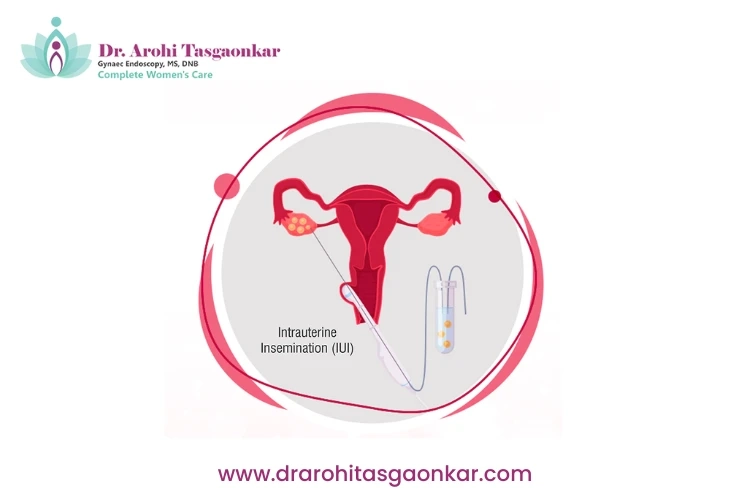
What exactly is IUI?
IUI is an acronym for intrauterine insemination. It is a kind of artificial insemination in which processed and washed sperm are inserted into the uterus, making the path to the fallopian tube considerably shorter around the time of ovulation, increasing the odds of becoming pregnant.
It is a relatively simple, non-invasive, not much costly form of ART offered to couples with few indications.
IUI Indications
Male Factor Infertility:
Semen analysis is routinely advised in the infertility workup of the couple and if any semen parameters like count, or motility show sub-optimal parameters IUI may help with some of these issues since the process of processing and preparing sperm for the treatment separates extremely motile and normal sperms. The goal of IUI in male factor infertility is to achieve a total motile sperm concentration of 10-15 million/ml after washing the sperm.
Donor Sperm:
Used in patients with testicular failure or non-obstructive azoospermia when donor sperm is not available. IUI is performed on women who need donor sperm to get pregnant. Before the IUI process, a frozen donor semen sample is received from a certified lab.
Unexplained Infertility:
When ovulation is documented, bilateral fallopian tubes are healthy and patent and sperm parameters are normal, and there is still no pregnancy, 3 - 6 cycles of IUI, depending on the age of both couples, may be attempted. The goal of the technique is to get 2 to 3 mature eggs by medication and then do IUI around the time of ovulation.
Infertility caused by Endometriosis:
Endometriosis is a chronic inflammatory condition of the female reproductive system that causes infertility. Infertility affects 40% of endometriosis patients. For situations of mild to moderate endometriosis, and depending on the age of the female partner, 3-6 rounds of IUI may be performed before moving on to more intrusive ART such as IVF.
Cervical factor Infertility:
Cervical mucus may be unfavorable to sperm, and scarring on the cervix can prevent sperm from reaching the egg. IUI works by passing sperm through the cervix and depositing it straight into your uterus, increasing the quantity of sperm accessible to meet the egg.
Ovulatory factor Infertility:
IUI may be conducted on anovulatory women who have been given ovulation induction medicines in order to promote ovulation and raise the chances of conception.
Complications and Risk
IUI is a straightforward, safe, non-invasive, outpatient treatment that does not need hospitalization and has a minimal risk of major consequences.
Infections - There is a tiny chance of infection as a result of the surgery itself, however, this risk is reduced when all precautions are taken.Spotting - The process of inserting an IUI catheter into the uterus might produce little spotting and cramping. This has no bearing on the likelihood of conception.Multiple pregnancies - Ovarian stimulation is performed to improve the likelihood of pregnancy; medications and injections are utilized with the goal of obtaining 2 to 3 eggs during IUI. This may result in twin, triplet, or multiple pregnancies. However, the goal of IUI for fertility therapy is to achieve a singleton pregnancy.How should a patient be prepared for IUI?
TVS cycle monitoring - Depending on the reason for IUI, oral drugs and injections are given to ovulate 2 to 3 eggs, and the cycle is monitored by TVs to check the size and maturity of the egg.Ovulation trigger - Once an egg seems to be developed enough by monitoring size on TVS, injections are administered to cause ovulation, which is also recorded by TVS.Semen processing and insemination -IUI is conducted 36-40 hours following the trigger injection. The sample is washed and processed in a laboratory, where highly lively, motile sperms are separated from lesser-quality sperms. Using a highly concentrated sample of healthy sperm enhances the chance of conception.Luteal phase support - Pregnancy is supported by oral medication and injections.Expectations during and after the procedure
After the sperm has been treated and cleansed, IUI takes 10- 15 minutes and is performed in a clinic.
After passing urine, you may be asked to lie down on an examination table with your legs in stirrups and a speculum inserted into your vagina.
During the procedure, a flexible catheter containing healthy sperm is put into the uterus via the cervical opening, and the doctor typically pushes the sperm sample through the tube into the uterus before removing the catheter and speculum. After insemination, you may be requested to lay down for 15-20 minutes before returning home and continuing with your normal activities.
Your doctor may ask you to do a home pregnancy test using a kit 2 weeks after the treatment. Generally, three to six rounds of IUI are suggested before going on to more advanced forms of treatment.
If you want to know more about IUI treatment, consult Dr. Arohi Tasgaonkar one of the top Gynecologist in Ghodbunder Road Thane.
You may also read All you need to know about PCOS.
Thanks for reading!