
Air quality, filtration performance, and system longevity are all critical factors in industrial environments. The cyclone separator is one of the most well established workhorses in the industry for good reason. Using centrifugal force to separate particulates from air, gas or liquid flows, cyclones are often deployed as pre-filters ahead of HEPA or cartridge filtration units. As well as improving overall system performance, they can help to reduce maintenance and downtime.
When specifying a cyclone for an industrial pipework system, the design decision will often come down to horizontal or vertical configuration. Each has its own merits and drawbacks, which can be particularly important to consider where existing space restrictions, ductwork infrastructure, and hygiene standards are present.
But what are the major differences between horizontal and vertical models and their implications in performance, installation, industry requirements and maintenance?
Compact size and simple installation
The horizontal cyclone is the most obvious choice when space is at a premium, since as the name implies, the unit is designed to sit inline with horizontal pipes. This makes it ideal in cases where headroom or vertical clearance is at a premium, whether below mezzanines, inside plant rooms or even where the unit can be slotted directly into an existing straight galvanised steel pipe run.
Horizontal versions are also particularly well suited to retrofit applications in existing ductwork systems, where re-engineering the entire system to create the clearance required for a standard vertical cyclone is either impractical, or very expensive.
Vertical cyclones, by contrast, require more space and a stronger structural support. In addition to their larger footprint, their orientation typically requires a larger depth of installation for this reason, to help provide the natural particle drop out that is aided by gravity in the separation process.
While both designs can of course be installed in ducting layouts with relative ease, the horizontal unit is typically the most popular in constrained or legacy applications, especially where disruption and installation time is a key concern.
Pre-filtration considerations
The main function of the cyclone separator is to remove particulates from the airstream and protect downstream filtration media. This can be particularly important in dusty processes such as pharmaceutical processing and food and beverage production.
By acting as a pre-filter to target large and medium-sized particulate matter, cyclones can significantly increase the lifespan of downstream filter elements or cartridges. This is because the air stream is already cleaner as it enters, there’s less risk of filter clogging and the airflow tends to be more consistent.
In practice, this means reduced replacement frequency, less manual labour and downtime, and more consistent operation, all of which contribute to cost savings and better environmental control.
The good news is that this principle works whether the cyclone is horizontal or vertical. In some cases, vertical cyclones may offer a small separation efficiency advantage for fine or variable-density particulates because of the gravitational assistance of the vertical orientation. For applications like pharmaceuticals or medical manufacturing, the cyclone separator can be used to drop out large, low-density materials like excipients or starches before passing to more sensitive filtration or containment systems.
Why food-grade materials matter
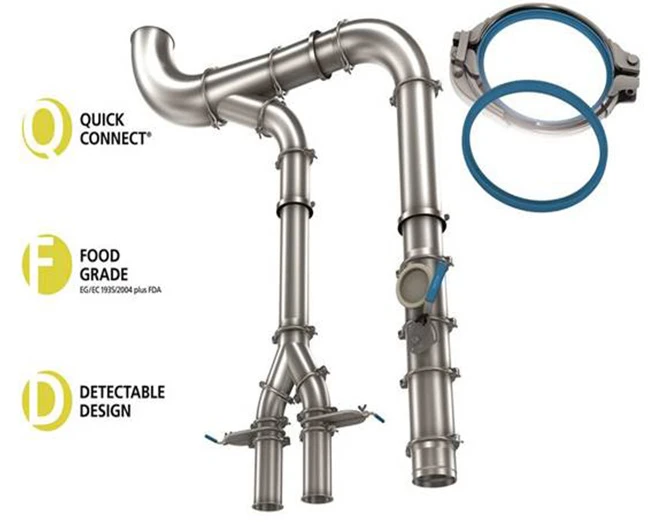
In food or pharmaceutical applications, cyclone separators must adhere to strict hygiene and material standards. This usually involves a construction of food-grade stainless steel ducting, plus internal surfaces that are as smooth and easy to clean as possible to help reduce the risk of contamination or retained product build-up.
An additional safety factor is the use of metal detectable components wherever possible. This refers to elements such as gaskets, seals, or even quick release closures that are specially manufactured so they can be easily identified by standard metal detection equipment.
This means that, should a component inadvertently drop into the product stream, it can be identified before the product is packaged or delivered to a customer. Both horizontal and vertical units can be constructed to these standards, with horizontal units generally offering more ergonomic accessibility to clean in place systems or internal inspection when mounted at lower working height.
Making maintenance easy
These are key points for all cyclone separators, and should always be considered when comparing horizontal and vertical unit styles. Dust build-up, abrasion from hard or heavy materials, or ingress of moisture can all affect a cyclone separator’s efficiency and performance over time.
Inspection doors or quick acting closures are therefore very useful features for cyclones of all types. It allows plant engineers to access critical internal components without needing to completely remove the unit from the pipework network, minimising downtime and enabling easier maintenance.
Horizontal cyclones are generally considered more ergonomic to access for inspection and cleaning, since the unit is at working height rather than requiring technicians to use ladders or scaffolding.
So, which is best?
From pharmaceutical cleanrooms to food production lines, the right cyclone separator can be key to protecting filter systems, reducing operating costs, and improving compliance to hygiene and safety standards.
Understanding your existing pipework layout and its environmental constraints, as well as the requirements for ongoing maintenance, can help you to choose the most suitable configuration. With a wide range of options available today from manufacturers, modern cyclones are more versatile and efficient than ever.






























Sign in to leave a comment.