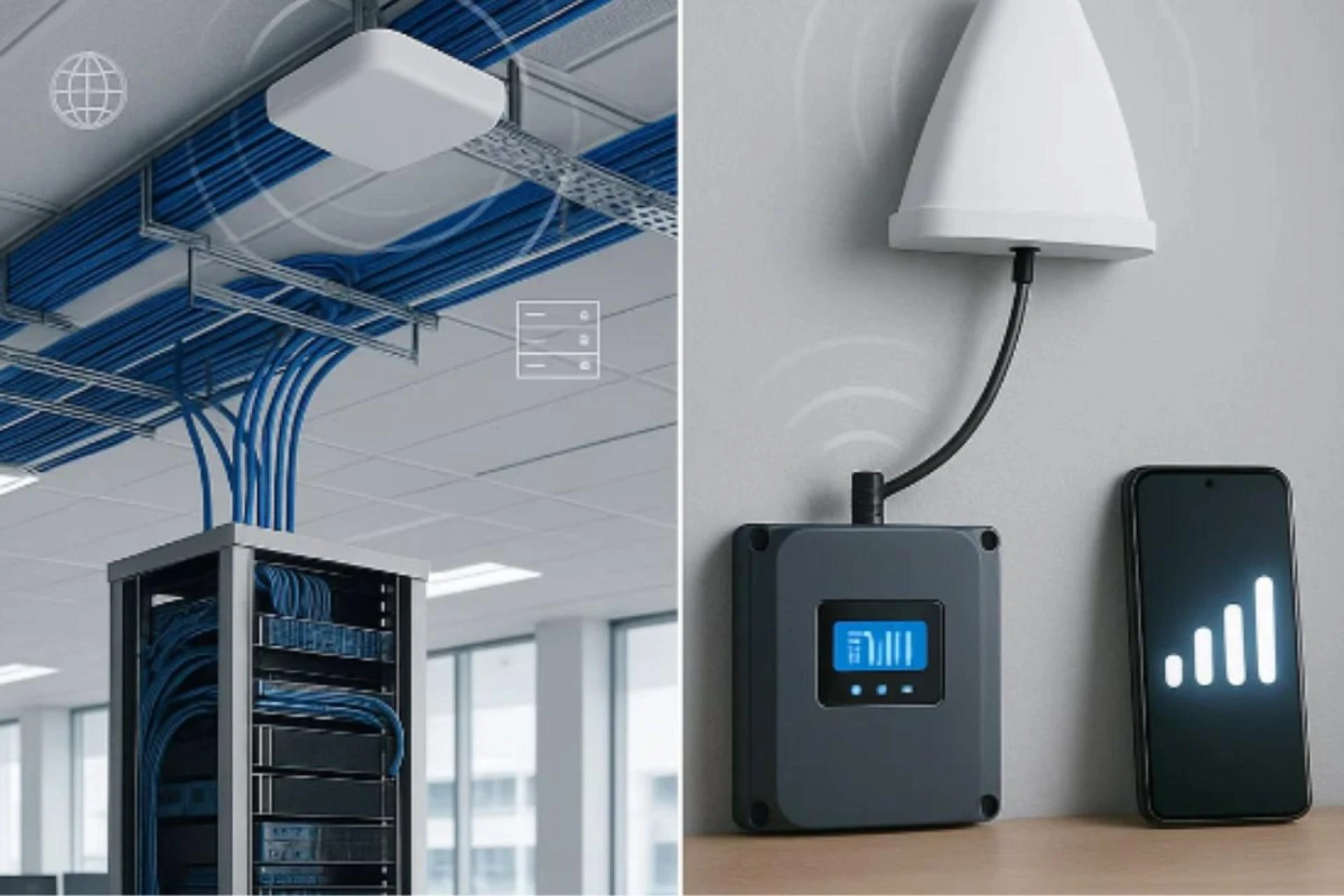

Staying connected is now a must. Employees need to make important calls in office buildings. Patients use wireless devices in hospitals. Good cell service is essential.
But even in cities with strong outdoor signals, many buildings have bad reception inside. Why? Thick walls, materials like glass and metal, and underground or multi level designs can block or weaken cell signals.
To fix this, two main technologies are used: signal boosters and Distributed Antenna Systems (DAS). Both work to remove dead zones. They differ in size, cost, setup difficulty, and long-term performance. Understanding these differences helps businesses and property owners make the right choice.
What Is a Signal Booster?
A signal booster is also called a cell phone repeater. Its job is to catch signals from outside and then send stronger signals inside the building.
How it works:
- An outdoor antenna picks up the nearest cell signal.
- An amplifier makes that signal stronger.
- One or more indoor antennas then broadcast the better signal inside the building.
Boosters are usually sold to homeowners and small businesses. They are low cost, simple to set up, and work right away. They are effective if the building already gets some weak outside signal.
Use cases:
- Small homes in suburban or rural areas
- Single floor offices
- Remote cabins that have some outdoor signal but it is weak or unstable
However, boosters have limits. They usually cover smaller areas. Even the best ones only cover up to 25,000 square feet. They also rely on outdoor signal strength. If the outside signal is weak, a booster cannot help much. It can only make the existing signal stronger.
What Is a DAS (Distributed Antenna System)?
A Das Antena is a network of antennas placed throughout a building or area. All these antennas connect to one central signal source.
Unlike a booster, DAS does not just make a weak signal stronger. It is built to provide strong and reliable coverage across very large or complicated spaces.
There are three main types of DAS:
- Passive DAS - Uses coaxial cables to carry signals from a central source.
- Active DAS - Changes signals to digital, sends them through fiber optic cables, then changes them back for broadcasting.
- Hybrid DAS - Mixes parts of both passive and active systems.
DAS is a permanent infrastructure solution. It needs professional design and installation. This is often done during building construction or a major remodel.
Once installed, it provides smooth coverage throughout the whole building. It works even in places where normal boosters would not, like underground parking, basements, or large hospitals.
The main doubt is who needs a DAS system? Any place that needs constant, large scale wireless coverage uses DAS. This includes hospitals, airports, malls, stadiums, government buildings, and universities.
Often, rules require DAS for emergency radio systems used by police, fire, and medical teams.
Key Differences Between DAS and Signal Boosters
Both solutions aim to improve indoor connectivity. But they are very different in size, cost, and performance.
1. Coverage Area & Scale
- Signal Boosters - Best for small areas. A strong booster can cover a big house or a small office. But it will not work well for buildings with many floors or large spaces.
- DAS - Made for very large and complex spaces. Multiple antennas can cover hundreds of thousands of square feet. This provides even coverage with very few dead zones.
2. Installation Complexity
- Boosters - Often, users can install it themselves or with just a little professional help. Setup usually only takes a few hours.
- DAS - It needs careful planning. This includes site checks, working with cell carriers, running cables, and often connecting to the building's systems. Installation can take weeks or even months.
- New chat
3. Cost
- Boosters - Prices usually range from $400 to over $4,500 AUD. The cost depends on the size of the area you need to cover.
- DAS - Costs can be very different. Big systems can cost hundreds of thousands of dollars. This is especially true when they use fiber optics, active parts, and need deals with cell carriers.
If you're wondering how much does a DAS distributed antenna system cost? A small passive DAS can start near $45,000 AUD. A full active DAS for a big place like a hospital or stadium can cost over $1.5 million AUD.
The price changes based on the size of the area, how complex the building is, which cell carriers are included, and what rules must be followed.
4. Reliability & Signal Quality
- Boosters - It improves coverage, but the signal can change if the outside signal changes. Its performance depends entirely on the strength of the outside signal it receives.
- DAS - It provides strong, reliable coverage like the cell carriers themselves. This is especially important for public safety or places where service must not fail.
5. Maintenance & Longevity
- Boosters - These devices are easy to use and need very little upkeep. If new technology comes out, replacing the unit is simple.
- DAS - It is more complex but lasts longer. It needs professional maintenance. It might need updates for new cell networks like 5G. But the system is built to be strong and can grow with your needs.
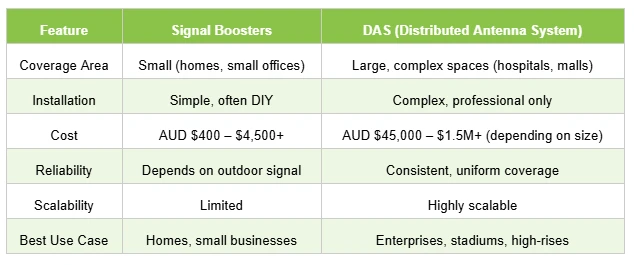
Comparison Table: DAS vs Signal Boosters
Real-World Scenarios
- Small Business Office (5,000 sq. ft.) - Employees lose calls near conference rooms. A $1,700 AUD signal booster fixes this fast and for less money.
- Shopping Mall (500,000 sq. ft.) - There are hundreds of stores, thick concrete walls, and many floors. A DAS gives smooth coverage for shoppers, workers, and security. The higher cost is worth it.
- Hospital - Doctors and nurses need mobile devices for patient care. Safety rules require DAS for emergency communications. Boosters are not enough here.
- Residential High-Rise - Boosters in separate apartments might help some tenants. But a DAS gives steady coverage for the whole building and raises the property's value.
Are antenna signal boosters worth it? Yes. For small or medium spaces that already get some outside signal, boosters are usually the easiest and cheapest option.
But for large, complex, or very crowded places, DAS is better. It provides the reliable and wide coverage that boosters cannot offer.
Final Thoughts
Signal boosters and DAS both help with indoor connectivity, but they are used for different situations. Boosters are low cost and work quickly for homes and small offices. DAS systems are strong and made for businesses with large and complex spaces.
If you are choosing between the two, first look at your building's size, current signal strength, and future needs. For small spaces, a booster might be enough. For bigger buildings, or where reliability and rules are important, a DAS is the better choice.
Working with a trusted provider like Fixtel can help you choose the right solution. They know how to design and set up both DAS and business communication systems. This ensures your investment will work well in the future, follow all rules, and meet your exact needs.






















Sign in to leave a comment.