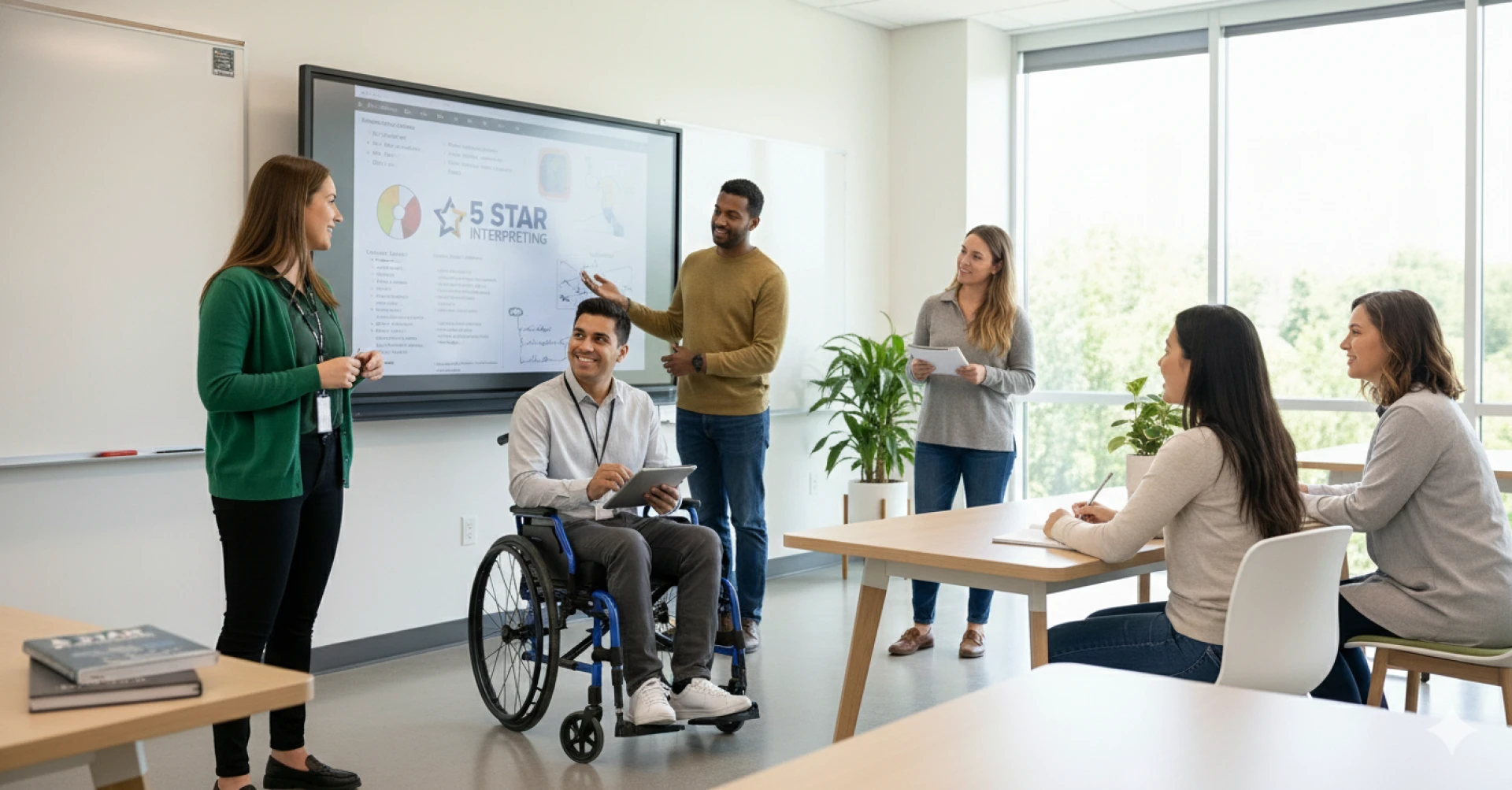
For many of today's inclusive education efforts, education translation services are seen as administrative functions rather than as things that belong in an educational mindset. This very mindset also contributes to many of the failures of inclusive education initiatives. Education translations are not just about appearance, nor about compliance with a policy.
Education translations and ASL interpreting are about whether students can understand, participate, and succeed in their classroom. When language access is weakened, learning is lost.
Importance of Education Translation Services in Academic Environments
Academic environments operate based on clarity and precise communication, from instructions to assessments, from lectures to feedback to classroom discussions. Education translation services are the means by which language access can be established for students who speak other languages or communicate through sign language.
Every student needs equal access to educational content in the same manner as their peers; that means education translation services provide students with exactly the same content their peers received, in a format that does not dilute or misinterpret the original content.
This is not a luxury: this has a direct correlation with students' academic performance, retention, and self-esteem. Poor translation creates confusion, creates gaps in understanding long after the educational translations have been provided, and creates situations that no amount of extra tutoring will ever be able to compensate for.
Role of ASL Interpreting in Inclusive Education
ASL interpreting is an integral part of accessible education for deaf and hard-of-hearing students, and ASL interpreting is not interchangeable with closed captions, subtitles, or written notes. A live classroom is dynamic, and there is constant communication, with changes in tone, emphasis, and dynamics.
To capture real-time elements of a student's understanding through ASL interpreting, trained professionals are essential. A qualified interpreter has knowledge of educational pacing, classroom etiquette, as well as terminology related to specific subjects; students lacking an interpreter will only have access to disconnected chunks of information and, as a result, must continually work to catch up. This is not what we mean when we speak about inclusion; it is actually an example of neglect passed off as an accommodation.
Education Translation is Not Similar to General Translation
A major mistake that educational institutions make is assuming that translation services used for educational content are equivalent to general sign language translation services; they are not. Educational content is structured, layered, and typically age-specific. Translators need to have an understanding of curriculum and grade level standards, academic language, and various learning objectives.
For instance, translating a science lesson requires knowledge of the scientific terminology and intent of the instructor, while translating a history lesson requires sensitivity to cultural context and the accuracy of the story being told; as a final example, translating assessments requires an incredibly high level of exactness, as a single mis-translated word could completely alter the meaning of an entire question.
Where Schools and Other Educational Institutions Go Wrong
The use of automated systems, the employment of unqualified bilingual staff members, and inconsistent interpreting practices are all common among many educational institutions. While these types of shortcuts may reduce costs in the short term, they will cost far more money in terms of ineffective results, formal complaints, and potential lawsuits.
Accessibility as the Foundation of Education
ASL Interpreting and educational translation Services are to be included in every educational plan from the very beginning. Waiting until the end of the planning process and then "throwing" them into the mix sends the message to students that the items for accessibility are optional. They are not optional.
When we say we want to have an inclusive education and provide all students equal access to understanding, engaging in learning, and achieving success in school, we must remember this: Anything less than that is not inclusive education; it is performative compliance.




















Sign in to leave a comment.