





In modern engineering environments, informed decision-making depends heavily on data, simulations, and technical evaluations performed before physical execution. Engineering Analysis Services play a critical role in helping engineers, manufacturers, and asset owners understand how systems behave under real-world conditions. By applying scientific principles, mathematical models, and advanced software tools, Engineering Analysis Services help identify potential risks, validate designs, and optimize performance across industries such as manufacturing, energy, aerospace, construction, and automotive engineering.
As part of a broader approach to reliability, safety, and performance engineering, these services act as a bridge between conceptual design and real-world application.
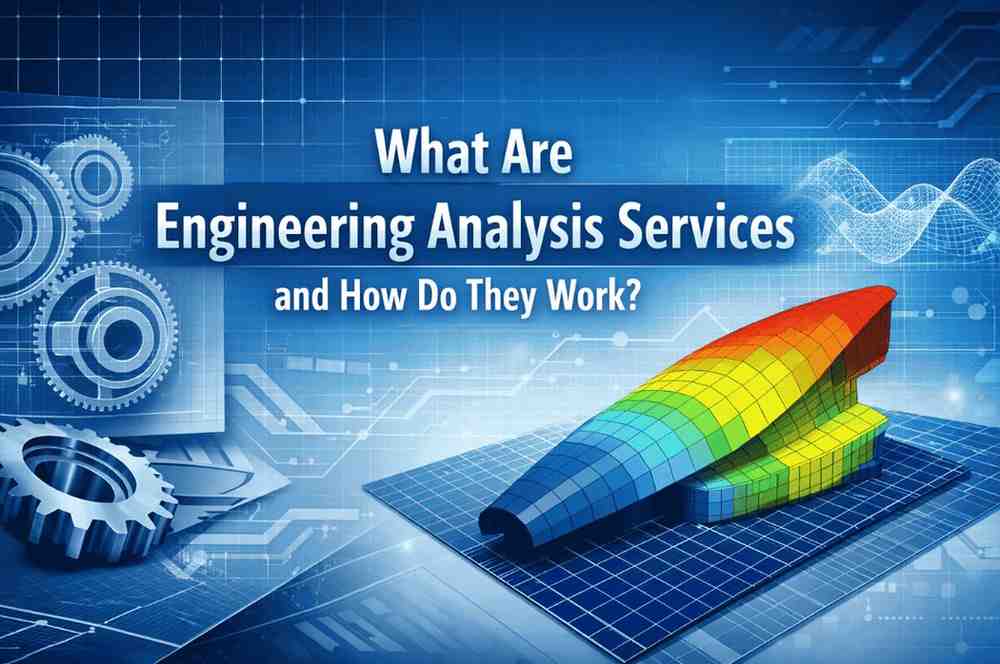
Understanding Engineering Analysis Services
Definition and Purpose
Engineering analysis services involve the systematic evaluation of structures, components, or systems using analytical methods and simulation techniques. The primary goal is to predict performance, identify weaknesses, and ensure compliance with safety and operational standards.
These services are typically applied throughout the product or system lifecycle—from early design stages to operational troubleshooting and life-extension studies.
Key Types of Engineering Analysis
1. Structural Analysis
Structural analysis evaluates how components respond to loads, forces, and environmental conditions.
Key focus areas include:
- Stress and strain distribution
- Deformation and displacement
- Load-bearing capacity
- Failure modes and safety factors
2. Thermal Analysis
Thermal analysis examines heat transfer and temperature distribution within systems.
Applications include:
- Overheating risk assessment
- Thermal fatigue evaluation
- Cooling and insulation optimization
3. Fluid and Flow Analysis
Often performed using computational methods, this analysis studies how fluids or gases move through systems.
Common use cases:
- Pressure drop estimation
- Flow efficiency analysis
- Turbulence and leakage evaluation
4. Fatigue and Fracture Analysis
This analysis predicts how materials behave under repeated loading or crack propagation over time.
Key objectives:
- Estimating service life
- Identifying fatigue hotspots
- Preventing unexpected failures
5. Vibration and Dynamic Analysis
Dynamic analysis evaluates how systems respond to motion, shocks, or cyclic forces.
Typical considerations:
- Resonance and natural frequencies
- Noise and vibration control
- Operational stability
How Engineering Analysis Services Work
Step 1: Problem Definition
The process begins by identifying objectives, constraints, operating conditions, and performance criteria. Clear problem definition ensures accurate and relevant results.
Step 2: Data Collection and Assumptions
Input data may include:
- Material properties
- Geometry and dimensions
- Load conditions
- Environmental factors
Engineering assumptions are documented to maintain transparency and traceability.
Step 3: Model Development
Analytical or numerical models are created using engineering principles and simulation software. These models represent real-world behavior as closely as possible.
Step 4: Simulation and Calculation
Advanced tools such as finite element analysis (FEA) or computational fluid dynamics (CFD) are used to run simulations and calculate responses.
Step 5: Result Interpretation
Engineers interpret outputs such as stress plots, temperature gradients, or flow vectors to identify risks, inefficiencies, or improvement opportunities.
Step 6: Validation and Reporting
Results are validated against standards, benchmarks, or experimental data. Findings are documented in technical reports to support design or operational decisions.
Industries That Rely on Engineering Analysis
Engineering analysis is widely applied across sectors, including:
- Manufacturing and industrial equipment
- Oil, gas, and energy infrastructure
- Aerospace and defense systems
- Automotive and transportation
- Civil and structural engineering
Each industry uses tailored analysis methods aligned with regulatory and operational requirements.
Benefits of Engineering Analysis Services
Technical and Operational Advantages
- Improved design reliability
- Enhanced safety margins
- Reduced material and operational costs
- Early detection of design flaws
Strategic Value
- Supports data-driven decisions
- Reduces need for physical prototypes
- Extends asset life through predictive insights
Relationship to Reliability, Safety & Performance Engineering
As discussed in Engineering Analysis Services for Reliability, Safety & Performance, engineering analysis forms the foundation for proactive risk management. By identifying failure mechanisms before they occur, organizations can improve operational resilience and meet compliance standards without over-engineering solutions.
Conclusion
In summary, Engineering Analysis Services provide a structured, scientific approach to evaluating how systems behave under real-world conditions. From structural integrity to thermal performance and fatigue life, these services help engineers make informed decisions that support safety, reliability, and efficiency. When applied consistently and responsibly, Engineering Analysis Services contribute to smarter designs, optimized operations, and reduced uncertainty across complex engineering projects—an approach aligned with the analytical methodologies followed by organizations such as DANSOB.