




Executive Summary
Enterprise recipe templating has become a defining capability for franchise brands scaling across the MENA region. As operators expand into Riyadh, Dubai, Doha, Jeddah, Abu Dhabi, and Manama, the challenge is no longer growth alone, but maintaining consistency of cost, taste, and brand experience across every outlet. In a region shaped by delivery dominance, labour turnover, supplier volatility, and aggressive expansion timelines, even minor deviations in recipe execution can create significant financial and reputational risk.
Many franchise groups discover too late that their most profitable dishes quietly lose margin as portion sizes drift, ingredient substitutions go untracked, and outdated recipes remain in circulation. What appears to be a training issue is almost always a systems issue. Static PDFs, localised recipe edits, and disconnected costing models cannot support modern multi-site operations.
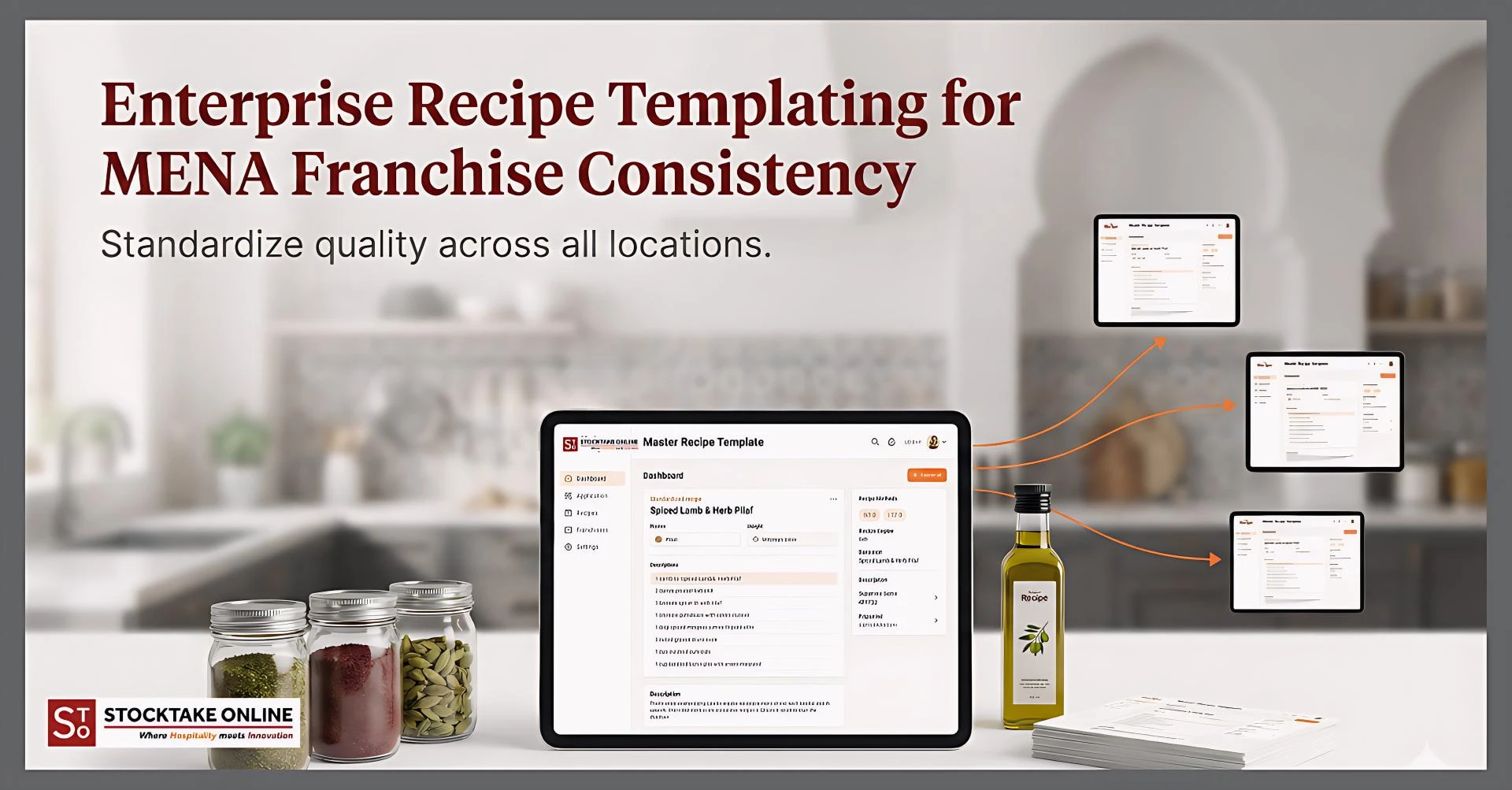
Enterprise recipe templating solves this problem by creating a single live source of truth for ingredients, methods, yields, allergens, and cost. When implemented correctly, it allows operators to scale faster while tightening control. This article explores why recipe templating matters more in the GCC than almost any other region, where breakdowns occur, the financial consequences of inconsistency, and how Stocktake Online enables franchise brands to stabilise growth while protecting margins through structured, enterprise-grade recipe control.
Industry and Market Context
The MENA food service sector is expanding at a pace unmatched by most global markets. Population growth, tourism recovery, government-backed hospitality investment, and the maturity of delivery platforms have created an environment where brands are expected to scale quickly and perform immediately. Franchise expansion is no longer measured in years but in quarters.
At the same time, operational complexity has increased. Ingredient sourcing varies widely between markets. Labour skill levels differ across cities and countries. Central kitchens and cloud production units now feed both dine-in and delivery channels. Menu innovation cycles have shortened, while customer tolerance for inconsistency has declined.
In the GCC, brand trust is built on predictability. Guests expect the same dish to taste identical whether ordered in Dubai Marina, Riyadh Boulevard, or West Bay Doha. Delivery customers are even less forgiving, as poor portioning or inconsistency translates directly into negative reviews and lost platform ranking.
Yet many expanding franchise groups still rely on manual recipe documentation, local spreadsheets, or static costing models that fail to reflect real operational conditions. As sites multiply, these weaknesses compound. What works for three locations collapses at fifteen.
This is why enterprise recipe templating has shifted from a best practice to a baseline requirement for serious MENA operators. It provides the operational backbone needed to support high-velocity expansion while maintaining financial discipline and brand integrity.
Operational Problems in Growing MENA Franchises
Recipe inconsistency rarely starts as deliberate deviation. It emerges gradually through operational pressure.
Prep teams prioritise speed during peak service periods. Delivery-heavy locations adopt batch production techniques that subtly alter yields. Local suppliers introduce alternative SKUs due to availability or pricing. Head office updates costs centrally, but the recipe version on the line remains unchanged.
Over time, the same menu item begins to fragment into multiple interpretations. Portion sizes increase slightly to satisfy local expectations. Ingredient substitutions are accepted informally. Cooking methods are adjusted to manage equipment limitations. None of these changes are documented centrally.
The most common breakdown points include teams working from outdated or locally edited recipe files, price changes not flowing into recipe costing, cloud kitchens operating different batch yields than retail outlets, allergen data not aligned with ingredient substitutions, and new franchise locations onboarding with incomplete or informal recipe guidance.
The result is operational drift. One signature dish quietly becomes five different versions across five cities. Stock usage diverges from theoretical consumption. Variance reports become unreliable. Managers struggle to explain margin erosion because the root cause is hidden inside the recipe layer.
Without enterprise templating, operators are effectively blind to these changes until financial performance deteriorates.
Financial Impact of Recipe Drift
The financial consequences of inconsistent recipe execution are significant and often underestimated. Gross profit erosion typically occurs in small increments that accumulate across high-volume items. A five percent portion increase on a top-selling dish may appear negligible at site level, but across multiple locations and months, it translates into substantial margin loss.
Inaccurate recipe costing leads to distorted menu engineering decisions. Items that appear profitable on paper may be loss-making in reality. Ordering volumes become unpredictable, increasing the risk of overstocking or emergency purchasing at unfavourable prices.
Cash flow pressure intensifies as food cost variance rises. Finance teams lose confidence in forecasting models. Franchise audits reveal discrepancies that strain relationships between brand owners and operators.
Perhaps most damaging is the erosion of brand consistency. When guest experience varies between outlets, repeat business declines, online ratings suffer, and delivery platform performance weakens. These impacts are difficult to quantify but directly affect long-term revenue.
Enterprise recipe templating addresses these issues by locking financial logic directly into operational execution. It ensures that what is planned, costed, and priced is exactly what is produced.
The Modern Solution Framework for 2026-Ready Operators
A modern recipe management framework must be dynamic, centralised, and operationally integrated. Static documentation no longer meets the demands of multi-site, multi-market hospitality businesses.
At a minimum, enterprise-grade recipe templating should include live ingredient linkage with automated cost updates, standardised yields and portion controls across all locations, clear preparation and production methods accessible at station level, integrated allergen and compliance data, and alignment between central kitchens, cloud kitchens, and retail outlets.
Recipes must function as operational tools, not reference documents. They should drive ordering, stock consumption, variance reporting, and menu performance analysis. When supplier pricing changes, recipe costs must update automatically. When a batch recipe is adjusted centrally, that change must cascade across every dependent outlet.
This framework creates a closed loop between finance, procurement, and kitchen execution. It is the only sustainable way to scale across diverse MENA markets without losing control.
How Stocktake Online Delivers Enterprise Recipe Templating
Stocktake Online provides a structured, enterprise-ready recipe templating capability designed specifically for multi-site hospitality operators. Recipes are built as live operational templates that connect ingredients, quantities, yields, allergens, and cost into a single controlled system.
Through the platform’s recipe costing and inventory logic, every recipe draws directly from approved ingredient lists and supplier pricing. When prices change, the financial impact is reflected immediately, enabling operators to monitor margin risk in real time. This capability sits at the core of the Stocktake Online platform architecture, explained in detail on the Features page at
https://www.stocktake-online.com/features
For franchise groups, this means every outlet works from the same approved recipe version. There are no local edits, outdated PDFs, or unofficial substitutions. Updates are managed centrally and distributed instantly, ensuring operational alignment across cities and countries.
Stocktake Online also supports batch recipes and sub-recipes, enabling central kitchens and cloud production units to align precisely with retail outlets. This is critical for delivery-first brands operating across the GCC, where production often occurs off-site. These workflows are part of the broader value-added inventory services framework available at
https://www.stocktake-online.com/value-added-inventory-services
Recipe templates integrate directly with stock consumption, allowing theoretical usage to be compared with actual usage. Variances can be traced back to specific recipes rather than being treated as generic stock issues. For finance and operations teams, this provides a level of transparency that manual systems cannot achieve.
The platform’s integrations with POS and supplier data further strengthen this control layer, as outlined at
https://www.stocktake-online.com/partner-integration
Together, these capabilities allow MENA franchise operators to scale rapidly without sacrificing financial accuracy or brand consistency.
Region-Specific Insights for the GCC
The GCC presents unique operational conditions. Delivery penetration is higher than in many Western markets. Labour turnover remains elevated. Supplier pricing fluctuates frequently due to import dependencies. Seasonal demand shifts dramatically during religious holidays and tourism peaks.
Enterprise recipe templating allows operators to respond to these pressures without destabilising operations. Central cost updates reflect regional price changes instantly. Standardised batch recipes ensure delivery volumes do not distort portion control. New outlets in emerging cities can be onboarded quickly using proven templates.
For brands expanding across Saudi Arabia, the UAE, Qatar, Bahrain, and Oman, this consistency becomes a strategic advantage rather than an operational burden.
Industry Use Cases Across Hospitality Segments
Full-service restaurant groups use enterprise recipe templating to protect signature dishes while expanding into new territories. QSR and fast-casual brands rely on it to maintain speed and consistency during high-volume service. Hotel groups use templating to standardise banquet and outlet menus across properties.
Cloud kitchen operators benefit from precise batch control and yield management, while bakery and café chains use templating to manage production schedules and ingredient volatility. In every case, the underlying requirement is the same: a single operational truth that connects finance and kitchen execution.
Best Practices and Action Frameworks
Successful MENA franchise operators treat recipes as financial assets. Best practice includes quarterly recipe audits, strict approval workflows for changes, and close alignment between procurement and menu engineering teams. Training focuses on execution against live templates rather than memorisation.
Operators should regularly review high-volume recipes for cost drift, validate yields under real production conditions, and ensure allergen data remains accurate. These practices are significantly easier to implement within a centralised system rather than through manual processes.
AI and Future Trends in Recipe Management
Looking ahead to 2026, recipe templating will increasingly incorporate AI-driven forecasting and automated optimisation. Predictive models will identify margin risk before it materialises. Autonomous ordering systems will adjust purchasing based on live recipe demand. Central kitchens will dynamically balance production across channels.
Stocktake Online is positioned to support this evolution by anchoring AI capabilities to structured, reliable recipe data. Without this foundation, advanced forecasting remains unreliable.
Frequently Asked Questions
What is enterprise recipe templating?
It is a centralised system where recipes are managed as live operational templates linked to ingredients, cost, yields, and execution.
Why is it critical for MENA franchises?
Because rapid expansion, delivery dominance, and supplier volatility amplify the financial impact of inconsistency.
How does it improve margins?
By preventing portion drift, ensuring real-time cost accuracy, and aligning theoretical and actual usage.
Can it support cloud kitchens?
Yes. Batch recipes and sub-recipes align production with retail outlets.
Does it replace training?
No. It strengthens training by providing clear, standardised execution guidance.
How does it affect audits?
It improves compliance by providing a single approved source of operational truth.
Is it scalable across countries?
Yes. Central templates adapt to regional pricing and supply conditions.
How quickly can benefits be seen?
Most operators see improvements within weeks of implementation.
Conclusion
In the GCC, consistency is not a luxury. It is the foundation of profitable growth. Enterprise recipe templating enables franchise brands to scale across MENA markets without losing control of cost, quality, or brand identity. It transforms recipes from static documents into dynamic operational tools that protect margins and simplify execution.
Stocktake Online delivers this capability as part of a broader enterprise inventory and operations framework built for modern hospitality groups. For operators planning regional expansion or seeking to stabilise existing networks, now is the time to strengthen the recipe layer before growth outpaces control.
Explore how Stocktake Online supports enterprise-grade recipe templating at
https://www.stocktake-online.com/
or request a tailored demo via
https://www.stocktake-online.com/contact