



In last-mile delivery, packaging faces its toughest test. From bumps and drops to unpredictable weather, every parcel endures a series of challenges. To keep products safe without adding weight or waste, several logistics teams are turning to Expanded Polypropylene (EPP). This versatile material is not only lightweight but also absorbs impacts and maintains its strength over time, offering a reliable solution for the most demanding delivery routes. Reducing damage, EPP helps companies lower replacement costs and improve customer satisfaction with reliable, on-time deliveries.
Why EPP fits last-mile operations
EPP in logistics helps teams balance protection with speed. The material is a closed-cell bead foam that absorbs shocks and retains its shape, so it protects cargo without permanent deformation. It is also light, so it reduces shipping mass and makes manual handling easier for staff on busy routes.
Core benefits of EPP in logistics
- Lightweight: Cuts freight mass, supporting cost control and improving handling.
- Durable: Resists repeated drops, stacking and abrasion across multiple delivery cycles.
- Impact absorption: Protects sensitive goods from vibration and shock during sorting and transport.
- Thermal and moisture resistance: Helps maintain temperature and keeps contents dry in humid or wet conditions.
- Chemical resistance: Tolerates oils and common cleaners used in depot hygiene.
- Reusability and recyclability: Supports returnable systems and circular objectives.
These attributes make the benefits of EPP in logistics relevant to sectors that face damage risk or tight delivery windows.
Custom EPP solutions for the final leg
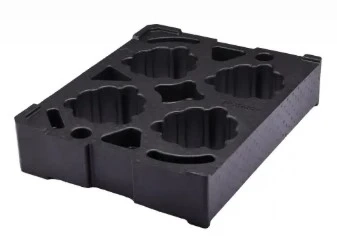
Standard cartons are not always enough for precision parts or high-value goods. Custom EPP packaging for shipping can be shaped to the product profile so loads are spread and movement is controlled. Inserts can include cable paths, finger grips, labels and QR recesses that speed up line picking and proof of delivery.
Common EPP applications in transportation
- Transport boxes made of EPP: Reusable totes with lids or straps for e-commerce, electronics, pharma and after-sales parts.
- Returnable dunnage: Trays and cavity inserts for inter-hub moves and store replenishment.
- Corner and edge protection: Shock-absorbing blocks for appliances and furniture during urban delivery.
- Cold chain payloads: EPP outers with phase change packs for grocery, meal kits and clinical samples.
- Kitting and line-ready packs: Custom cavities that present components in build order at the destination.
Each solution is sized for vehicle space, shelf depth and conveyor constraints so it works with existing handling systems.
Operational gains that teams notice
Packaging should improve the flow, not slow it down. With the right design, EPP in transportation reduces repacks and returns, simplifies scanning and shortens training time for new staff.
- Cycle life: Reusable EPP boxes and inserts last longer even under harsh conditions, which lowers waste and purchasing frequency.
- Consistent fit: Moulded features keep parts stable, which reduces rework at the customer end.
- Cleanability: The closed-cell structure prevents water absorption, allowing boxes to dry quickly, reducing downtime and increasing operational efficiency.
- Quiet handling: EPP reduces rattle on vans and conveyors, which improves the working environment.
Designing EPP for the last mile
Good results start with engineering. Kitting teams and packaging engineers should work together on the product mix, route profile and return plan.
Key designing steps
- Define the duty: Drop height, stack load, route vibration and ambient range.
- Set density and thickness: Select bead density to balance stiffness, cushioning and mass.
- Model the fit: Design ribs, radii and clearances so parts are located precisely without scuffing.
- Plan lab tests: Drop, compression and vibration tests that mirror sortation and van movement.
- Validate the loop: Confirm cleaning method, scan visibility, label life and return flow.
This approach keeps prototypes focused and shortens the path to a production-ready kit.
Sustainability considerations
Reusable EPP reduces single-use packaging in last-mile delivery. At the end of life, parts can be mechanically recycled into new articles. A single EPP container can be used hundreds of times, extending material life and minimising resource depletion. This approach not only lowers carbon emissions but also reinforces circular economy practices - enabling businesses to comply with Extended Producer Responsibility (EPR) mandates and fulfill sustainability reporting obligations.
By choosing EPP over single-use materials, companies significantly lower their environmental impact. Programmes can pair these reusable containers with simple return policies for stores or riders, ensuring that packaging comes back on the next route. Clear marking helps sorting and increases recovery rates.
If you want an overview of material fundamentals, see our page on expanded polypropylene foam for background and design notes.
Where EPP adds value by segment
- Electronics and appliances: Guard corners and screens from shock while keeping weight low for stair carries.
- Automotive aftersales: Protects painted trim, lamps and fragile mouldings during van drops and dealer handling.
- Healthcare and diagnostics: Maintains temperature with ice packs, resists spills and cleans easily between runs.
- Grocery and meal kits: Insulated outers with liners that tolerate condensation and frequent washing.
- Industrial spares: Returnable trays that keep fragile and high-value parts organised by work order to reduce mispicks.
Getting started
Projects move fastest when requirements are clear. A short brief that covers product specifications, route profile, vehicle type, return policy and cleaning method is enough to scope the prototype. Trials can then be measured against damage rate, handling time, vehicle fill and return rate, so the decision is data-led.
Conclusion
EPP in logistics offers a practical way to cut damage and keep deliveries moving while reducing waste from single-use packaging. Lightweight construction, durable performance and custom shaping make it well-suited to busy urban routes and high-frequency delivery models. With thoughtful design and testing, transport boxes made of EPP and returnable inserts can support both operational targets and sustainability goals for last-mile delivery.
K. K. Nag Private Limited brings decades of polymer engineering to packaging for last-mile operations. The team works from intent to implementation, which includes concept studies, design, density selection, tool build, moulding, assembly and delivery. Business partners can run pilots to capture route data, then lock designs for scale.