




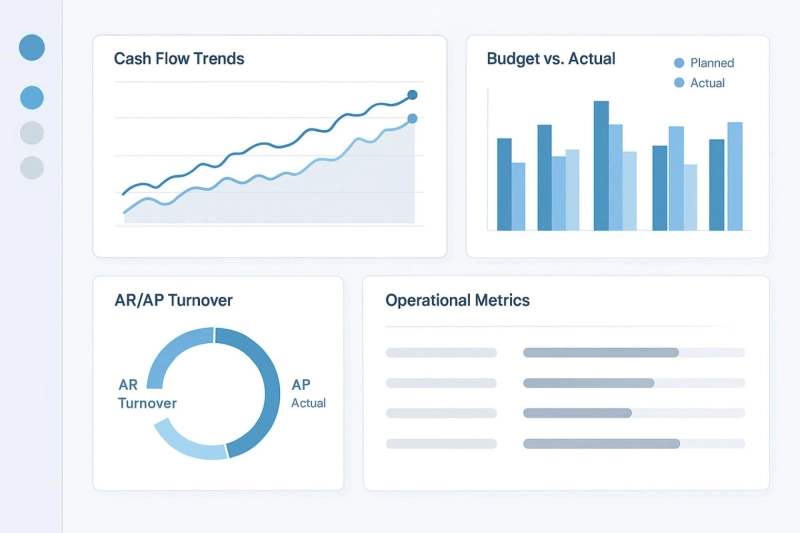
Financial KPIs give business owners a clear view of performance, cash strength, and long-term stability. When tracked the right way, these metrics help you spot problems early, manage spending, and make better decisions that support profitable growth.
This guide highlights the must-monitor KPIs for modern businesses. Insights was supported by Datastub, a U.S.-based outsourced accounting firm that helps businesses manage bookkeeping, payroll, tax, and virtual CFO work.
Core Financial Health KPIs
These metrics form the basic report card for your company’s financial stability and operating efficiency.
1. Operating Cash Flow (OCF)
What it measures: Cash generated from core operations.
Why it matters: A true check on the business’s health. If operations don’t produce cash, nothing else works.
Formula:
OCF = EBIT + Depreciation – Taxes
2. Working Capital
What it measures: Your short-term operating funds.
Why it matters: Shows your ability to handle payroll, vendor bills, and day-to-day work.
Formula:
Working Capital = Current Assets – Current Liabilities
3. Current Ratio
What it measures: Basic solvency.
Why it matters: Shows whether the company can cover short-term liabilities. Many owners aim for 2.0 or higher.
Formula:
Current Ratio = Current Assets ÷ Current Liabilities
4. Quick Ratio (Acid Test)
What it measures: A stricter solvency check.
Why it matters: Uses only liquid assets. Inventory is excluded because it takes longer to convert to cash.
Formula:
Quick Ratio = (Cash + Marketable Securities + A/R) ÷ Current Liabilities
5. Debt-to-Equity Ratio (D/E)
What it measures: Financial leverage.
Why it matters: Shows whether growth is funded with debt or owner investment. High leverage = higher risk.
Formula:
D/E = Total Liabilities ÷ Total Equity
6. Return on Equity (ROE)
What it measures: Profitability relative to shareholder investment.
Why it matters: Reflects how effectively the business uses equity to generate profit.
Formula:
ROE = Net Income ÷ Shareholder Equity
Operational & Efficiency KPIs
These KPIs show how well your internal processes support performance and cash flow.
7. Revenue vs. Target
Compares actual revenue to projected revenue per line of business.
Why it matters: Helps leaders see which departments or products need attention.
8. Expenses vs. Budget
Shows where spending missed the plan.
Why it matters: Helps tighten budgets, reduce waste, and fix process issues.
9. Accounts Receivable (AR) Turnover
Measures how fast customers pay.
Why it matters: Slow collection creates cash flow pressure.
Datastub insight: Aim for short DSO and predictable customer payment cycles.
10. Accounts Payable (AP) Turnover
Shows how fast you pay suppliers.
Why it matters: Good vendor relations matter—and so do early-payment discounts.
11. Inventory Turnover (E-commerce/Retail)
Measures how quickly inventory sells and is replaced.
Why it matters:
- Low turnover → overstocking and cash tied up
- Very high turnover → frequent stockouts
12. Customer Satisfaction (e.g., NPS)
Measures loyalty and the likelihood of repeat business.
Why it matters: Loyal customers cost less to keep than new customers cost to acquire.
Modern KPIs Most Competitors Don’t Cover
Accounting Process & Data Integrity KPIs
13. Month-End Close Cycle Time
Days required to fully close the books and produce final financials.
Healthy target: Fast close with no reconciling items older than 30 days.
A shorter cycle gives owners faster, more confident decision-making.
14. Billing & AP Error Rate
Percentage of errors in customer invoices, vendor payments, and data entry.
Why it matters:
- Fewer disputes
- Better vendor relations
- Faster, cleaner month-end close
15. Payment Application Accuracy
Accuracy and speed in applying customer payments to the correct accounts.
Why it matters:
- Clearer cash flow visibility
- Fewer recon errors
- Fewer customer credit disputes
E-Commerce & Marketplace KPIs
16. T+2 Marketplace Settlement
Measures whether payouts from Amazon, Shopify, Walmart, etc., settle in the expected time (usually T+2).
What owners watch:
Goal = $0 unreconciled balance by T+5.
Any leftover amount signals a cash risk or bookkeeping mistake.
Service, Contractor & Project KPIs
17. Job Costing Variance
Actual job cost versus estimated cost.
Why it matters: High or inconsistent variance means poor estimating or weak project management—both cut margins fast.
Compliance & Risk KPIs
18. Sales Tax Filing Timeliness
Checks whether sales tax returns are filed and paid by due dates.
Why it matters: Even one day late triggers penalties and interest.
19. Payroll Compliance Accuracy
Checks if payroll is processed on time and follows all state and federal rules.
Why it matters: Avoids back-pay claims, penalties, lawsuits, and IRS issues.
(Definitely not the kind of drama any business wants.)
How Businesses Track These KPIs
Monitoring this many metrics requires structure, tools, and accurate books.
Most businesses use a combination of:
- Accounting Software Dashboards
(QuickBooks, NetSuite, and similar tools)
- Custom KPI Spreadsheets
Often used for job costing, settlement tracking, and error rate metrics.
- Bookkeeping & Reconciliation Reports
Clean data = reliable KPIs.
- Outsourced Accounting Firms
Many small to mid-sized companies offload the heavy lifting to experts.
“Many companies rely on outsourced firms like Datastub to maintain accurate books, manage compliance, and deliver monthly KPI dashboards they trust for high-stakes decisions.”