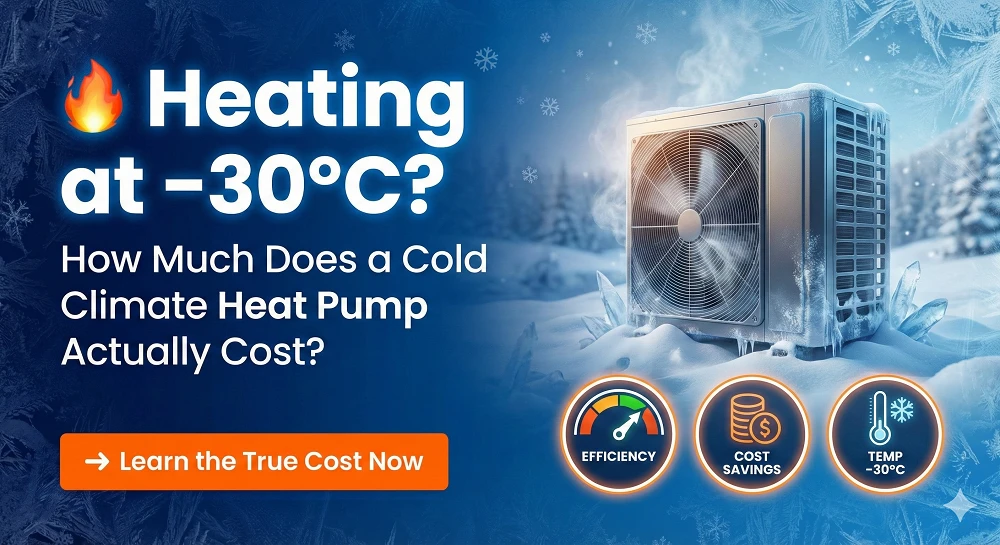

A Complete Cost, Savings & Incentives Guide - 2026
As energy prices continue to fluctuate and winter storms in North America become increasingly unpredictable, homeowners in the Northern US and Canada are looking for reliable alternatives to expensive propane and oil furnaces. Enter the Cold Climate Air Source Heat Pump (ccASHP).
Unlike older models that failed when temperatures dropped below freezing, modern cold climate heat pumps are engineered to keep your home toasty even when it is −22°F (−30°C) outside. But this advanced technology comes with a price tag.
If you are considering making the switch, this guide provides a comprehensive breakdown of cold climate heat pump costs, potential savings, and the government incentives available in 2026.
What Makes a "Cold Climate" Heat Pump Different?
Before looking at the price, it is vital to understand what you are paying for. A standard heat pump loses efficiency rapidly once the temperature drops below 32°F (0°C). A Cold Climate Heat Pump utilizes two key technologies that justify its higher cost:
Variable Speed Inverter Compressor
Unlike standard "on/off" compressors, these ramp up and down to maintain a precise temperature, using significantly less electricity.
📌 Example A standard compressor in a Toronto winter toggles ON at full blast, then shuts OFF — wasting energy each cycle. A variable-speed inverter compressor in the same home runs at 40% capacity most of the time, cutting electricity use by up to 30%. |
Enhanced Vapor Injection (EVI)
Think of this as a turbocharger for your heating system. It injects refrigerant back into the compressor to boost heat output, allowing the unit to maintain 100% efficiency even at 5°F (−15°C) and continue working down to −22°F (−30°C).
📌 Example During a −15°F night in Minneapolis, a standard heat pump might only deliver 60% of its rated heating capacity. The same home with an EVI-equipped unit (e.g., Mitsubishi Hyper-Heat) continues delivering full rated output, keeping the thermostat at a comfortable 70°F without switching on a backup heater. |
Cold Climate Heat Pump Cost Breakdown (2026 Estimates)
The cost varies significantly based on the size of your home, the existing ductwork, and the specific brand (e.g., Mitsubishi Hyper-Heat, Daikin Aurora, Fujitsu). Here are the average installed costs including equipment and labour:
| System Type | Est. Cost (USD) | Est. Cost (CAD) | Best For |
| Ductless Mini-Split (Single Zone) | $4,000 – $7,500 | $5,500 – $9,500 | Garages, additions, or a single main living area |
| Ductless Mini-Split (Multi-Zone) | $9,000 – $22,000 | $12,000 – $28,000 | Homes with electric baseboards or no existing ductwork |
| Centrally Ducted ccASHP | $16,000 – $26,000 | $20,000 – $32,000 | Replacing an existing gas/propane furnace; uses existing vents |
| Geothermal (Ground Source) | $25,000 – $45,000+ | $35,000 – $55,000+ | Large properties looking for the lowest possible operating cost |
📌 Example Sarah in Vancouver has a 1,800 sq ft home with no ductwork. She installs a 3-zone ductless mini-split (Daikin Aurora) for $14,500 USD — one head unit per bedroom plus one in the open-plan living area. No walls were torn open. Mike in Manitoba replaces his old propane furnace with a centrally ducted ccASHP (Mitsubishi Hyper-Heat) for $21,000 USD, reusing his existing vents and adding a gas furnace backup for the coldest weeks. | |||
Hidden Costs You Must Consider
When budgeting, do not overlook these potential extra expenses:
Electrical Panel Upgrade (Cost: $2,000 – $4,000)
Older homes with 100-amp panels may need an upgrade to 200-amp service to handle the electric load.
📌 Example A 1970s home in Buffalo, NY runs on a 100-amp panel. The electrician determines a new ccASHP draws 40 amps on top of existing appliances. An upgrade to 200-amp service is required before installation — adding $3,200 to the total project cost. |
Snow Stands & Wind Baffles (Cost: $300 – $600)
In Canada and the Northern US, outdoor units must be mounted on stands 12–18 inches high to stay above the snow line.
📌 Example A homeowner in Winnipeg has the outdoor compressor mounted on a raised concrete pad with a steel snow stand. After a 30-inch snowfall in January, the unit remains fully exposed and operational. |
Backup Heating (Dual Fuel)
In extremely cold regions (e.g., Minnesota, Manitoba), you may choose to keep your existing gas furnace as a "backup" for the coldest days of the year. This requires specific coil integration.
📌 Example During a polar vortex in Duluth (−25°F), the heat pump operates at reduced capacity. The system automatically switches over to the backup gas furnace at a preset outdoor temperature threshold (e.g., 0°F), ensuring the home stays warm without any manual action. |
Incentives: How to Lower Your Cost
Governments in both the US and Canada are aggressively pushing for electrification, offering significant financial aid.
1. USA: Inflation Reduction Act (IRA)
25C Energy Efficient Home Improvement Credit
You can claim a federal tax credit of 30% of the project cost, capped at $2,000 per year.
📌 Example David in Ohio installs a ducted ccASHP for $18,000. His 30% federal tax credit equals $5,400 — but since it is capped at $2,000/year, he claims $2,000 this year and can claim another $2,000 next year on a related upgrade (e.g., insulation or a smart thermostat). |
HEAR Rebates
Low-to-moderate income households may qualify for point-of-sale rebates up to $8,000 (varies by state rollout).
📌 Example A family in New Mexico earning below 80% of their area's median income qualifies for a HEAR rebate. Their $12,000 ducted system receives a $7,500 point-of-sale rebate — they pay only $4,500 out of pocket on the day of installation. |
2. Canada: Federal & Provincial Programs
Canada Greener Homes Loan
Homeowners can apply for an interest-free loan of up to $40,000 CAD with a 10-year repayment term to cover the upfront cost.
📌 Example A homeowner in Ontario installs a $28,000 CAD ducted system. They apply for the Greener Homes Loan and receive $28,000 interest-free, repaid at $233/month over 10 years — with zero interest charges. |
Provincial Rebates
Provinces like British Columbia (CleanBC), Quebec, and Nova Scotia offer additional rebates ranging from $1,000 to $6,000 depending on the system's efficiency rating.
📌 Example A BC homeowner installs a high-efficiency ductless system rated at HSPF2 12. Through CleanBC, they receive a $4,500 provincial rebate on top of the federal loan — dramatically cutting the net cost. |
Are They Worth It? — ROI Analysis
While electricity rates are generally higher than natural gas, the Coefficient of Performance (COP) of a heat pump changes the math entirely.
| Heating Source | Efficiency | Typical Payback Period |
| Gas Furnace (Best Case) | 95% | — |
| Cold Climate Heat Pump | 250% – 400% | 3 – 6 years (propane/oil users) |
For homeowners currently using propane, heating oil, or electric baseboards, the return on investment is typically 3 to 6 years. For natural gas users, the savings are smaller, but the environmental impact and the addition of central air conditioning (cooling) provide significant extra value.
📌 Example A family in Portland, ME currently spends $3,200/year on heating oil. After installing a ccASHP (total cost $19,000 after a $2,000 IRA credit), their annual heating bill drops to $1,100. The $1,800 annual saving pays back the system in roughly 10 years — or under 6 years once provincial and state rebates are factored in. |
Frequently Asked Questions
Q: Do cold climate heat pumps really work when it is −20°F?
A: Yes. Modern systems using EVI technology (like the Mitsubishi Hyper-Heat or Cooper & Hunter Hyper) are rated to provide heat down to −22°F (−30°C). However, efficiency does drop as the temperature falls. At extreme lows, the system may rely on electric backup strips or a gas furnace (dual fuel) to maintain comfort.
📌 Example During a −18°F night in Fargo, the Mitsubishi Hyper-Heat operates at about 75% of its rated capacity. The electric backup strip kicks in briefly to top off the heat — keeping the house at 68°F with no disruption. |
Q: How much does it cost to run a heat pump in the winter?
A: This depends on your local electricity rates. Generally, a heat pump is 2–3× cheaper to run than electric baseboards or oil furnaces. Compared to natural gas, costs are often comparable, but you save money by eliminating the fixed monthly gas connection fees if you go fully electric.
📌 Example In Ontario, electricity costs roughly $0.16/kWh. A ccASHP with a COP of 2.5 effectively delivers heat at $0.064/kWh — cheaper than both oil and propane in most regions. |
Q: Can I install a heat pump in an old house with no ducts?
A: Absolutely. Ductless Mini-Splits are designed exactly for this purpose. You can install a "head" unit on the wall in key rooms, connected to an outside compressor, giving you zoned heating and cooling without tearing open your walls.
📌 Example A couple renovating a 1940s house in Halifax installs two wall-mount head units — one in the kitchen, one in the bedroom. A single outdoor compressor powers both zones. Total install time: two days. No ductwork needed. |
Q: What is the lifespan of a cold climate heat pump?
A: With proper annual maintenance, a high-quality cold climate heat pump typically lasts 15 to 20 years. In contrast, central air conditioners usually last 12–15 years.
Q: Do I need a backup heat source in Canada or the Northern US?
A: It is highly recommended. While the heat pump can handle the load in most conditions, having an electric resistance backup (integrated into the air handler) or keeping a gas furnace ensures your pipes won't freeze during a catastrophic polar vortex or power grid fluctuation.
📌 Example A homeowner in Thunder Bay keeps their old gas furnace connected as a backup. During a week-long polar vortex with temps at −30°C, the gas furnace handles the load. The rest of the year — over 340 days — the heat pump does all the work, saving thousands in fuel costs. |
A homeowner in Thunder Bay keeps their old gas furnace connected as a backup. During a week-long polar vortex with temps at −30°C, the gas furnace handles the load. The rest of the year — over 340 days — the heat pump does all the work, saving thousands in fuel costs.



























Sign in to leave a comment.