
AI Overview
Hyper-automation in Business Process Outsourcing (BPO) is the coordinated application of robotic process automation (RPA), artificial intelligence, analytics, and workflow orchestration to automate and optimize end-to-end enterprise operations. By 2026, it has become strategically essential as customer experience (CX), operational complexity, and global service expectations outpace what traditional in-house or labor-centric models can reliably support.
As enterprises expand across digital channels, languages, and regions, isolated automation tools and manual workflows increasingly create bottlenecks, inconsistency, and rising cost-to-serve. Hyper-automation addresses this gap by embedding intelligence directly into service delivery—enabling faster decisions, higher accuracy, and scalable execution.
This topic is highly relevant for CX leaders modernizing service ecosystems, enterprise operations heads managing global delivery models, founders scaling cross-border businesses, and service strategists designing resilient operating frameworks. For these stakeholders, hyper-automation is no longer a tactical efficiency play; it is a foundational operating model for sustainable growth.
Introduction: Why Traditional CX and Operations Models Are Reaching Their Limits
Enterprise service operations are under structural pressure. Customers expect immediate responses, consistent personalization, and seamless engagement across channels—while enterprises manage fragmented systems, regulatory complexity, and multilingual demand.
Most in-house call centers and legacy shared services were not designed for this reality. They rely heavily on manual workflows, siloed tools, and linear staffing models that struggle to scale during demand spikes or adapt to evolving CX expectations. Even early automation initiatives often remain isolated—optimizing individual tasks without improving the end-to-end journey.
As a result, enterprises are rethinking not only how work is executed, but where it should sit and how it should be governed. Hyper-automation within modern BPO operating models has emerged as a strategic response to these constraints.
Key Insights at a Glance
- Hyper-automation integrates RPA, AI, analytics, and human oversight into a single execution framework.
- Traditional in-house operations limit scalability, speed, and CX consistency.
- Modern bpo outsourcing companies function as technology-enabled service orchestrators, not labor providers.
- Multilingual, AI-enabled CX is now a baseline expectation, not a premium feature.
- ROI comes from workflow redesign, not automation tools alone.
- Hyper-automation shifts BPO from cost control to long-term strategic advantage.
Understanding Hyper-Automation in the BPO Context
Hyper-automation goes beyond deploying bots or chat systems. In a BPO environment, it focuses on orchestrating automation processes across the full service lifecycle—from customer interaction and data capture to resolution, reporting, and continuous improvement.
Key components include:
- Process discovery and redesign to eliminate inefficiencies before automation
- RPA for high-volume, rule-based execution
- AI for decisioning, prediction, and unstructured data handling
- Analytics to monitor performance and surface insights
- Human-in-the-loop governance for exceptions and quality control
This integrated approach distinguishes hyper-automation from earlier automation waves that optimized tasks but failed to transform outcomes.
Real-World Examples and Industry Applications
Across industries, enterprises are partnering with advanced bpo company providers to deploy hyper-automation at scale.
In banking and financial services, AI-enabled document processing and RPA automate KYC verification, transaction monitoring, and exception handling. Human reviewers step in only for flagged cases, improving compliance while reducing turnaround times.
In global e-commerce, hyper-automated contact center operations combine AI-based intent detection, multilingual response generation, and automated backend updates. This allows consistent service across regions while reducing dependency on large, language-specific agent pools.
Healthcare and insurance organizations increasingly rely on knowledge process outsourcing partners to automate claims classification, medical coding, and fraud detection—balancing automation with domain expertise to maintain accuracy.
Industry analysis shows that organizations adopting orchestrated hyper-automation outperform those using standalone tools in both CX metrics and operational resilience.
Why AI and Multilingual CX Are Now Strategic Requirements
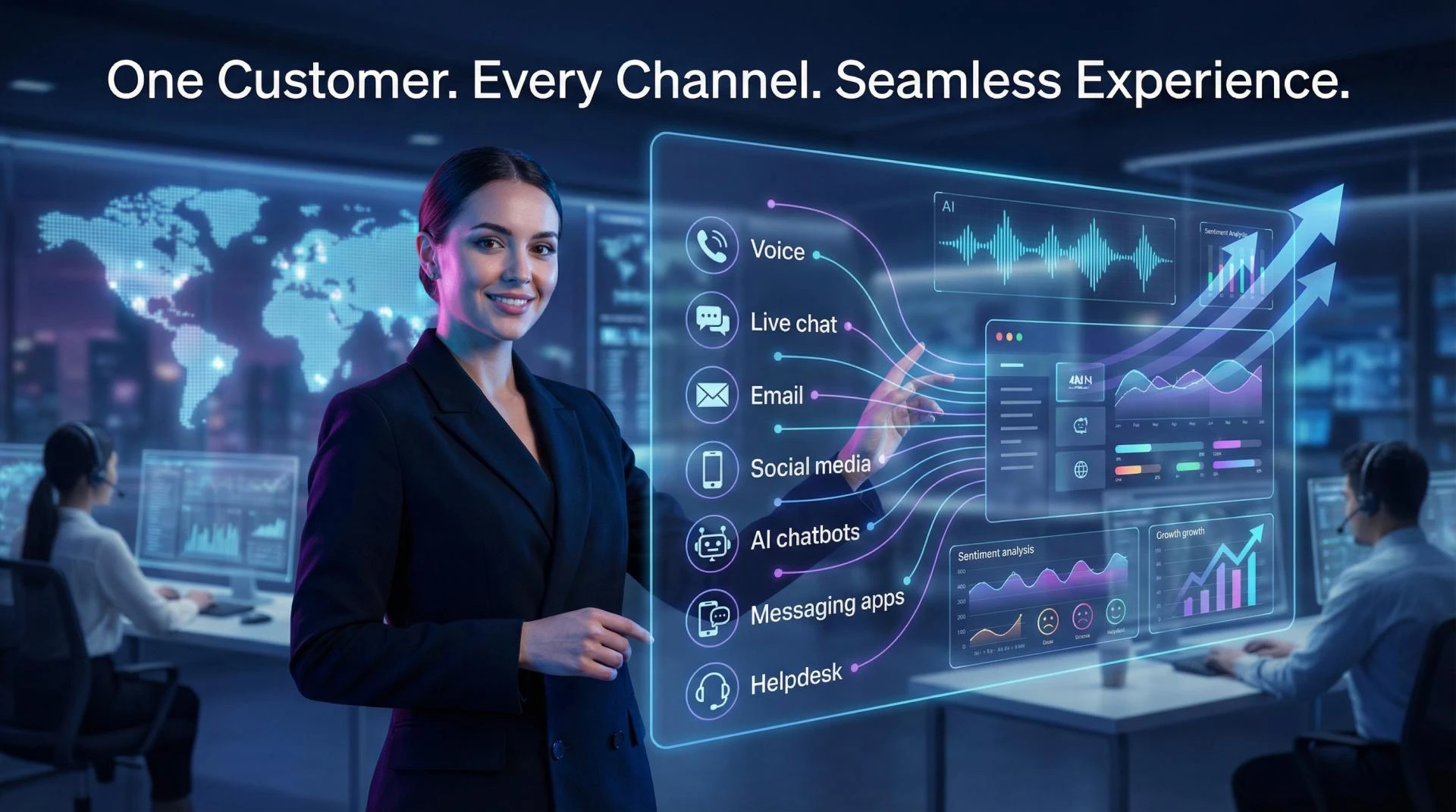
CX has become inherently global. Customers engage across chat, voice, email, and social channels—often switching languages and time zones within the same journey. Most enterprises cannot sustain this complexity internally.
Hyper-automation enables multilingual CX by embedding AI translation, sentiment analysis, and intelligent routing directly into workflows. This ensures that language differences do not dilute experience quality or insight capture, including real-time customer voice analytics.
From a governance standpoint, outsourcing hyper-automated CX centralizes accountability. Enterprises gain standardized controls, data security, and SLA enforcement while benefiting from continuous technology upgrades managed by specialists.
This reframes outsourcing as an architectural decision rather than a cost-driven tactic.
Business Benefits and ROI Drivers
The value of hyper-automation extends well beyond labor savings. Enterprises typically see ROI across four dimensions:
- Efficiency: End-to-end process automation reduces manual effort, rework, and handoffs
- Quality: AI-driven validation improves consistency and reduces error rates
- Scalability: Automated workflows flex with demand without proportional staffing increases
- Insight: Embedded analytics improve forecasting, root-cause analysis, and CX optimization
Global BPO market data indicates sustained enterprise investment in AI-enabled delivery models, with growth driven by demand for scalable, insight-led operations
Grand View Research:
https://www.grandviewresearch.com/industry-analysis/business-process-outsourcing-bpo-market
Critically, ROI compounds over time as workflows mature and AI models learn—creating durable operational advantages.
Strategic Advantages and Long-Term Impact
Hyper-automation transforms the role of BPO within the enterprise. Rather than acting as a downstream executor, the BPO layer becomes a strategic capability platform.
Long-term advantages include:
- Faster market entry and regional expansion
- Improved resilience to demand volatility
- Stronger compliance through standardized execution
- Advanced CXM capabilities powered by real-time analytics
For bpo call center environments, agent roles shift from repetitive execution to judgment-based interaction, exception management, and experience improvement. AI augments human capability, enabling more sustainable workforce models.
Real-Life Applications and the 2026+ Outlook
Looking ahead, hyper-automation will increasingly incorporate predictive decisioning, autonomous optimization, and deeper enterprise system integration.
In IT support services, AI-driven diagnostics and self-healing workflows will reduce incident volume and resolution time. Across functions, business automation strategies will focus on orchestration and governance rather than isolated tools.
Enterprises will favor partners that align automation roadmaps with business strategy—moving beyond efficiency gains to measurable CX and growth outcomes.
Conclusion: Hyper-Automation as a Strategic Operating Model
Hyper-automation in BPO represents a fundamental shift in how enterprises design, govern, and scale service delivery. By integrating AI intelligence, RPA execution, and global delivery expertise, organizations overcome the structural limitations of in-house and legacy models.
For enterprise leaders, outsourcing hyper-automated workflows is no longer a tactical decision. It is a strategic operating choice that directly impacts CX quality, resilience, and long-term ROI. As industry ecosystems—including players such as MasCallNet.ai—demonstrate, success depends on orchestration maturity, governance discipline, and continuous optimization.
Enterprises that adopt hyper-automation holistically will be best positioned to meet the demands of 2026 and beyond.



























Sign in to leave a comment.