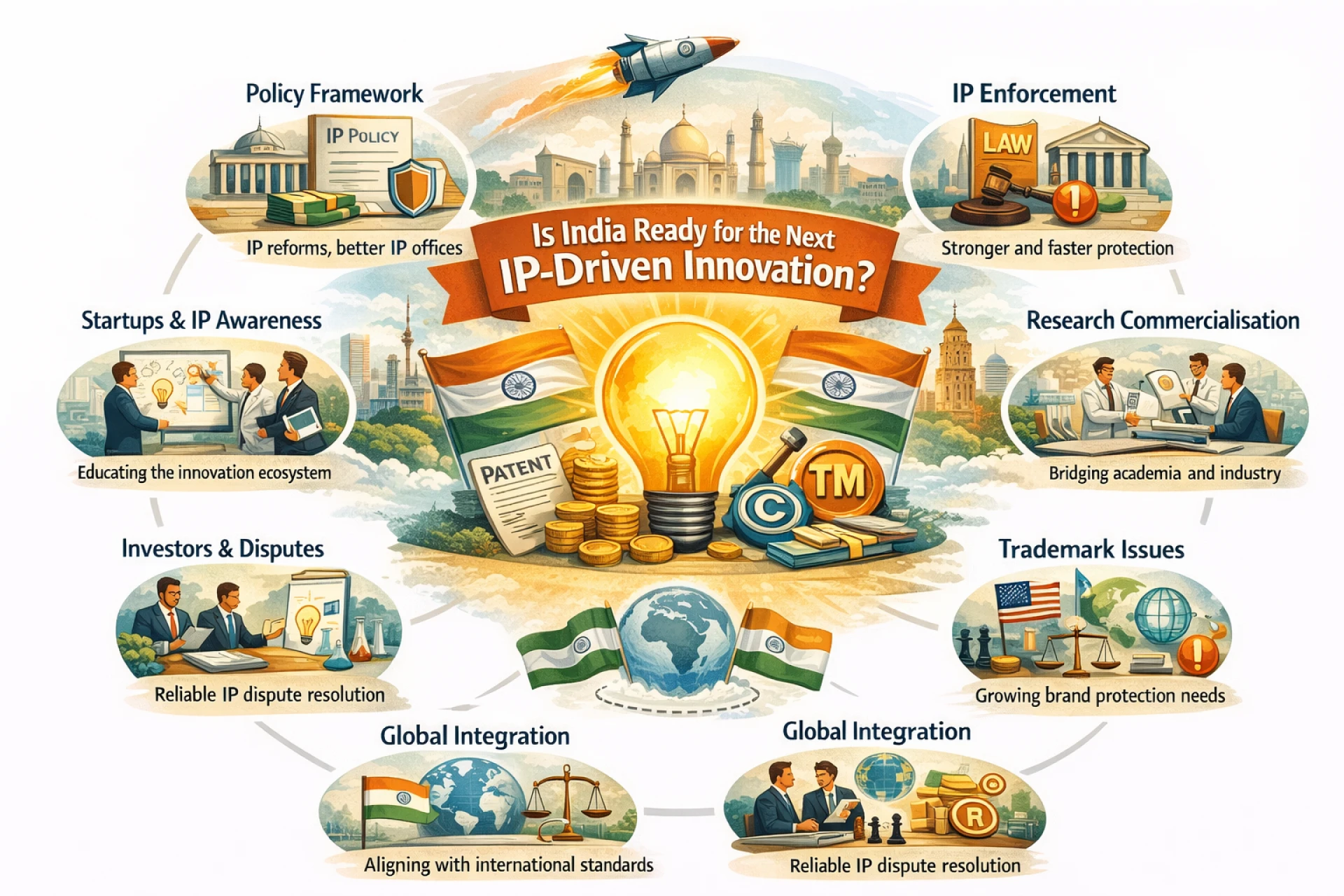

India stands at a critical juncture in its innovation journey. Over the past decade, the country has moved from being a cost driven economy to one increasingly shaped by ideas, research and intellectual capital. Start ups, research institutions and established enterprises now rely more on intangible assets than physical infrastructure. Intellectual property has become central to business valuation, investment decisions and global competitiveness.
The question many stakeholders ask is whether India is institutionally and commercially prepared for the next wave of IP driven innovation. The answer lies in examining policy intent, enforcement strength, industry readiness and the evolving role of intellectual property in economic growth.
The shift towards an IP centric economy
Innovation today no longer depends only on manufacturing scale or natural resources. It thrives on patents, trademarks, designs and copyright. Digital platforms, biotechnology, artificial intelligence and green technology rely heavily on IP protection to attract funding and scale globally.
India has seen a steady rise in patent and trademark filings. Domestic applicants now file more aggressively than before. This reflects growing awareness among Indian businesses about protecting innovation early. Universities and public research bodies also participate more actively in IP creation and commercialisation.
Yet filing numbers alone do not define readiness. Effective enforcement, commercial clarity and investor confidence play an equally important role.
Policy framework and institutional intent
India has introduced several reforms to align its IP regime with global standards. The National Intellectual Property Rights Policy aimed to streamline administration, strengthen enforcement and promote IP awareness. Dedicated commercial courts and specialised IP benches have improved adjudication quality.
Digitisation of IP offices reduced processing delays. Time bound patent examination and online trademark hearings enhanced accessibility. These changes indicate strong institutional intent to support innovation.
However, policy effectiveness depends on consistent execution across jurisdictions. Smaller innovators often face procedural complexity and cost barriers. For the next innovation wave, simplifying access remains crucial.
Enforcement remains the true test
Strong IP laws lose impact without predictable enforcement. Innovators assess risk based on how quickly and effectively rights are protected. India has made progress through specialised commercial courts and interim relief mechanisms.
Judicial recognition of brand value, trade secrets and technological know how has improved. Courts increasingly grant injunctions where infringement risks cause irreparable harm. This judicial maturity strengthens confidence among rights holders.
At the same time, enforcement timelines still vary. Counterfeiting and piracy continue to affect several sectors. Bridging this gap will define India’s readiness for high value innovation.
Engaging an experienced IP Enforcement Law firm in Delhi often becomes essential for businesses navigating complex enforcement landscapes, especially where cross border elements are involved.
Start ups and IP literacy challenges
India hosts one of the largest start up ecosystems globally. Innovation flows rapidly across fintech, health tech, clean energy and software services. Many founders prioritise speed to market over early IP strategy.
This approach creates vulnerabilities later. Lack of early patent filing or weak brand protection leads to disputes during scaling or funding stages. Investors increasingly conduct IP due diligence before committing capital.
Improving IP literacy among founders remains a pressing need. Awareness programmes and accessible advisory support can ensure innovation translates into defensible assets rather than exposed ideas.
Research institutions and commercialisation gaps
India produces high quality research across science and technology domains. However, converting research into market ready IP remains uneven. Technology transfer offices exist but often lack commercial negotiation expertise.
Collaboration between academia and industry requires clearer IP ownership structures. Licensing frameworks must balance public interest with commercial viability. Countries leading in IP driven innovation invest heavily in research commercialisation infrastructure.
India shows positive movement in this direction but consistency across institutions remains a challenge.
Role of trademarks in the innovation economy
Innovation extends beyond patents. Trademarks protect identity, trust and consumer recall. As Indian brands expand globally, trademark disputes increase in frequency and complexity.
Digital commerce amplified brand misuse through domain squatting and online counterfeiting. Enforcement in the digital space requires swift legal response and platform coordination.
Businesses increasingly rely on a skilled trademark infringement lawyer in Delhi to address cross platform brand misuse and prevent dilution before it escalates into prolonged litigation.
Global integration and international alignment
Innovation driven economies operate across borders. Indian IP systems must align with international treaties and enforcement norms to support global expansion.
India participates actively in global IP forums and complies with major international conventions. Yet differences in enforcement perception still influence foreign investment decisions.
Consistent judicial reasoning and faster dispute resolution enhance India’s credibility as an innovation destination. International collaborations depend on trust in local IP protection mechanisms.
Balancing public interest and private innovation
India faces a unique challenge. It must encourage innovation while safeguarding public interest. This balance becomes sensitive in pharmaceuticals, agriculture and essential technologies.
Compulsory licensing provisions and access driven policies often attract global scrutiny. Courts play a critical role in maintaining equilibrium between innovation incentives and social welfare.
The evolving jurisprudence reflects maturity in handling these competing interests. Transparent reasoning strengthens global confidence without undermining domestic priorities.
Commercial awareness within enterprises
Large Indian enterprises increasingly view IP as a strategic asset rather than a legal formality. Boards discuss IP valuation, licensing revenue and portfolio management more frequently.
However, many mid sized companies still treat IP defensively. Reactive protection exposes them to disputes and missed monetisation opportunities.
The next innovation wave demands proactive IP strategy integrated with business planning. Legal, technical and commercial teams must collaborate from ideation to execution.
Dispute resolution and investor confidence
Innovation attracts disputes. Patent challenges, licensing conflicts and joint development disagreements rise alongside growth. Efficient dispute resolution mechanisms reduce uncertainty.
Arbitration and mediation gain relevance in IP commercial disputes. India’s expanding arbitration framework supports confidential and faster resolution, especially for technology driven sectors.
Predictable outcomes enhance investor confidence. Capital flows towards jurisdictions where IP disputes do not stall business momentum.
Is India prepared for the next phase?
India demonstrates strong intent, improving infrastructure and growing awareness. The foundation for IP driven innovation exists. Challenges remain in enforcement consistency, commercialisation depth and literacy outreach.
Readiness does not require perfection. It requires adaptability, institutional learning and stakeholder collaboration. India appears to move steadily in this direction.
The next wave of innovation will test the system under greater complexity and scale. How effectively India responds will determine whether it emerges as a global IP powerhouse or remains a developing innovation hub.
Conclusion
India’s innovation future depends on more than creativity. It depends on trust in intellectual property protection, enforcement reliability and commercial clarity. Progress over the past decade signals readiness, though refinement continues.
As innovation intensifies, businesses, policymakers and legal professionals must align efforts. Intellectual property will shape economic leadership in the coming years. India stands closer than ever to seizing this opportunity.





























Sign in to leave a comment.