



Every founder believes their idea is the next big thing. Yet, the painful statistics of startup failure often trace back to one root cause: building something nobody wants. The Minimum Viable Product (MVP) has become the anthem of lean startup methodology, but not every concept gracefully survives the transition to this stripped-down, market-ready state. How can you critically evaluate if your idea is truly MVP-worthy before investing precious time and capital?
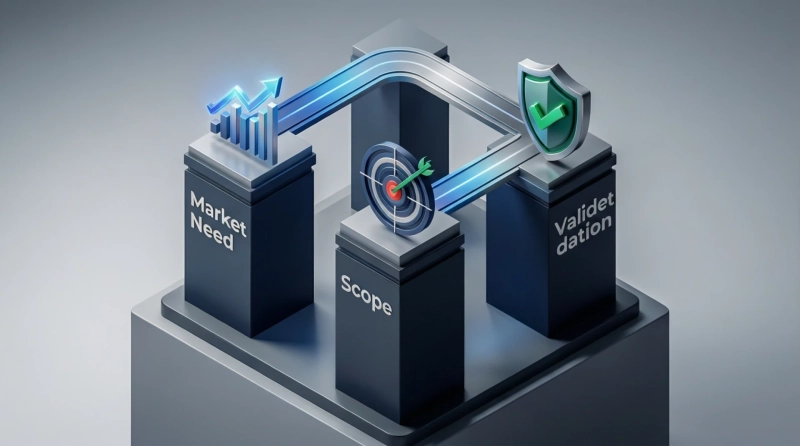
The answer lies in a disciplined framework centered on three pillars: Market Need, Scope, and Required Validation. Applying this lens can transform your passion from a pet project into a viable starting point.
1. Validating Market Need
An MVP is not merely a "basic version" of your grand vision; it is a specific test of a fundamental business hypothesis. The first question is not "What can I build?" but "What critical assumption must I prove true?"
Is the problem acute? Are people currently experiencing this pain point, or are you educating them on a problem they don't yet feel? An MVP tests a solution for an existing behavior or frustration.
Is there a willingness to pay (or adopt)? Your MVP must be designed to measure this. It might be a landing page with a "Sign Up for Early Access" button gauging interest, a concierge service manually solving the problem for a few users, or a prototype used in customer interviews. If you cannot define how your MVP will test demand, the concept isn't ready.
2. The Art of Constraint
This is where visionary ideas meet practical reality. An MVP's "Minimum" is defined by the smallest set of features required to test your core hypothesis - nothing more.
Can you describe the single, primary job a user hires your product to do? Your MVP should focus exclusively on enabling that job with minimal friction.
Think of your MVP as an editable draft, not a published book. It should be built with the explicit intent of being changed or even discarded based on feedback. If the thought of radically altering it after launch feels like a failure, your scope is likely too large and too precious. The goal is learning, not launching a perfect product.
3. Identifying Your Proof Points
What does "validation" concretely look like for your idea? Define success metrics before development begins.
Technical Validation: Is the core technology feasible? A "smoke test" or a crude prototype can answer this.
User Validation: Will users engage with the core workflow? A Figma prototype or a wizard-of-oz setup (manual backend) can provide this learning.
Business Validation: Is there a path to monetization? A pre-order page or a stripped-down paid pilot delivers this data.
Clarity on which type of validation is primary shapes your entire MVP strategy. A deep-tech startup's MVP prioritizes proving feasibility, while a consumer app's MVP prioritizes user engagement loops.
Navigating the Execution Gap
This framework illuminates the path, but many founders stumble during execution. Translating a validated concept into a functional, stable, and insightful MVP requires a nuanced blend of product strategy, technical expertise, and disciplined process. It demands building just enough to learn, yet not so little that the test is invalid. This is the critical gap where vision either gains traction or dissipates.
This precise challenge - transforming a worthy concept into a strategic, learnings-driven MVP is where specialized expertise changes trajectories. A startup development partner focuses on this foundational phase, guiding startups to build not just a product, but a validated foundation for their business. By aligning development strategy with your core hypotheses and validation goals, they help ensure your first market entry is a purposeful experiment, not just a launch.
Ultimately, an MVP-worthy idea is a question poised for an answer. It embraces uncertainty, seeks evidence over applause, and values learning above all. By rigorously applying the lenses of Need, Scope, and Validation, you move from asking "Can I build it?" to the far more powerful question: "Should I?" The answer to that is the true beginning of your startup journey.