




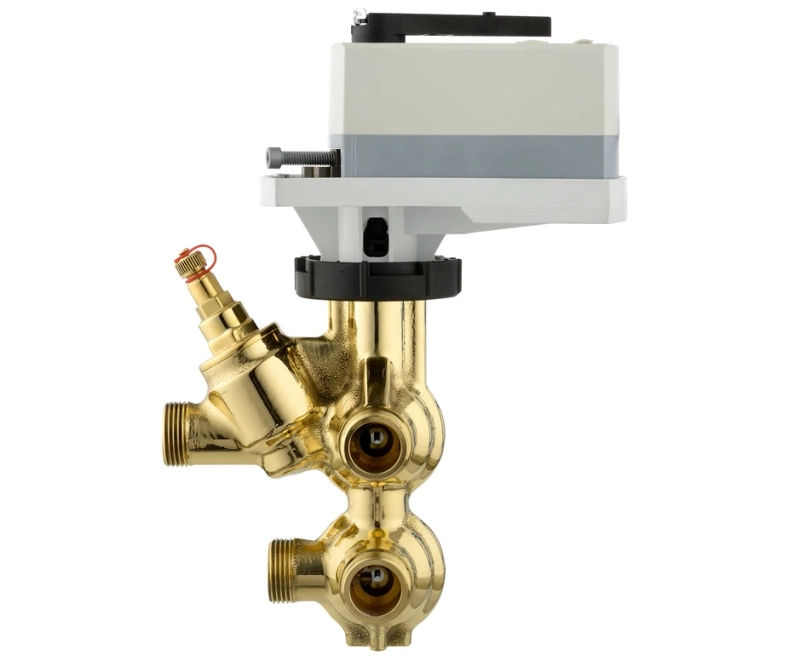
Johnson Controls Control Valves are household names in the oil and gas sector, distinguishing themselves from other products because of their high-end performances. They possess a bridged system that offers the users an opportunity to reliable, durable, and state-of-the-art products. The control valves are responsible for regulating and directing the flow rate of fluids up to their optimal capacity. Stability is assured when using this product, and the chances of fluid spillages are reduced to nothing.
Parts of Johnson Controls Control Valves
They are made up of three major parts responsible for their mechanism of action. They include:
The Body- This is the most obvious part consisting of about 80 percent of the entire control valve. It houses the transmission elements that transpose the electrical impulses responsible for controlling the action of a control valve.The Actuators- This part is arguably the most important part of the control valve. They are responsible for controlling the opening and shutting of the control valve. They can elicit action either manually or automatically, depending on your preference.The Positioners- it has both a primary and secondary function. It primarily functions as a part of the control valve that controls the degree of opening of a control valve. The secondary function is to adjust the air pressure entering the control valve to prevent potential wear and tear.Today’s article will elaborate more on the positioners, their mechanism of action, and also the different types.
Mechanism of Action
Positioners are very important parts of Johnson Controls Control Valves which are responsible for regulating the opening of a control valve up to a set point.They work in conjunction with actuators to elicit their action. They work either linearly or rotationally to ascertain the particular degree of opening that will elicit optimal action of the control valves.
In the event that the opening differs from the set point, impulses are sent to the positioner, which rectifies the situation by communicating with the actuator. This is its fail-safe mechanism.
Types of Positioners
There are three types of positioners used in control valves. They differ in their mechanism of action.
Pneumatic Positioners: The particular type works by encompassing air pressure and regulating it before moving the right air pressure into the actuators. With this, the actuators ensure that the control valves elicit optimal action.Electro-Pneumatic Positioners: They make use of the combination of air pressure and electricity to hold the valves open at the required limit. The electricity makes up for the shortcomings of the pneumatic positioners, and together, they give optimal actions.Digital Positioners: This type works by using a microprocessor that converts analog signals into digital transmissions for the actuator. They elicit action through a feedback mechanism.
0